Then on Thursday I’m joining the Broadband for the Bush Conference on rural and regional access to digital technology and communications, running a presenterless workshop session on planning for the future. I’ll be drawing on science fiction, Afrofuturism, and comics alongside debates around copyright, government policy, and the presentation of financial data.
I’m very interested in the vogue for locative literature, where texts are linked to physical spaces through digital or conventional media. But there are questions still to be asked: not just whether we add a virtual layer of story and literature to physical spaces, but who gets to create the content in that virtual layer.
If writers are having a creative and critical conversation about the world, and in the locative age we are venturing outside of traditional venues, we still need to ask: who are “we” having those conversations with? And how could a simple online comic maker start expanding that circle of storytelling, literary production, and critical discussion?
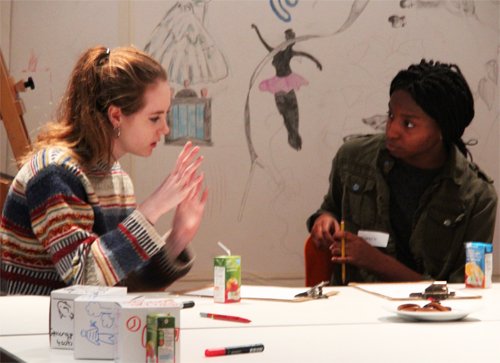
Inspired by the work of M.C. Escher, the event saw teens exploring comics and biography through thirty boxes containing text and images from the life of a mysterious woman.
Over the course of a two-hour session, participants transformed the thirty boxes into individual artworks which together formed a biographical installation: a three-dimensional comic book which used perspective and storytelling to respond to the facts and feelings of a stranger’s life.
Today I’m running an event for Dulwich Picture Gallery’s Off The Wall series of teen workshops. Dulwich is the oldest purpose-built public art gallery in the world and this year I’ve been working with them on outreach events which address 21st century challenges in making art with communities.
Escher is currently undergoing something of a reevaluation, as Darran Anderson captures in his review of the exhibition. The artist, once seen as a creator of mere visual tricks, more suited to student-dorm posters and video game designs than critical interrogation, might now be recognised as influential and intriguing in ways we’d previously overlooked. This process of recognising the artist and his works afresh has parallels to the work of detectives re-opening a cold case; returning to the accumulated files, seeking new evidence, and trying to see it all from a fresh perspective.
Solving crimes is never really about arriving at a final truth; it’s about making a story which more closely and convincingly tends to the evidence at hand. This process also applies to the business of art history, and the activities which ran at Dulwich today.
Critical examination of Escher’s biography plays a part in our reopened investigation. Divorced from context, sold as a poster, used as the background of an old video game, an Escher landscape can look impersonal, technical, heartless. Nowadays, however, we recognise the ways in which Escher’s mindscapes are grounded in personal experience and observation. His youthful travels in Italy seem to have informed works like Belvedere; Escher’s visit to the Alhambra in Spain shaped his later explorations of pattern and tessellation. Micky Piller, curator of the Escher Museum in the Hague, recently discovered that many architectural elements from the artist’s “impossible worlds” can be found in the stairwells of Escher’s old high school.
For young people creating art, Escher offers a range of possible paths to explore. His Italian and Arabic influences demonstrate the way that leaving home for travel and adventure can provoke and inspire deeper reflection. At the same time, the fact that Escher returned to, and spent most of his life in, the Dutch town of Baarn reminds us that wonder can be generated in even the most ordinary of settings. In an age when we are increasingly preoccupied with the need for technological skills and scientific thinking, Escher reminds us that mathematics, science, and technology are always grounded in feeling, in human possibility, in a sense of wonder. As Anderson puts it:
The view of mathematics and science as purely and coldly intellectual exercises is exposed as inaccurate in Escher’s work; they are at work everywhere in nature; indeed, they are how we interpret the cosmos.
Countless books, movies, and shows from Harry Potter to Labyrinth and Doctor Who (which named an episode after Escher’s Castrovalva) have helped us to explore Escher’s cosmos by placing characters within their impossible architecture, lending life and motion to his precise, troubling geometries.
The figure of Escher, “modest yet colossal”, challenges our ongoing attempts to pigeonhole creative work. He is at once popular and ubiquitous to the point of banality, yet also marginal, his work set aside by the art-critical establishment. If his work has been dismissed on occasion as a “juvenile curiosity”, perhaps we should think on the current debate in which literary critics disparage YA literature, written for adolescents. Juvenilia has never been a weaker term of critical disparagement, in an era when young people are finally being accorded some of the power and voice to which they are entitled, and in which so many of us still feel the tensions and complications associated with adolescence. If Escher prints like Other World and Relativity are haunted by the traces of the artist’s high school experience, maybe he is the secret YA artist we never knew we had.
The contradictions abound. For the viewer, Escher made visual puzzles for which there was no solution; for artmakers, he found solutions to challenges in perspective which had no real-life equivalent. His work is “cold” and technical, yet steeped in personal experience and memory: the villages of Italy, the school of his youth, the tiles of the Alhambra where he imagined “a place of serenity where the universal laws of physics were everywhere and yet somehow might not apply.”
In Your Mind Is The Scene of the Crime, visitors explore this blend of the personal and perspectival when they are given visual and textual clues from the life of a mysterious woman. These photographs and snippets of prose will form the basis for a collaborative 3D visual artwork, creatively reconstructing a life story from limited cues.
In solving the mystery of a stranger’s life, and the challenge of juxtaposing images in three dimensional space, our Dulwich detectives will discover that solutions are only ever provisional; that the neatest account of the cosmos may defy the laws of nature; and that your mind is always the scene of the crime.
Just a quick update to tell you I’ll be speaking at two events this month.
This Sunday, 8th November, I’ll be presenting at the Thinking Through Drawing symposium in London, making 3D biographical comics with attendees in a session on “Play, Chance, and Comics”.
I’ll be talking about digital comics projects including the Fun Palaces Comic Maker and a new version of Comic Book Dice from Manila’s Museum of Contemporary Art and Design, plus my game for The Lifted Brow, “A Tear in Flatland“.
The Comic Maker is inspired by the Comic Book Dice activity I originally created for Manila’s Museum of Contemporary Art and Design (MCAD). The team at MCAD have created their own digital riff off Comic Book Dice which will be released soon.
The Comic Maker lets you drag and drop characters inspired by Emily Medley’s original Fun Palaces illustration into a comic-book story of your own devising.
We’ve been working on this behind the scenes for a long time, ever since I pitched the idea of an online version of Comic Book Dice for Fun Palaces 2015.
Talia Yat and Phil Gullberg of the State Library of Queensland have run with this idea and developed it into an amazing online game, as part of the Queenslanders’ contribution to Fun Palaces 2015.
It’s been a huge team effort and thanks must go to: Fun Palaces’ Stella Duffy, Sarah-Jane Rawlings, Hannah Lambert, and Kirsty Lothian; Zoey Dixon of Lambeth Libraries; Daniel Flood of State Library of Queensland; our web host Simon Appleby of Bookswarm, plus Sandy Mahal who put us in touch with him; and last but not least our digital Brains Trust of Ed Bishop, Martin Feher, Barney Lockwood, and Steven Moschidis (“I’m tempted to say I will host it just to stop the funky emails!”).
Australian arts journal The Lifted Brow has just published my review of Nick Sousanis’ doctoral-thesis-as-comic-book, Unflattening.
The review is a little different – it’s an online choose your own adventure, which sees the reader trapped in a mysterious library, trying to locate Nick’s book and escape in one piece.
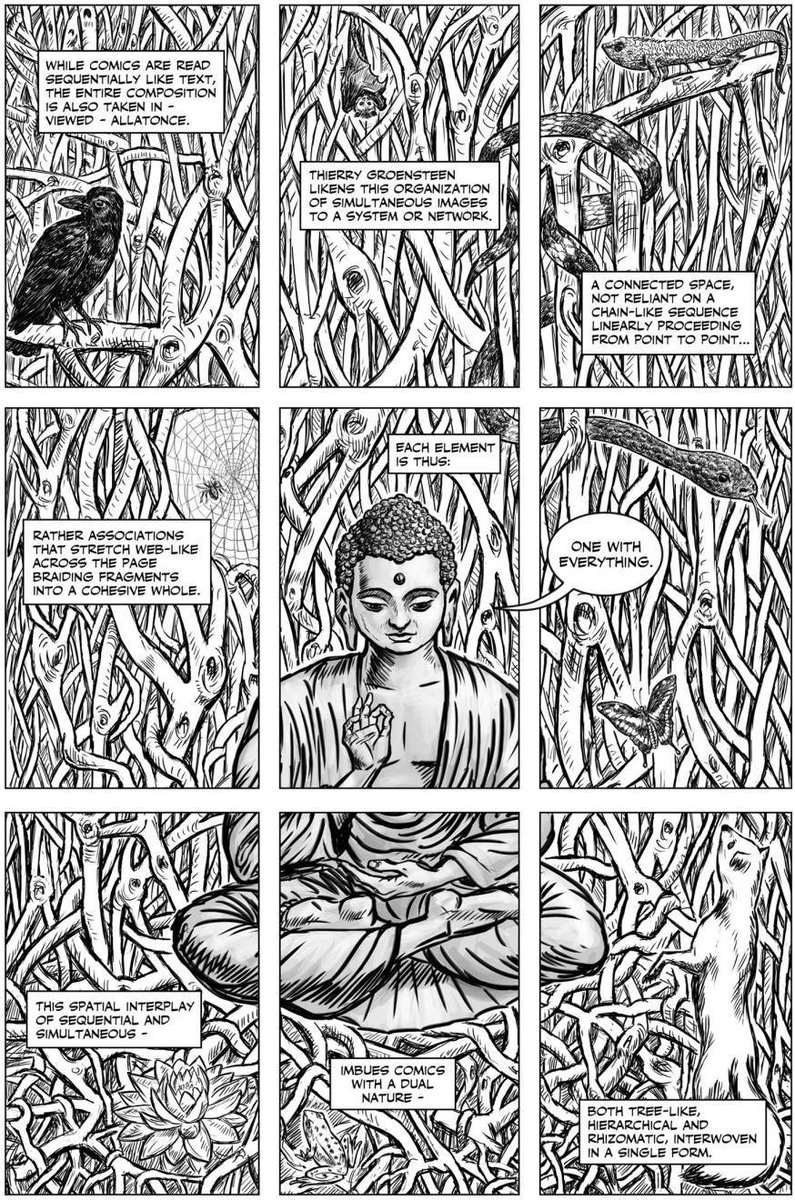
The Lifted Brow piece is something special to me, though. It comes from being persuaded of Nick Sousanis’ case, in Unflattening, that the traditional priority of words over illustrations is wrong: words and images cannot be explored separately from one another.
Reading the book, it becomes difficult to feel satisfied with comics criticism that deals in words alone. Alternatives like Terry Elliot’s experiments with digital annotation of Unflattening look increasingly appealing; therefore I decided to create my response to Unflattening in the form of a game: a set of sequential incidents which the reader can navigate at will – rather like the panels of a comic book.
“You run around dressed like a moron, beating people up!” “It’s not that simple and you know it!”
I was pleasantly surprised by Netflix’s new TV show Daredevil, based on the Marvel comics character.
I’m a bit over growlyman vigilantes, but it has a great supporting cast, an interesting and vulnerable villain, plus a New York where there’s plenty of languages other than English being spoken.
With its gangland politics, comic book elements, and deliberately narrow colour palette, Daredevil is kind of like The Wire, but set in Warren Beatty’s Dick Tracy universe. If you took the superhero out of it, I’d happily watch a show where a plump, mouthy lawyer, a woman with a troubled past, and a weary journalist decided to take on a larger-than-life crimelord and his syndicate.
I never read much Daredevil, as a kid or an adult, but Mark White in New York got me to buy a Christmas issue of the comic a couple of years back. It was an unexpectedly thoughtful story on the limits of macho heroism and the importance of education.





 matt finch / mechanical dolphin