“Though it’s just a trick of the calendar, as the new year begins our thoughts inevitably turn to the future. Yet we cannot gather data from events that haven’t happened yet, and forecasts drawing on precedent can flounder when situations are unstable.”
What do I do? I help people think through big decisions, individually or collectively, when situations are uncertain.
It’s strategy, not therapy, but there’s kinship between the two.
Learning about “what goes on within and between us”, the psychology of individuals and groups, nourishes the work – and you can find that nourishment in unexpected places.
Sometimes it’s pretty conventional: a journal article, a course at the Tavistock, formal professional gatherings such as a group relations conference.
Sometimes learning seems to find its way to you: a challenging event in your personal life yields a nugget of wisdom, a conversation with a musician provides an unexpected metaphor, or maybe you get an unexpectedly helpful book recommendation from a chatty shop assistant. (That’s how I first encountered the work of Irvin Yalom).
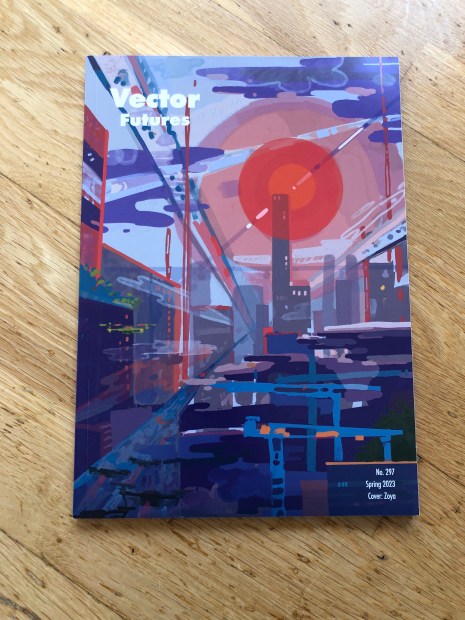
“Facing The Strategic Sublime: Scenario Planning as Gothic Narrative”, my piece with Marie Mahon, is in the latest issue of the British Science Fiction Association’s Vector magazine.
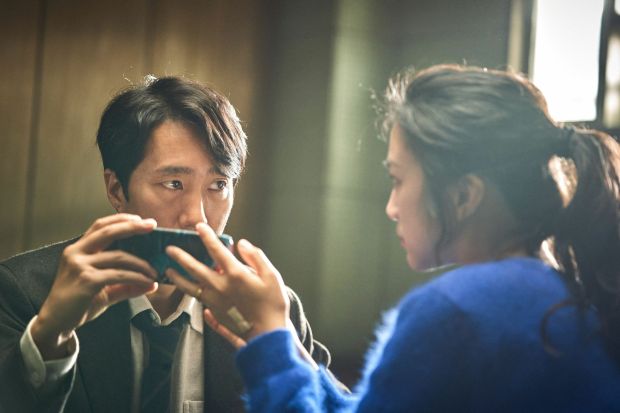
I recently watched Park Chan-wook’s tremendous new film Decision to Leave. Styled “a romantic thriller”, it deals with a detective who falls for a suspect in the murder investigation he is leading.
Hae-Jun, the insomniac detective, investigates the death of a former immigration officer in an apparent mountaineering accident. Suspicion falls on the officer’s Chinese wife, Seo-Rae, whom the cops think isn’t showing enough grief. As Seo-Rae and Hae-Jun become entangled beyond the scope of the investigation, the mystery deepens: who is snaring whom?
A 1960s song which recurs throughout Decision to Leave, “Mist” by Jung Hoon Hee, highlights some of the movie’s themes.
The beautiful lyrics just hit my heart straight away, especially the part where it says, “Open your eyes in the mist.”
[…T]hroughout the song, you get this impression that the one that you love is leaving you, and you see them in silhouette, obscured in this deep fog; that’s the dominating image in the song.
And then, towards the end, you hear this lyric: “Open your eyes in the mist.” And that is a command to you, to open your eyes and take a straight look at that person.
So the command is, even though it’s misty, things are ambiguous, you have to make an effort to see clearly. Now, what is this song commanding you to take a look at straightforwardly? I think you can fill in the blank. It could be the person you love, or your own emotions, or just reality in general.
That was really the inspiration [for Decision to Leave]. It conjured the image of a detective, someone who always tries to take a clear look at his situation. And that’s when I decided to put in the scenes where the detective uses artificial tears. He always uses them to kind of clear his eyes, whenever there’s a decisive moment that he really wants to take a straightforward look at.
For so many of us in this era, we too find ourselves peering through the fog and mist of the so-called “TUNA conditions”, characterised by turbulence, unpredictable uncertainty, novelty, and ambiguity. No matter how hard we try to resolve these conditions, we cannot be fully sure of what is going on or what will happen next.
When I heard this interview with Park Chan-wook, I was intrigued by the story about the pop song which inspired the movie, but I was also startled by the term “artificial tears”. I’d never heard this phrase used to describe eye drops before. I loved it.
It made me think how, in TUNA times, we can look at the world around us, considering the uncertainties with the power to reshape our immediate environment, and create future scenarios to help us think about how those uncertainties might play out in times to come.
Those future scenarios are designed to challenge our assumptions – not to be dystopian or utopian necessarily, but to go beyond our already-existing expectations, hopes, and fears, so that we see from outside of our old frame of reference and, taking the vantage point of an imagined future, see our own here-and-now more clearly.
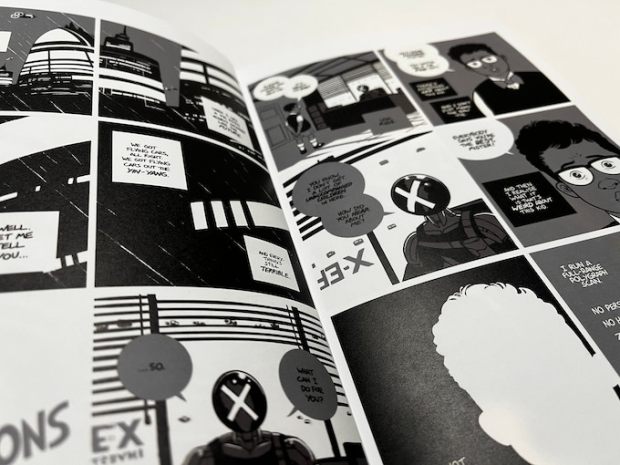
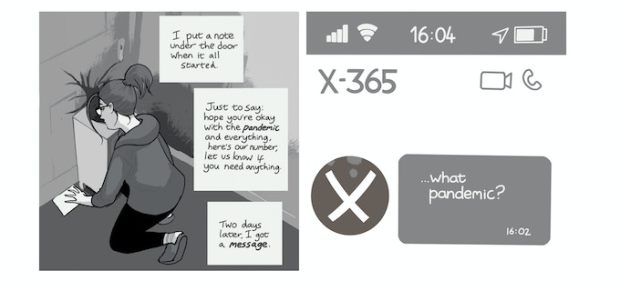
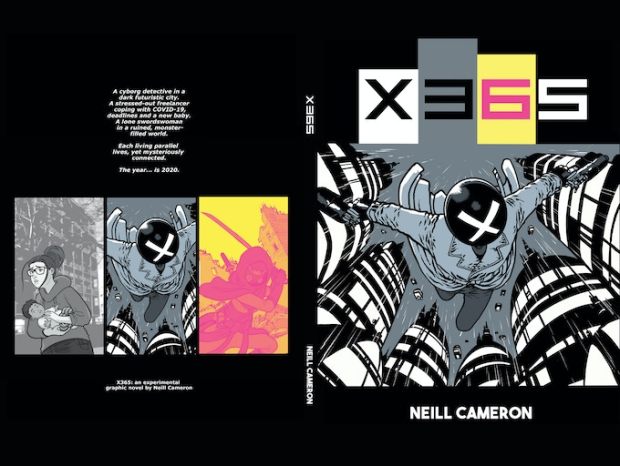
In early 2020, acclaimed comic creator Neill Cameron began to write and draw the one-panel-a-day comic X365: “No plan going in, no preparation. I’d just make a story up and see where it took me.”
When the pandemic hit, it reshaped the tale Neill was telling, of parallel worlds entwined.
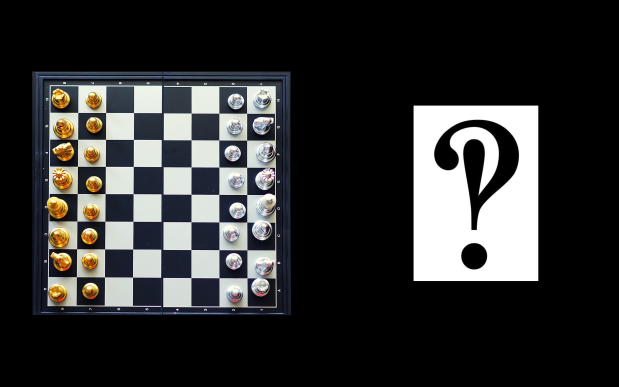
On the left is a chessboard, the setting for a game where all the moves are knowable in advance, and the winning and losing conditions clearly defined. It’s just a matter of which piece goes where and when within the constraints of the rules. (Not that it makes chess easy!).
On the right is an interrobang, an unusual punctuation mark which is intended for use at the end of an exclamatory rhetorical question: Are you out of your mind!? Is this for real!?
To me, the point of manufacturing plausible futures when doing strategy work is more about the right hand side of the image than the left.
It’s not about identifying all the contingencies, or modelling all the ways you think the action could play out according to today’s rules.
It’s about showing you something which usefully pushes the bounds of what you believe is plausible; which uncovers issues previously unseen from your standpoint in the present, and makes you question yourself.
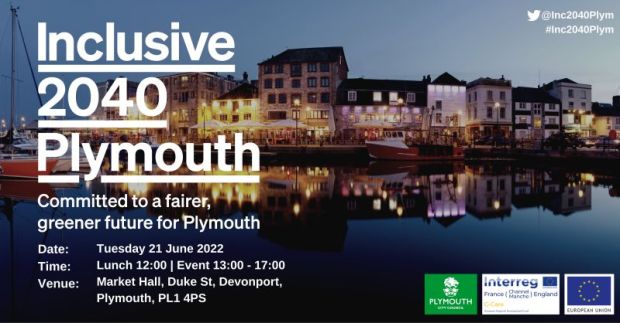
I spoke this week at the Inclusive 2040 event hosted in Plymouth, England, to explore the future of sustainable, equitable growth in that city.
Alongside speakers including Stephen Evans of the Learning and Work Institute, Fiona Tuck of Metro Dynamics, Alexis Bowater OBE, and Tim Sydenham, I presented an interactive session on strategic foresight, drawing on an adapted version of the IMAJINE scenarios.
Britain’s so-called “Ocean City” has been a strategically important naval site for centuries, thanks to its shipyards and dockyards. In exploring the future for the city, we also wanted to acknowledge its long history. Who we have been in the past shapes who we are today, and the potential for who we might need to become tomorrow.
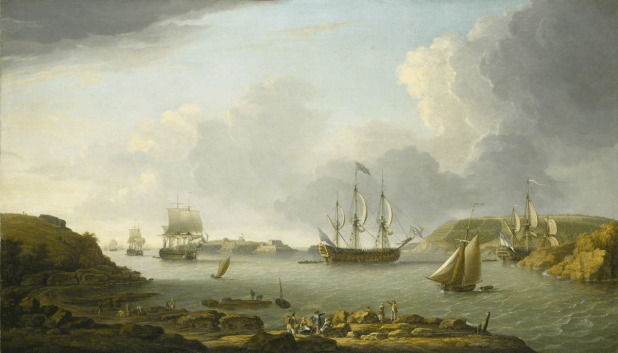
In Plymouth’s naval heyday, the time of the Napoleonic wars, each ship was its own “wooden world”, a microcosm moving through the ocean. The image of a man o’war sailing into battle evokes a particular notion of strategy: directing one’s own organization like a vessel through changing waters, assessing the conditions of the weather and the sea, weighing one’s limited resources, managing the morale of one’s crew, and making judicious choices in combat and competition with other, rival ships.
At times, leading an organization can feel like steering one of the ships pictured in Dominic Serres’ Return of a Fleet into Plymouth Harbour: even in a familiar setting, all is not certain. Some hazards are evident and well-charted; others may lie below the waterline; others still may vary with the conditions of the sea and the sky. Each figure in Serres’ painting, whether on the land or aboard a vessel large or small, will have a different perspective on the waters which the fleet is seeking to successfully navigate.
Such multiple perspectives can prove useful in helping us to understand the three elements which Geoffrey Vickers identified as fundamental to wise decision-making in his book The Art of Judgment:
What is going on? What does it mean for us? And what can we do about it?
Yet our world is different from that of centuries past. The connections and complexities which define it have evolved considerably, as has the speed and quality of communication. Strategizing today involves much more than guiding a single ship, squadron, or fleet in competition against hostile powers.
Thinking narrowly, in terms of traditional sectors, industries, or geographies, can limit or blindside an organization. A better approach is to think in terms of systems. Doing so sensitizes leaders to broad changes of context and allows them to bring actors together from many sectors, which in turn enables the creation of new value.
Marie Mahon of NUI Galway and I are in Vector with a new piece taking a literary approach to strategy, scenarios, and foresight.
In “Facing the Strategic Sublime: Scenario Planning as Gothic Narrative“, we investigate how constructing plausible future scenarios can help people to test their assumptions, suspend preconceptions, and engage with issues and information that they had previously framed out of consideration.
In doing this, we argue, scenarios are akin to Gothic literature, offering what Leila Taylor calls “a means of working through the discomfort of a changing world through the safety of fiction”.
Treating scenarios in this way “restores both our humility with regard to external forces that may seem almost unbearable to face, & the troubling sense that our own desires may not be pure or uncomplicated…”



 matt finch / mechanical dolphin

_-_Return_of_a_Fleet_into_Plymouth_Harbour_-_BHC1913_-_Royal_Museums_Greenwich.jpg)