Are we even talking about tomorrow? at UCL Languages of the Future

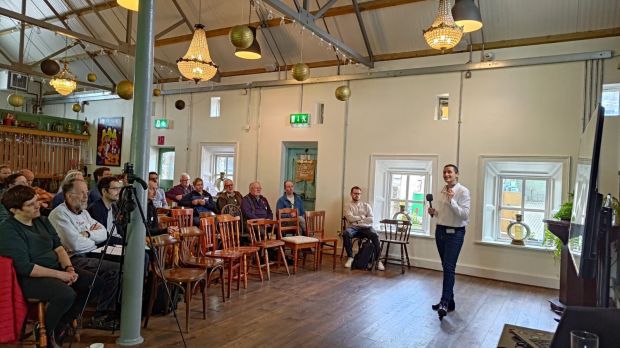
I’m speaking at the UCL Languages of the Future conference on 6th June, presenting a paper titled “Are we even talking about tomorrow? Uncertainty, agency, and the encounter with the sublime”.

The event brings together contributors from across academia and broader society to think through the complex relationships between languages and times to come. We’ve been given a few big questions to chew on, like: How can “languages of the future” encapsulate specific individual disciplines, embrace diverse knowledge systems, convey the urgency of problems that are yet to arise, and honour the voices of the more-than-human world?

I’ll be standing on the shoulders of thinkers like UCL’s Richard Sandford to explore uncertainty, agency, and the “thick present”: an understanding of the here-and-now encompassing remembrance and anticipation. As Rafael Ramírez and Angela Wilkinson have it,

The future is always an aspect of the present. The future has not “taken place,” but the present always “holds” the future, and holds it as potential. Indeed, the future is never “later,” is it always (experienced, imagined) “now.”

Droplets hanging from a leaf in close up. The image is titled WHAT MIGHT TRANSPIRE? and includes a quotation from Sandford 2023: 'It is precisely action that makes the present thick. Pursuing the ends that we have demands that we weave together pasts, presents, and futures, producing the thick present through the exercise of our agency.'

Peat Hub Ireland: 2050 Scenarios

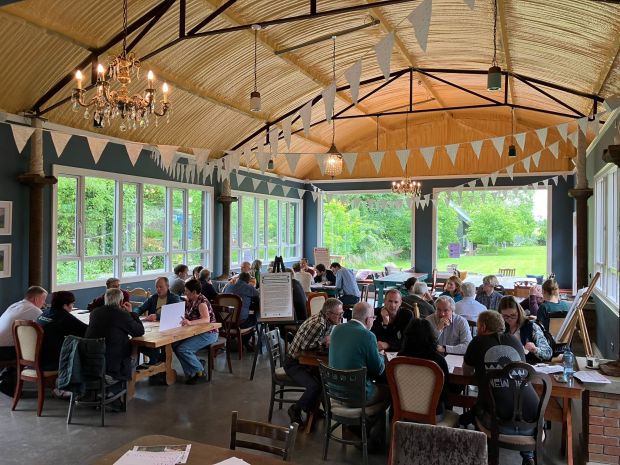
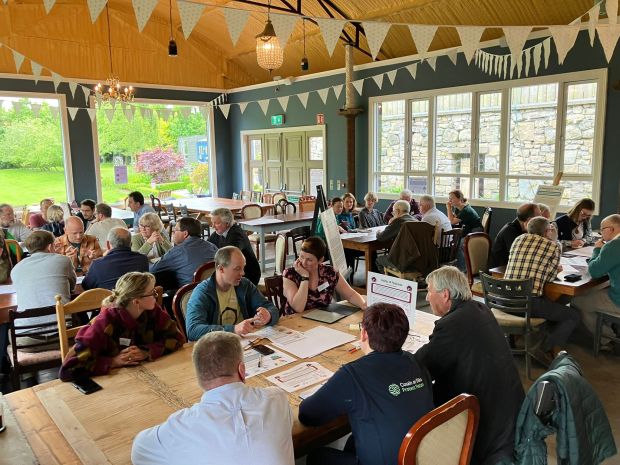
I’m just back from collaborating with the Peat Hub Ireland team on a scenarios workshop which invited participants from across the communities and institutions involved in Irish peatlands management to explore three visions of the world in 2050.

Historians, scientists, community members, officials, archaeologists, educators, researchers, activists, and businesspeople all gathered to find new ways to think about sustainability and custodianship, suitable for times of turbulence and unpredictability.

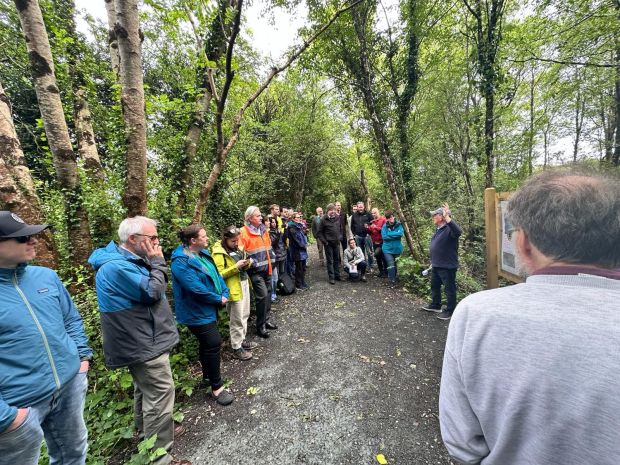
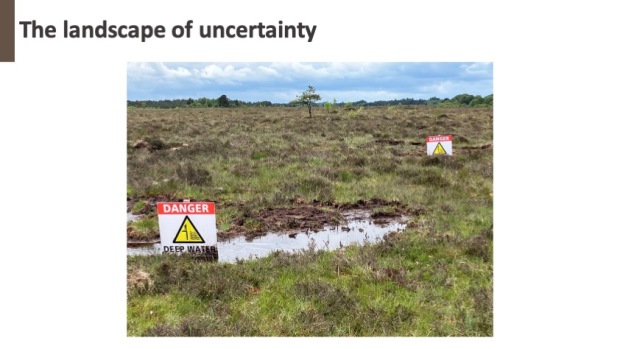
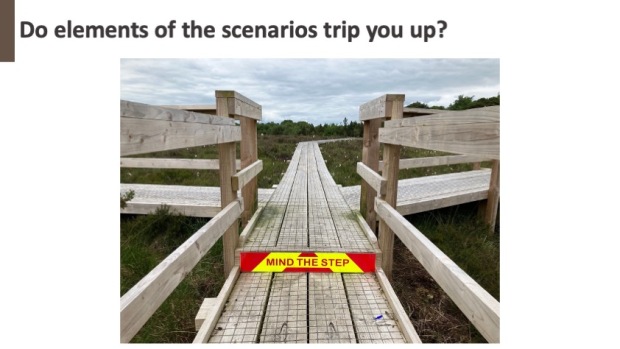
It was quite unique to run a scenarios day incorporating a two-hour break for a lunchtime country walk – but being out on the bog gave us a shared experience of the landscape whose future we were exploring, and some useful metaphors for dealing with conditions of uncertainty.

Our work built on the scenario elements of the Horizon Europe-funded IMAJINE project, which were led by the University of Galway’s Marie Mahon and myself. Peat Hub Ireland’s Florence Renou-Wilson, David Wilson, and Kate Flood worked with me to develop IMAJINE materials into a fresh set of scenarios for the world of peatlands management in 2050. We were supported in delivering the workshop by colleagues including Elena Aitova and Liz Bruton.

You can find out more about Peat Hub Ireland at their website – and there’s an account of the day from the Department of the Environment, Climate, and Communications’ Dave Dodd here. Stay tuned for more about the scenarios, too.

The View from Fourth Place

The concept of practising failure perhaps prompts us to discover our inner dweeb, to be underachievers, to fall short, to get distracted, to take a detour, to find a limit, to lose our way, to forget, to avoid mastery, and, with Walter Benjamin, to recognise that “empathy with the victor inevitably benefits the rulers.”

– Judith Halberstam, The Queer Art of Failure

It’s a funny thing, foresight work.

You help people to build pictures of the future context for a given entity or issue — but you’re not saying what you think is going to happen.

We’re not in the prediction business, nor even that of saying what we want the future to be.

Instead, we’re looking at ways in which today’s uncertainties might play out over time, challenging current assumptions and expectations, even current hopes and fears.

The scenarios we create together can offer unique vantage points on the issues of the here-and-now: manufactured hindsight. You know, as a scenario user or learner, that you’ve done a good job if you see something strategically useful which you couldn’t see at the outset of your work.

That sense of going beyond what you could already perceive, or conceive, is sometimes called the “a-ha” moment: a realisation, not always comfortable, that things could be otherwise.

This is why scenarios should be built with people, not for them. Re-perception of our current situation comes as much from the process as the end product; you can’t outsource the thinking that lets you see the world anew.

Still, as my Oxford colleague Gerard Drenth points out, there’s a danger of “So what?”

The work can’t just be interesting, it has to be useful.

Some people think that what’s useful is to “get it right” – to correctly forecast what the future will bring.

But the job is not merely to guess what happens next. Rather, it’s to see what we’re missing in our understanding of what’s already around us, right here and now.

Read more

Human-Land Podcast: Spatial Justice and Realms of Citizenship

I joined the Swedish University of Agricultural Sciences’ Human-Land podcast to talk about social justice and foresight in spatial planning, and their links to environmental psychology.

As environmental psychologists explore the relationship between human beings and their environments – including how humans shape those environments and are shaped by them in turn – foresight work allows us to explore how that relationship might change in times to come, and how our ideas of what is fair or just in terms of access to different environments might also evolve.

Host Hannah Arnett and I spoke about the IMAJINE scenarios project and the possiblity of an approach to questions of space and justice that brings together a range of disciplines and perspectives on the common ground of the unwritten future.

You can listen to the episode now on Spotify and Soundcloud.

Islands in the Sky: a course on planning for the future at the Open University

As part of its OpenLearn free online learning offer, the Open University has released a planning course which incorporates Islands in the Sky, an adaptation of the Oxford Scenario Planning Approach developed during the height of the COVID-19 pandemic.

As the course notes explain, “Islands in the Sky is a situational awareness and scenario-based strategic planning tool that is especially useful for managing uncertainty. It is designed for structuring conversations about the future business environment to inform decision-making in the present.”

It was a privilege to develop the approach with a team from the Open University and other colleagues, and contribute to the video materials for the course. You can find more about the Open University’s version of Islands in the Sky at their website.

Hopper/Vermeer: Things that never quite were

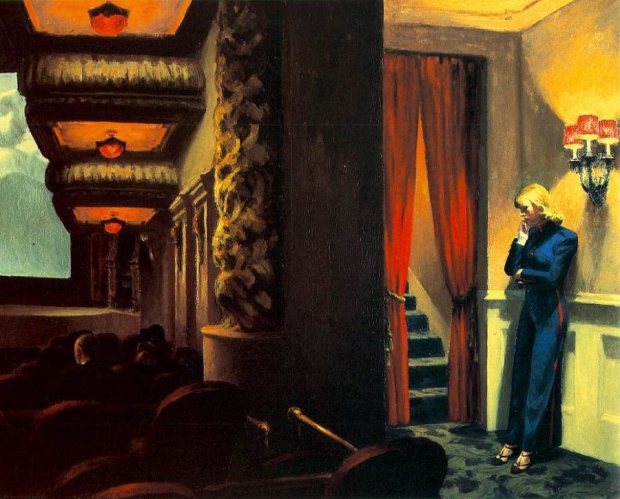
New York’s Whitney Museum is currently hosting an exhibition on Edward Hopper’s New York, which I visited on a recent trip.

As the exhibition blurb puts it, for Hopper “New York was a city that existed in the mind as well as on the map, a place that took shape through lived experience, memory, and the collective imagination.”

The show is especially satisfying for its use of newly acquired archives, showing how Hopper and his wife Josephine Nivison Hopper collaborated in a lifetime of artistic production.

Works like New York Movie are exhibited alongside preparatory studies and sketches as well as photographs from some of the real-life locations the artists visited as part of their creative process.

We see just how fictive Hopper’s New York was: scenes created from amalgamation of multiple locations, with imaginary additions or even omissions, creating a city-that-never-was which is nonetheless powerfully evocative of New York specifically and a certain quality of mid-twentieth-century American life more generally.

I’m always seduced by sketches; I love it when people show their working. You can see the traces of their choices, the possibilities they pursued and then abandoned, especially when the artist is “thinking through drawing”.

Read more

The Time of the Surprise: Strategy for the Wooden World

I spoke this week at the Inclusive 2040 event hosted in Plymouth, England, to explore the future of sustainable, equitable growth in that city.

Alongside speakers including Stephen Evans of the Learning and Work Institute, Fiona Tuck of Metro Dynamics, Alexis Bowater OBE, and Tim Sydenham, I presented an interactive session on strategic foresight, drawing on an adapted version of the IMAJINE scenarios.

Britain’s so-called “Ocean City” has been a strategically important naval site for centuries, thanks to its shipyards and dockyards. In exploring the future for the city, we also wanted to acknowledge its long history. Who we have been in the past shapes who we are today, and the potential for who we might need to become tomorrow.

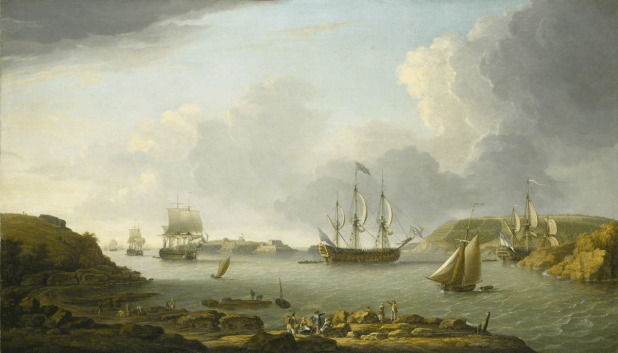
In Plymouth’s naval heyday, the time of the Napoleonic wars, each ship was its own “wooden world”, a microcosm moving through the ocean. The image of a man o’war sailing into battle evokes a particular notion of strategy: directing one’s own organization like a vessel through changing waters, assessing the conditions of the weather and the sea, weighing one’s limited resources, managing the morale of one’s crew, and making judicious choices in combat and competition with other, rival ships.

At times, leading an organization can feel like steering one of the ships pictured in Dominic Serres’ Return of a Fleet into Plymouth Harbour: even in a familiar setting, all is not certain. Some hazards are evident and well-charted; others may lie below the waterline; others still may vary with the conditions of the sea and the sky. Each figure in Serres’ painting, whether on the land or aboard a vessel large or small, will have a different perspective on the waters which the fleet is seeking to successfully navigate.

Such multiple perspectives can prove useful in helping us to understand the three elements which Geoffrey Vickers identified as fundamental to wise decision-making in his book The Art of Judgment:

What is going on? What does it mean for us? And what can we do about it?

Yet our world is different from that of centuries past. The connections and complexities which define it have evolved considerably, as has the speed and quality of communication. Strategizing today involves much more than guiding a single ship, squadron, or fleet in competition against hostile powers.

As Trudi Lang and Richard Whittington write in Harvard Business Review, we must adopt a broad view of strategy, rather than leaders’ traditional approach of “taking the long view and focusing on where they’re going”:

Thinking narrowly, in terms of traditional sectors, industries, or geographies, can limit or blindside an organization. A better approach is to think in terms of systems. Doing so sensitizes leaders to broad changes of context and allows them to bring actors together from many sectors, which in turn enables the creation of new value.

Read more