We have lots of children from the climate change protest here in Tūranga. They – and all other customers – are being well looked after by staff. There are storytimes taking place, people playing video games, reading, and some watching Shrek. ^DR pic.twitter.com/Aswrbpz0bj
— Ngā Kete Wānanga-o-Ōtautahi (@ChristchurchLib) March 15, 2019
A condolence book has been set up on the ground floor of Tūranga, so people can leave messages of support and sympathy for those affected by Friday’s mosque shootings.
The Christchurch Foundation, at the Mayor's request, has established a new fund to help raise money to support the families and Muslim communities impacted by Friday's tragic events, now and into the future. https://t.co/cmWIXPMNwR
— Ngā Kete Wānanga-o-Ōtautahi (@ChristchurchLib) March 15, 2019
Christchurch’s librarians have been tested by crises that no community should face, and proved themselves to be brave, compassionate, effective, and resolute. They are heroes of the information profession. Spare a thought for them this weekend.
Arohanui. Thanks to everyone for your words of support and caring concern for Christchurch. It means a lot. ^DR pic.twitter.com/VTtV3IpTB5
— Ngā Kete Wānanga-o-Ōtautahi (@ChristchurchLib) March 16, 2019
Recently I had the opportunity at work to attend a course on character strengths run by the Mental Health Education Resource Centre. It’s great that these opportunities for healthcare professional development are being opened up to librarians. Last year I went to one of their courses on grief. This was an incredibly valuable session where I learnt a lot; one thing that stood out to me was that we don’t just grieve for people, we also grieve for places and things, particularly in times of change. Sometimes these aspects are inextricably linked.
Because I work in the centre of Christchurch, I am surrounded by sites of memory and sites of mourning. Read more →
Last year, I was invited to give a keynote speech at Aotearoa/New Zealand’s national library conference, LIANZA 2017.
I wanted to realise a long-held dream and present a collective keynote with a number of Australian & New Zealand colleagues sharing the stage, but it wasn’t practical for LIANZA to fly a whole group of us across the Tasman Sea.
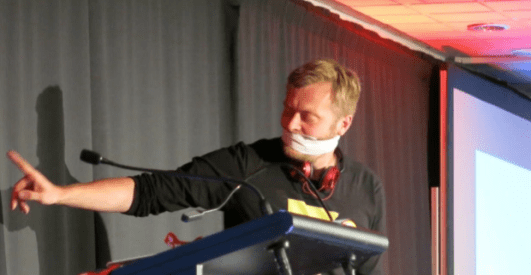
In the end, we contrived a way to deliver a unique collective keynote – by taping my mouth shut and inviting members of the audience on stage in an hour-long series of creative, constructive, collaborative activities.
In October, US librarian Justin Hoenke approached me to co-nominate Rachael for the American Library Journal‘s annual Movers & Shakers Award, highlighting professionals who have done exceptional work in libraries around the world.
Today, Rachael was announced as a winner of the 2018 Movers & Shakers Award and her friends & supporters worldwide are justifiably celebrating. From her days back in suburban Auckland to current international glory, including her own individual library keynote in Edinburgh, Rachael is one of the greatest heroes of public librarianship in 2018.
Voices like hers deserve to be elevated. Look her up. Learn from her. Change the world for the better.
A special guest joins us on the blog today. Chantel Theunissen, Children and Teens Librarian, Koraunui Stokes Valley Community Hub, and editor of New Zealand’s Library Life, tells us how she orchestrated havoc, chaos, and sheer delight to commemorate the closure of a temporary library in Aotearoa New Zealand.
Photo supplied by Chantel Theunissen. Used with permission.
Photo supplied by Chantel Theunissen. Used with permission.
Let me start off by saying all of my favourite things I’ve done at work (and in life really) haven’t been planned.Read more →
I’m over at Library Whisperers joining in the conversation, led by the brilliant Kim Tairi, around #LibrarianStyle – the fashion choices of people who work in and with libraries and other knowledge institutions.
There will always be a tension in the style choices of knowledge professionals, especially those working in public-facing institutions. Should staff wear uniforms? Do they make it easier to identify staff on the floor of the library, museum, or university?
Which ranks become exempt from uniform and what does that do for an “us and them” mentality?
Does sartorial expression ever become self-indulgent, distracting, or damaging to your professional role?
Do these questions play out differently depending on whether you identify as a man or a woman – with this patriarchal world placing more demanding expectations and standards on women in the workplace?
This is the last post in this series setting out our process, so you can think about how to run such an activity, and push the boundaries even further than we did.
This slideshow requires JavaScript.
In this entry I’m just going to focus on all the stuff which remained below the waterline – songs which didn’t make it to the final session, videos which inspired us but whose inspiration might not be very visible in the finished product. Read more →
I had approached Rachael to conclude the keynote so that it ended with a local voice and a speaker who was delivering practical front-line services to a New Zealand community. Rachael is a great example of a library branch manager whose teams are finding new and compelling ways to engage their community, from services for the homeless through to personalised one-to-one music sessions.
So great to hear from @MCrtt talking about offering services for the homeless community in libraries. Excellent work! #open17
So, it’s the afternoon of Sunday 24th September, 2017, at the Addington Raceway in Christchurch, Aotearoa New Zealand. Laurinda Thomas has just given an excellent talk about librarians’ professional identity and I’m invited to the stage.
I acknowledge the traditional owners of the land and say a few words in te reo Māori.
Then this appears on the conference screens: Read more →
In August last year, the organisers of LIANZA Open 2017 invited me to be a keynote at their conference, the national gathering for the librarians of Aotearoa New Zealand.
Last week, it all happened – I taped my mouth shut for an hour and led an adventurous conference session which brought the audience onto the stage, delivered a working library service within the keynote hall itself, and got us coverage on New Zealand’s national news.
So what exactly took place over in the city of Christchurch, how did we get here, and what can we do with the experience? If I share with you not only the product, but the process, could you see your way to trying something like this…or even going beyond what we achieved in New Zealand?



 matt finch / mechanical dolphin
