IMAJINE: Scenario Planning for Europe’s Regional Future

Since last year, I’ve been working as a foresight consultant on the IMAJINE project, a Horizon 2020 project exploring the future of regional equality and territorial cohesion across the European Union.

To help people understand how IMAJINE is using scenario planning to explore Europe’s future, Marie Mahon of NUI Galway and I have recorded a five-minute video introducing the scenario planning component of IMAJINE.

You can watch the video below or read more at the IMAJINE project website.

Scenarios of Heat, Light, and Power @ Energy Consumers Australia Foresighting Forum 2020

This week sees the 2020 Foresighting Forum hosted by Energy Consumers Australia (ECA).

The event brings together stakeholders from across the Australian energy sector, plus international guests, to talk about what lies in store for Australians and their future relationship to energy.

As part of this year’s forum, I’ve worked with ECA to create four scenarios set in the year 2050. Each offers a radically different vision of the Australian relationship to heat, light, and power, intended to enrich current assumptions and strategies by indicating new opportunities and unexpected challenges which may await.

The event takes place on 19 and 20 February at the University of Technology Sydney, and I’ll be contributing video presentations for attendees – but you can also follow along on social media via the hashtag #TakeCharge20.

The scenario documents and materials will be released publically following the event on ECA’s website – stay tuned for more information.

Risk literacy and futures literacy: New column

The first instalment of “Scripturient”, my new quarterly column for Information Professional magazine, is out now.

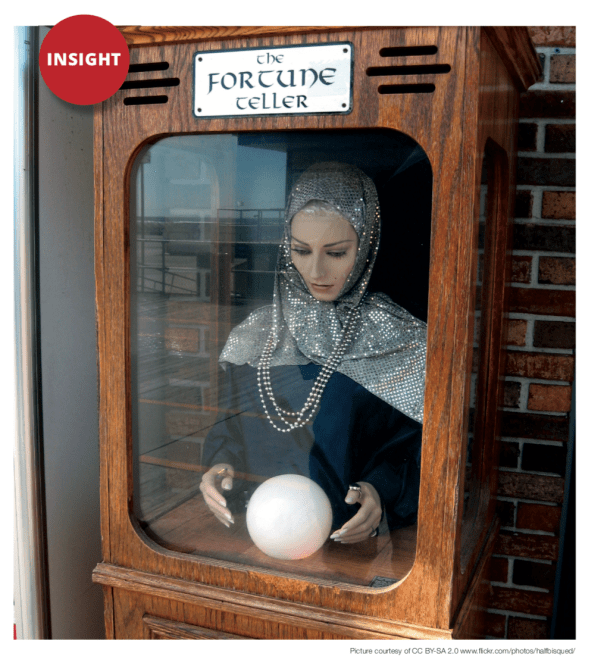
Picture of a mechanical fortune teller from CILIP's Information Professional Magazine, captioned with the word "insight"
Picture licensed CC BY-SA 2.0 from Flickr user halfbisqued

In this series, I’ll be looking at how we can push the boundaries of literacy in the 21st century, to encompass new areas of representation. What does it mean to read the future? To read risks? To read the forces that underpin our relationships and drive us psychologically? To read the signs and signals which exist in the natural world?

Join me, over four instalments in 2020, to explore some of these questions in the pages of Information Professional.

You can read the first column, which covers futures literacy and risk literacy, in this PDF download, or in the text below. Read more

Interview with Joshua Polchar, OECD

As part of last month’s article on scenario planning for The Mandarin, I interviewed Joshua Polchar, a strategic foresight analyst and facilitator at the Organisation for Economic Co-Operation and Development (OECD).

OECD Conference Centre Paris – Photo by Wikipedia user Nick D – CC BY-SA 3.0

Scenario planning has been part of the OECD’s futures toolkit in the 1970s, but over the last decade, the organisation has started to enhance its capacity for strategic foresight.

Joshua began the conversation by explaining why – I’ll let him take it from here: Read more

Next Library Brisbane: Interview with Vicki McDonald

This year, the international Next Library conference holds its satellite event at the State Library of Queensland (SLQ) in Brisbane. Information professionals and librarians from around the world are invited to Australia’s ‘Sunshine State’ to explore questions of innovation, risk, and resilience. I spoke a little about why SLQ is the perfect place to have these conversations in a recent video.

Screen Shot 2020-01-14 at 07.50.50.png

I’ve worked with SLQ since 2016, spending two years with them as their Creative-in-Residence leading special innovation and engagement projects. Most recently, I co-wrote the new vision for public libraries in the state with the University of Southern Queensland’s Dr Kate Davis.

The State Library’s current CEO, Vicki McDonald, became the organisation’s leader part-way through my tenure there, and in 2017 I interviewed her for the Library as Incubator project.

That means it’s a good time to check back in with Vicki and her team – and this week, I interviewed Vicki again. Since she took the top job, what has changed at SLQ? What does she see as the future of libraries? And why is SLQ now inviting the world’s librarians to visit for a discussion about risk and resilience?

Read more

Scenario Planning at The Mandarin: Prediction vs. Plausibility

My December 2019 article in Australia’s publication for public sector leaders, The Mandarin, is available here on my site and can be republished freely.

Here’s the full text of “We Can’t Predict the Future, but Scenario Planning Can Identify What It Might Look Like“:

File:Parliament House Canberra NS.jpg
Australia’s Federal Parliament house, by Wikipedia user JJ Harrison – (CC BY-SA 3.0)

What would it mean to prepare for a future that you didn’t see coming?

Whether it’s the Brexit vote, Trump’s presidency, the global financial crisis, or the changing climate, we increasingly face what some foresight experts call “TUNA” conditions, characterised by turbulence, uncertainty, novelty, and ambiguity. In such circumstances, old models of the future lose predictive power, and our expectations are thwarted.

Scenario planning is a foresight methodology that seeks not to predict the future but to usefully challenge our assumptions about what’s coming next. The pioneering scenario planner Pierre Wack was among the figures who developed the approach in the mid-20th century and gave it credibility through successful strategic counsel at the oil firm Royal Dutch Shell. Read more

2020 Foresighting Forum, Energy Consumers Australia

I’ll be appearing via video at next month’s 2020 Foresighting Forum hosted by Energy Consumers Australia, the national voice for residential and small business energy consumers in Australia.

The Forum brings together stakeholders from across Australia’s energy sector to explore long-term questions of heat, light, and power.

I’ll be presenting a group of scenarios, created with representatives of the Australian energy sector in 2019, which could help reframe curent perspectives on Australia’s energy future and the strategic decisions which must be made in the present.


Planning your new year with Arrows of Time

The arrival of a new year tends to focus our attention on what’s coming. People make resolutions, use the holiday season to take stock and decide where they want to go next, or treat January 1st as a turning point for their lives at work or home.

Here’s a tool I sometimes use, adapted from the Oxford Scenario Planning Approach, where it’s called “Arrows of Time”. I shared it at the end of 2018 and I’ve added a little something extra for this year’s version.

To get started, you just need a piece of paper and something to write with.

Read more

2019 GovLove Hit Parade: Leadership & Scenario Planning

The US-based GovLove Podcast, run by the Engaging Local Government Leaders network (ELGL),  celebrates the end of each year by showcasing the most popular episodes of the previous 12 months.

I’m pleased to announce that July’s episode on Leadership & Scenario Planning, which I recorded with ELGL’s Kirsten Wyatt, has taken the number one slot.

Check out the whole list in this Twitter thread from the GovLove team.


The Mandarin: Scenario Planning for the Public Sector

My latest article has just been published in The Mandarin, Australia’s publication for public sector leaders.

File:Parliament House Canberra NS.jpg
Australia’s Federal Parliament house, by Wikipedia user JJ Harrison – (CC BY-SA 3.0)

We can’t predict the future, but scenario planning can identify what it might look like” explores the practice of scenario planning, including interviews with practitioners and clients from the OECD, Australia’s science organisation CSIRO, and leadership roles in government and policy bodies.

Visit the Mandarin website to read the article today.