Appointment to Futures Council, National Security College, Australia

I’m pleased to have been appointed to the Futures Council of the National Security College (NSC) at Australian National University.

The Council is an international group of individuals with expertise relating to the mission of the NSC’s Futures Hub, a whole-of-government and whole-of-nation resource for futures analysis in Australia.

Read more about the Hub and their work at the NSC here.

Scripturient: Handover

After five years, I’m passing ‘Scripturient’, my column at Information Professional magazine, over to the National Library of Australia’s brilliant Barbara Lemon.

Barbara joined me for a special handover edition of the column, looking back one last time – and taking a glance at what’s to come.

Read the latest ‘Scripturient’ as a PDF download here.

ISF Podcast: Threat Horizon and the auDA scenarios

I recently joined the Information Security Forum’s Mark Ward and auDA’s Sophie Mitchell for a short podcast discussion exploring foresight, uncertainty, cybersecurity, and Internet governance.

We looked at these issues through the prism of auDA’s recent scenarios for the future of the Internet and ISF’s own Threat Horizon foresight product.

Check out our episode of the ISF podcast here.

“Portraits of queer futurity” at National Portrait Gallery, Canberra

Where do we find the limits of identity and desire? What secret possibilities of thinking the world anew exist in quiet suburbs, remote farmsteads, Olympic pools, and the farthest reaches of time and space?

Join me next month for a special online virtual tour of Australia’s National Portrait Gallery, exploring portraits that offer different gateways to worlds beyond, blending past, present and future.

‘The future is queerness’s domain. Queerness … allows us to see and feel beyond the quagmire of the present.’ – José Esteban Muñoz

BMJ Medical Humanities Podcast: Scenario Planning, Healthcare, and the Humanities with Professor Matthew Molineux

Years ago, casting around for a way to explore “applied medical humanities”, I read Matthew Molineux’s essay “A Labour in Vain”, a kind of intellectual history of occupational therapy which spoke directly to the fraught, pragmatic question of what good we really do, when we strive to help others. It’s one of my all-time favourite pieces of scholarly writing and you can find it as a free PDF download from publishers Wiley here.

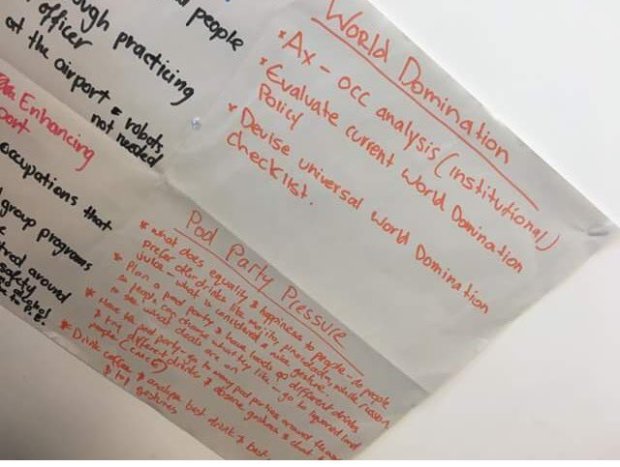
Working with Matthew in a collaboration between Griffith University and State Library of Queensland, I got to know him not just as a great writer, but a colleague and a friend. Combining a creative hands-on approach to occuaptional therapy education with foresight and psychodynamic work, we took Griffith students to distant futures — all in the service of exploring occupational therapists’ role in a changing world.

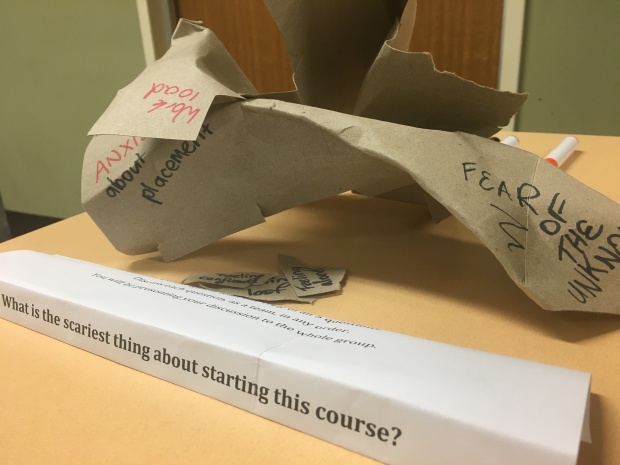
Toys, cake, and cardboard were just some of the materials which were brought into the work, which included a challenge to produce an edible presentation. The students were resourceful, empathetic, creative, good-humoured – exemplfying the best characteristics of their profession.

Now for The BMJ’s Medical Humanities podcast, Matthew and I join hosts Cristina Hanganu-Bresch and Brandy Schillace to explore scenario planning, healthcare, art, foresight, and the humanities.

Scripturient: AI and the future of intellectual property

The latest edition of Scripturient, my column for Information Professional magazine, features Alex Roberts of IP Australia, the government body responsible for administering intellectual property (IP) law in Australia.

As director of the agency’s IPAVentures unit, Alex leads a team dedicated to exploring what might be needed for the IP rights system of the future. They use foresight and innovation tools to consider how we regulate “creations of the mind”: everything from literary and artistic works to trademarks, brand names, and protected product designs.

Recently, IPAventures developed a set of scenarios exploring the impact of generative AI on intellectual property – ranging from ever more lengthy and elaborate patent specifications to accelerated ideations by inventors and even changes to the regulation of plant breeding.

You can read more about the scenarios, and IPAVentures’ work, in our interview from the latest issue of Information Professional magazine.

Ideas on Ghosts: Scenarios and the Spectral Metaphor

Did you just ghost me?

I just read Catie Disabato’s U Up?, a strange little mystery novel set in contemporary L.A.

Eve is a researcher for an app called LA By Foot which offers “definitive walking guides to the secret history, hidden paths, pedestrian staircases, and beautiful architecture of Los Angeles”. A historian at UCLA highlights notable locations in the city, then Eve visits them, photographs them, and writes the copy.

“I could do it all myself,” Eve explains, “research the history of Los Angeles by reading any or all of the many books James Danielson has published, but he has something I don’t have: the social power that comes from having a masculine name that starts with a J.”

So Eve walks the city, through hangovers and simmering California heat, all the while keeping another secret: on her iPhone, she texts her friend Miguel, who died by suicide a year before. And Miguel’s ghost texts back.

The novel follows the events around the first anniversary of Miguel’s death, when Ezra, who was Miguel’s friend and Eve’s, goes suddenly missing. As she tries to discover whether Ezra is merely avoiding her or something more sinister has happened, Eve is forced to confront what is going on within and between their circle of friends.

Disabato’s book addresses different kinds of spectrality with delicacy and deftness. In this world, there’s little difference between a supernatural revenant like Miguel’s ghost and a living friend who Eve is messaging, “trapped inside my useless idiotic lump of an iPhone.”

Read more

Simon Groth: After the Future of the Book

To consume media today means using the same tools and skills as it takes to produce; the device in your pocket is capable of both and its platforms are built with this in mind. This is a profound shift, even from the assumptions that underlie the web, and it’s a landscape in which, superficially, the book does not seem to have an obvious place.

In the latest edition of his newsletter, marginalia, Australia’s Simon Groth describes the closure of if:book Australia, the Brisbane-based “institute for the future of the book” which explored new forms of literature and the changing relationship between writers and readers in the digital age.

if:book projects included a book written and published in just 24 hours, the live-writing event series Memory Makes Us, the N00bz project which saw writers take up tools and formats which were strange to them, the “remixed memoir” collection Lost in Track Changes, and Hunted Down, another “remix” of short stories by nineteenth-century author Marcus Clarke.

Simon’s elegaic piece recounts his journey with if:book as “one of being swept up by larger shifts in current that made it possible—if only for a brief moment in time—to create interesting experiences and opportunities for a small number of writers and readers to engage with each other”.

The anxieties and excitement around digital literature in the 2010s, back when some thought that “the ebook spelled the end of civilisation as we know it”, created an opportunity for the if:book community to surf for a while on some of the more challenging and remote parts of Australia’s literary coastline. No matter how many people were standing on the shore to bear witness, those surfers know what they achieved. The tricks and techniques they discovered will continue to teach all of us who are interested in the future of the written word, both digital and physical.

Today, Simon notes, if:book Australia has no web presence:

Its various project sites have all vanished, their domains no longer point to active sites. Its social media accounts are deleted. If not for the Internet Archive, there would be almost no online evidence that any of it had happened. Maybe this was how it was meant to be. Memory Makes Us had already anticipated disappearance as the logical end for digital literary projects. Such is the nature of the web and digital media more broadly: the threat of data rot is much more aggressive and immediate than the slow degradation of the page.

[…] Ten years on from its initial flurry of activity, its bold charge to explore and investigate how technology was set to expand our conception of the book, all that’s left of if:book Australia is a collection of printed, bound pages.

See more about Simon Groth’s work, and the projects he ran for if:book Australia, at his website.