Right Here, Right Now Global Youth Climate Summit

I’m pleased to be delivering two sessions as part of the University of Oxford’s contribution to the Right Here Right Now Global Youth Climate Summit, a 24-hour virtual event presented by UN Human Rights and the Saïd Business School.

The online gathering brings together students and educators from across the world to share ideas about embedding climate action at the heart of education systems.

Find out more at the Saïd Business School website or register for the 24-hour livestream here.

'Dreaming Spires', by Flickr User JJBullock - Copyright JJ Bullock 2010
‘Dreaming Spires’, by Flickr User JJBullock – Copyright JJ Bullock 2010

UNESCO Prospects Journal: Scenarios and the future of education

The question for teachers, learners, and the various organizations and communities in which they participate becomes “How will we adapt, evolve, and thrive even if uncertainties play out in ways for which we had not initially prepared?”

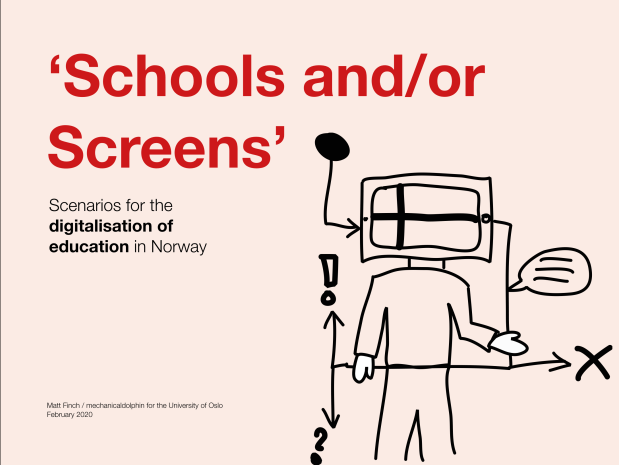
In the UNESCO International Bureau of Education’s journal Prospects, the University of Oslo’s Steffen Krüger, the University of Agder’s Niamh Ní Bhroin, and I discuss the “Schools and/or screens” scenario project for the digitalisation of education in Norway.

UNESCO Headquarters sign. (C) Matt Finch, 2023

We show how challenging issues raised in the context of distant imagined futures proved to be immediately pertinent in the developing Covid-19 pandemic, and, as a wide range of actors explore the possibility of a new social contract for education, we reflect on how future scenarios can provide fresh perspectives on issues that are difficult or even impossible to resolve within current frames of reference, including questions of equity and justice that may be construed differently in times to come.

Read “Unlearning, relearning, staying with the trouble: Scenarios and the future of education” at Prospects online.

OER 22: Open to Uncertainty?

Together with the Open University’s Anne Gambles and Open Education Global’s Executive Director Paul Stacey, I presented an interactive session “Open to uncertainty? Foresight and strategy for turbulent times” at the Open Education Resources conference OER22, run by the Assocation for Learning Technology.

Our session invited participants to explore ways of strategic thinking which support the goals of the open education movement during “TUNA conditions” characterised by turbulence, uncertainty, novelty, or ambiguity.

How might the fundamentals of publishing and intellectual property change in the future? What impact will changing social, economic, and political values have on the open education ecosystem? What new domains of learning and research might it be possible to “open” in times to come? Will the very definition of what is “open” evolve? How might exploring the answers to such questions help us make better decisions today?

In 2021-2022, I worked with Anne’s team on the Islands in the Sky project exploring future ways of working at the OU, and with Paul’s organisation on their new strategic plan Open for Public Good, as well as further work on value co-creation in the open education movement. They shared insights from their projects during the session.

You can watch a recording of our joint session from OER 22 below, or on YouTube.

SHAPE Education: Schools, Work, and the Adaptation Advantage

The archive from this summer’s SHAPE Education event, organised by Cambridge University Press and the Judge Business School, is now online.

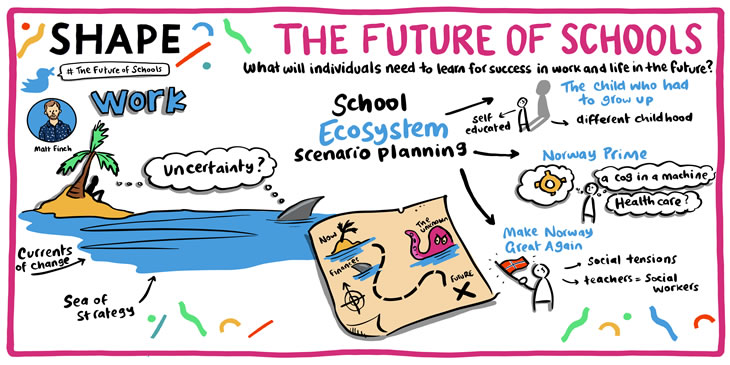
I spoke on the future of work and its implications for education with a panel including Bell Education’s Silvana Richardson, Cambridge University Press’ own Ben Knight, and Heather E. McGowan, author of The Adaptation Advantage.

We were also supported by live drawings from the brilliant Rebecca Osborne.

SHAPE Education: Matt Finch's talk

You can find more about the SHAPE conference series online, and explore the University of Oslo “Schools and/or Screens” scenarios, which I discussed during the panel, here.

Learning from futures you didn’t see coming? Scenario planning, education and the (post)pandemic world at CO:RE

It was my privilege to join the University of Oslo’s Niamh Ní Broin and Steffen Krueger at the website of CO:RE, the Children Online: Research and Evidence project funded by the European Commission, to write about last year’s scenarios for the future of Norwegian schools.

These explored different contexts for the digitalisation of education in Norway, considering how the relationship between learners, digital devices, and educational institutions might shift in times to come.

You can read our piece, “Learning from futures you didn’t see coming? Scenario planning, education and the (post)pandemic world”, here.

SHAPE Education: Schooling, Skills, and the Future of Work

I’ll be speaking at the SHAPE Education 2021 conference on Wednesday 14th July, joining the panel “What will individuals need to learn for success in work and life in the future?” alongside Heather E. McGowan and Silvana Richardson.

We’ll be asking, what skills, knowledge and characteristics will employers need and be looking for in future? How will education systems help people develop these within and beyond schools? And will relationships between schools and employers change?

You can join our panel, and other sessions from the week-long SHAPE event, for free.

“Why would you write it if you’ve already solved it?”: Interview with Chana Porter, Part 3

Playwright, novelist, and education activist Chana Porter joined me to talk about her new novel The Seep

In the book, Porter imagines an alien invasion of an unusual kind. The Seep find their way into the Earth’s ecosystem and cause every living being on the planet to become connected. “Capitalism falls, hierarchies and barriers are broken down; if something can be imagined, it is possible.”

You can read the first part and second part of our interview here, or check out the complete text now as a PDF download. In this instalment, Chana talks about loss, change, her goals as a writer, and the histories of secret writing in her own family.

M: The book is so steeped in grief, and it’s a theme we see elsewhere in your writing; the play Phantasmagoria has this question, for example, “Do the dead truly leave us?”

How did grief come to the forefront in this particular novel?

C: Don’t you think that ageing is a kind of grief? We betray our younger selves, our ideas of who we were or what we wanted, as we move on in time. I’ve lost some dear people who are close to me, people who died suddenly and young, so I have a little more of that shock of grief than some — but I think that in any kind of long-term relationship, what people don’t tell you about marriage is that there is a slow betrayal of whoever you were on your wedding day. I think that if there’s not, you’re doing it wrong! 

You need to become another person when you make this commitment, and you’re very lucky if you can change alongside your partner in a way that you get to rediscover one another. I don’t really know how we manage to promise anyone else anything, except to be clear, and true, and kind.

Read more