I’m presenting today to Portugal’s [Re]Pensar conference, an event for public librarians to reimagine their services, with a focus on gaming and maker technology.
The global innovation foundation Nesta has just published Imagination unleashed: Democratising the knowledge economy, a report on building inclusion in the era of radical change shaped by digital infrastructures, networks, services, and products.
It’s a compelling document which explores current challenges to our societies and sets out a broad-ranging agenda for addressing them in ways which promote inclusion and equity.
Reading this report from an information professional’s perspective suggests a great number of opportunities for libraries and other information institutions to play a part in making a fairer and more prosperous world, where more people get to realise their full potential.
In this post, I’m going to talk you through the report, suggesting a few of the implications and opportunities – and I’d encourage anyone interested in the future of knowledge to check out the report alongside this commentary. Read more →
I visited Vienna’s superlative Jewish Museum on my recent trip to the city. Their exhibitions and programmes are always sharp, relevant, and thoughtfully curated.
Currently, they’re hosting an exhibition on Kabbalah, the esoteric branch of Judaism which has been popularised by various celebrities from David Bowie to Madonna.
I wandered round, learned a little, and made some unexpected connections as well.
I’ve spent a fair chunk of the last two years working on something called “Library Island”. You might have seen photos, videos, or social media posts appearing online as university staff, health workers, museum professionals, students, and, yes, librarians take part in this interactive training activity.
Library Island might just be the best thing I’ve ever done at a library conference ever. https://t.co/F8txNvkZx4
Later this year, a free CC-licensed print-and-play kit for Library Island will be released, so that people anywhere can take this activity and use it with their institutions, companies, and communities.
But what exactly is Library Island? Read on to find out… Read more →
Today I’m joined by Norway’s Martin Kristoffer Bråthen. Martin is head of innovation and product development at Biblioteksentralen, the cooperative business which supplies libraries across Norway with collection materials, equipment and services.
Prior to that, Martin worked at Deichman Bibliotek, the Oslo Public Library, in a range of project roles. During that time, he wrote a robust defence of public libraries in the age of the e-book in response to a comment by a senior Norwegian arts editor that “digitisation leaves public libraries on the scrapheap of history.”
How do you get a whole nation thinking about the challenges which lie ahead of it?
How can you help a community to solve seemingly intractable problems?
Which institutions need to be part of the discussion about society’s future directions?
I visited Norway this week to speak and run a workshop at the national library conference, #biblkonf2018. I asked these questions, and more, with a focus on how libraries might serve the innovation agenda articulated by Norway’s innovation agency, Innovasjon Norge. (You can see slides from the keynote here).
A colleague working in a think tank faced a knotty challenge: how to lead a conversation about a team’s attitude to collaboration and teamwork, when she herself was a part of that team.
The activity formed part of an away day and the session was set to last ninety minutes. I worked with my colleague to devise activities that would prompt frank and constructive conversations, free her from the role of facilitator, and create space for imaginative new ideas to surface.
The Question Box
The core activity we came up with was a series of questions or challenges written on cue cards, to be drawn from a box. Like the Presenterless Workshops activity, this encourages participants to take charge of the discussion and gives them freedom in how they approach the topic.Read more →
Matt Thanks for joining me, Rob. I got in touch for this chat after reading the section of Spedding’s book where he describes changing his approach while nursing a pint of beer:
“If thinking differently was going to make me a better runner, I could do it sitting in the pub. I smiled to myself and took another drink as I figured I was making myself a better runner right now.”
And I thought of you!
Rob
That is awesome! I am no runner, but I do get to thinking differently. Sometimes that happens whilst nursing a beer… sometimes it is over a coffee; or even descending the stairs… But a beer helps!
Often because it’s not at work, you’re in a different place, more relaxed and can take a longer, more considered, view of things and put 2 and 3 together better than when distracted by what goes on at work.
In a sense, it’s giving yourself permission to have some thinking time.
It’s a big part of my job, which essentially has two sides.
One of them is connecting and coaching people to bring their own bright ideas to fruition: finding resources, partners, and opportunities for them to realise marvellous initiatives.
Another part is scouting out the unmarked territory, the unknown spaces beyond service models and strategic visions, the opportunities we hadn’t even considered yet.
That includes using speculative fiction, sci-fi, and fantasy as a way of thinking about how things could be different…and what comes next.

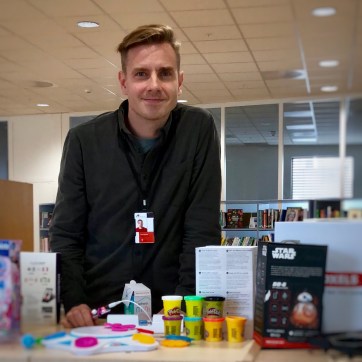 Today I’m joined by Norway’s Martin Kristoffer Bråthen. Martin is head of innovation and product development at Biblioteksentralen, the cooperative business which supplies libraries across Norway with collection materials, equipment and services.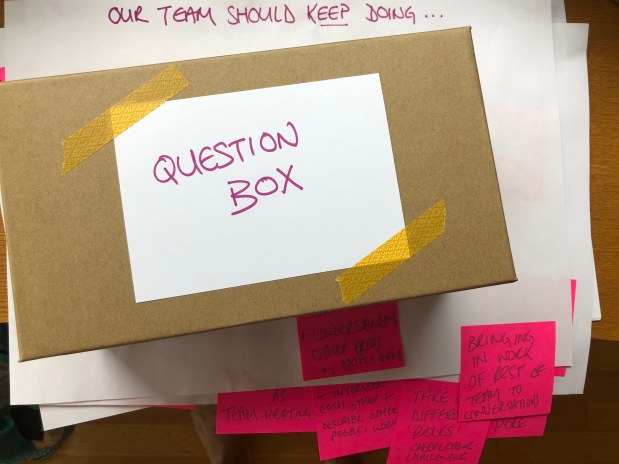


 matt finch / mechanical dolphin
