Reimagining the future of urban-rural balance

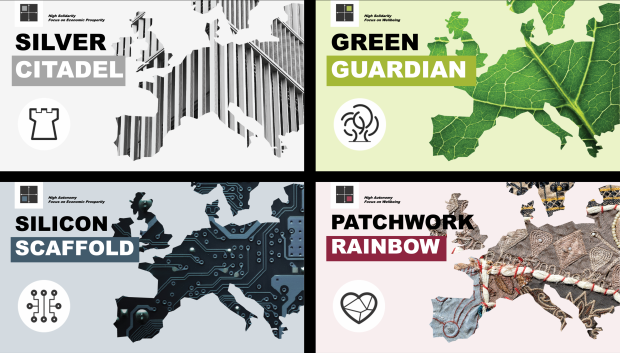
How will Europe’s urban-rural balance shift in years to come? In times of uncertainty, when tomorrow may not look like today, how can researchers and decision-makers best explore future relationships and dynamics between regions? In addition, how can such speculations be related back to pressing questions in the here and now?

In the new issue of the Regional Studies Association’s online magazine, IMAJINE‘s Marie Mahon and I share our experiences using scenario planning to explore the future of regional development in Europe, and answer the question: why are serious researchers spending time dreaming of futures which may never happen?

Read more in our article, “Reimagining the future of urban-rural balance: using scenarios to explore territorial inequality”.

Learning from futures you didn’t see coming? Scenario planning, education and the (post)pandemic world at CO:RE

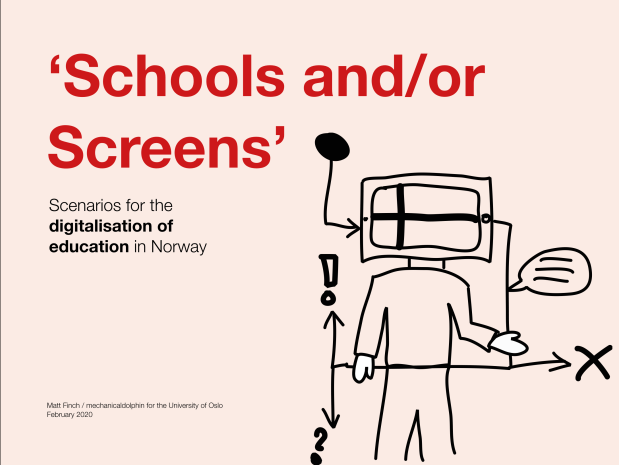
It was my privilege to join the University of Oslo’s Niamh Ní Broin and Steffen Krueger at the website of CO:RE, the Children Online: Research and Evidence project funded by the European Commission, to write about last year’s scenarios for the future of Norwegian schools.

These explored different contexts for the digitalisation of education in Norway, considering how the relationship between learners, digital devices, and educational institutions might shift in times to come.

You can read our piece, “Learning from futures you didn’t see coming? Scenario planning, education and the (post)pandemic world”, here.

Informatics of the Oppressed? Interview with Rodrigo Ochigame

For the latest edition of Information Professional magazine, I interviewed MIT’s Rodrigo Ochigame about researching and building alternative systems to search, index, and filter the information we want, need, or require.

From social media protests over Brazilian land rights disputes to liberation theology, information technology in socialist Cuba and contemporary attempts to produce “alternative metadata”, you can read about Rodrigo’s work in the latest edition of my column “Scripturient”, here.

Tales of the times to come: the humanities and scenario planning

“What do the humanities have to offer strategists, policymakers, and decision-takers in the age of the algorithm? As machine intelligence and computational power increase, as we gather ever more data from ever more sources, do the humanities still offer a valuable perspective on times yet to come?”

Over at the website of the Irish Humanities Alliance, Marie Mahon and I have a piece on what our training in the humanities has brought to our work on the IMAJINE project for the future of European regional inequality.

SHAPE Education: Schooling, Skills, and the Future of Work

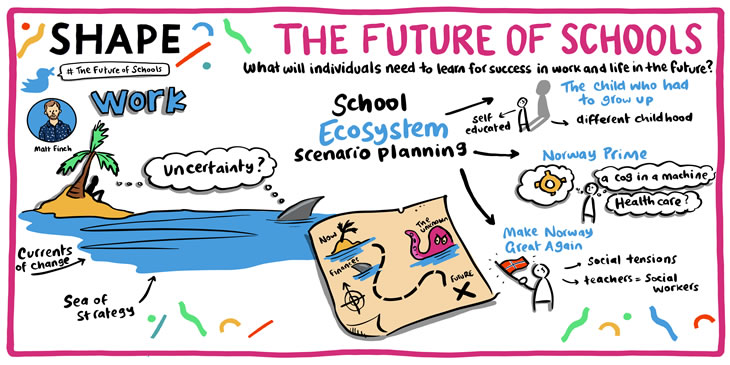
I’ll be speaking at the SHAPE Education 2021 conference on Wednesday 14th July, joining the panel “What will individuals need to learn for success in work and life in the future?” alongside Heather E. McGowan and Silvana Richardson.

We’ll be asking, what skills, knowledge and characteristics will employers need and be looking for in future? How will education systems help people develop these within and beyond schools? And will relationships between schools and employers change?

You can join our panel, and other sessions from the week-long SHAPE event, for free.

RCOT 2021: Scenarios, foresight, and occupational therapy

Next week, Griffith University’s Professor Matthew Molineux and I present on scenario planning for the 2021 conference of the Royal College of Occupational Therapists.

In advance of the conference, we got together for an informal chat covering five years of work pushing the boundaries of occupational therapy education, exploring what futures & foresight work can do for occupational therapists, and how learning from the futures which challenge our assumptions can complement the practical experience which comes from student placements.

“Why would you write it if you’ve already solved it?”: Interview with Chana Porter, Part 3

Playwright, novelist, and education activist Chana Porter joined me to talk about her new novel The Seep

In the book, Porter imagines an alien invasion of an unusual kind. The Seep find their way into the Earth’s ecosystem and cause every living being on the planet to become connected. “Capitalism falls, hierarchies and barriers are broken down; if something can be imagined, it is possible.”

You can read the first part and second part of our interview here, or check out the complete text now as a PDF download. In this instalment, Chana talks about loss, change, her goals as a writer, and the histories of secret writing in her own family.

M: The book is so steeped in grief, and it’s a theme we see elsewhere in your writing; the play Phantasmagoria has this question, for example, “Do the dead truly leave us?”

How did grief come to the forefront in this particular novel?

C: Don’t you think that ageing is a kind of grief? We betray our younger selves, our ideas of who we were or what we wanted, as we move on in time. I’ve lost some dear people who are close to me, people who died suddenly and young, so I have a little more of that shock of grief than some — but I think that in any kind of long-term relationship, what people don’t tell you about marriage is that there is a slow betrayal of whoever you were on your wedding day. I think that if there’s not, you’re doing it wrong! 

You need to become another person when you make this commitment, and you’re very lucky if you can change alongside your partner in a way that you get to rediscover one another. I don’t really know how we manage to promise anyone else anything, except to be clear, and true, and kind.

Read more

“Leap, and the net will appear”: Interview with Chana Porter, Part 2

Playwright, novelist, and education activist Chana Porter joined me to talk about her new novel The Seep

In the book, Porter imagines an alien invasion of an unusual kind. The Seep find their way into the Earth’s ecosystem and cause every living being on the planet to become connected. “Capitalism falls, hierarchies and barriers are broken down; if something can be imagined, it is possible.”

You can read the first part of our interview here, or check out the complete text now as a PDF download. In this instalment, Chana talks about her practice as a writer and its connection to her experience as a person who stutters, and reflects on questions of point-of-view, identity, and appropriation raised by The Seep.

M: I was reading about your play Leap and the Net Will Appear. You talk about the play coming to you after a silent retreat. I wondered about what the balance between writing-as-inspiration and writing-as-carpentry was for you?

Read more

“A wonderful way to tell yourself a story” – Interview with Chana Porter, Part 1

Playwright, novelist, and education activist Chana Porter joined me to talk about her new novel The Seep

In the book, Porter imagines an alien invasion of an unusual kind. The Seep find their way into the Earth’s ecosystem and cause every living being on the planet to become connected. “Capitalism falls, hierarchies and barriers are broken down; if something can be imagined, it is possible.”

Trina Goldberg-Oneka, a middle-aged trans woman, is the book’s protagonist. An artist who retrains as a doctor after the invasion, she cherishes “the casual overthrow of everything that had felt codified but broken for so long“ — until her partner Deeba decides to use the Seep’s power to be reborn as a baby, moving on to a new life. The book follows Trina along her spiral of grief as she begins a strange quest in a transformed world.

Our conversation touched not just on the novel, but also Porter’s plays and her work as an education activist. She is a founder of the Octavia Project which brings together young women and trans, gender non-conforming, or non-binary teens to create speculative fictions offering “new futures and greater possibilities for our world”, blending creative writing, art, science, and technology.

Part 1 of the interview is below, or you can read the whole thing right now as a PDF transcript.

I began by asking Chana about her first glimpse of the idea that became The Seep.

C: There’s a secret book that probably no-one will ever see, written from the point of view of a teenager in my hometown. 

I was really intrigued by this concept of an Invasion of the Body Snatchers style alien takeover, without it being a cut-and-dried thing of “This is good, this is bad.” This is also the feeling I have when I watch the 1978 Body Snatchers movie; it feels so brutal because we don’t really understand what these beings are feeling or what they care about, but the more that we understand as a scientific community about how trees communicate with each other, and protist communications, the more we question: what is alive? What is a life? What is social? What is a community?

When you use the lens of a horror film to reflect on these issues, when you consider the destruction we have wrought on the planet, it prompts you to ask: what if it’s not bad? 

Read more