COVID-19: Video Coaching & Facilitation

To help organisations, communities, and people working through the coronavirus pandemic, I’m going to be offering remote services, webinars, and videoconferenced sessions to support and coach you in dealing with key organisational issues.

Following previous successful long-distance engagements in Australia and the US, I’m offering clients the opportunity to address issues of strategy, foresight, and internal or external engagement remotely from my office in London.

This was something we were planning to roll out in May based on our successful pilot projects, but I’m announcing it early to help people, institutions, and communities who may find themselves increasingly working from home.

To find out more about working with me remotely, visit the Video Coaching & Facilitation page.

Future health: Oslo and the ‘a-ha’ moment

Our University of Oslo scenarios for the future of schools, out this week, surfaced health, and perceptions of health, as a battleground between parents and institutions in the education sector of 2050.

This was an “a-ha” moment for university researchers seeking new issues to explore around the digitalisation of education.

In scenario planning, we don’t aim to predict the future, but rather to generate plausible visions which can usefully inform present-day decision-making.

The future stories we create together are intended to highlight issues and drivers which exist in the present; the future scenario can then be set aside in order to focus on the issue at hand.

For the Oslo education researchers, a world in which parents and institutions warred over children’s health in a heavily-surveilled society – bickering with ‘the algorithm’ even over when to wipe your child’s nose – highlighted the extent to which their research should explore questions of health and wellbeing.

Today, in the Norwegian news, we see a parent-led Facebook group urging the city to close schools while the municipal authorities maintain that there is no reason yet to do so.

The campaigners argue that if businesses are sending staff home, then young children – who are less able to follow guidelines on infection control, like coughing into your elbow – should certainly go back to their families too.

Questions of distance learning, and education via screens and digital devices, may be sharpened by the current pandemic – even for the youngest children.

How will coronavirus affect the way we teach and learn, in the short and long term? Could it impact even the youngest children, irrespective of whether they contract the disease?

Good foresight work can help communities, institutions, and individuals navigate such turbulent and uncertain situations. You can read more about the Oslo education scenarios project here.

Strategy and Impact Workshops at State Library of New South Wales

Following a successful engagement last year at the State Library of New South Wales, I’ll be returning to Sydney with colleague Brendan Fitzgerald for two workshops in early May.

In our “Library Leaders Workshop Day” on May 4, Brendan & I will help senior library staff to explore a range of strategic tools and techniques. These will help teams think about changing wants and needs in their communities, building the capability to respond with creative local strategies.

Then, on May 5, we will explore ways of defining, measuring, and sharing the difference that public libraries make to their communities, in “Next-generation Measures and Metrics for Public Libraries“.

Join us for one or both of these sessions in May – we’re looking forward to seeing you.

Scenarios for the Australian Energy Sector: Futures of Heat, Light, and Power

The scenarios I created for Energy Consumers Australia’s 2020 Foresighting Forum, Futures of Heat, Light, and Power – are now publicly available.

In four visions of Australia in 2050, we presented future contexts that challenge current assumptions about how the energy sector works and where it’s headed, with a focus on the experience of the Australian consumer.

In each scenario, we join Josie and her daughter Hannah at their breakfast table, to explore how they live their lives – and how Josie’s role as an energy worker changes – from one future to the next.

You can download the full scenario report (PDF) via the Energy Consumers Australia site, or watch a series of videos based on the scenarios as a YouTube playlist.

Imperial College London’s Dr. Jeff Hardy led a panel discussion unpacking the implications of the scenarios at the Forum, which you can also see on YouTube.

At a critical moment in Australia’s energy future, these scenarios help us to think differently about the world which might await us thirty years from now, and explore both the challenges and opportunities which may exist.

See more from the Energy Consumers Australia 2020 Foresighting Forum at their site.

Webinar: Intro to Scenario Planning for Information Professionals

On 18th March, at 12.30pm Greenwich Mean Time, you can join me for a webinar organised by the UK’s Chartered Institute of Librarians and Information Professionals.

We’ll be talking about scenario planning and foresight techniques which participants can employ in their organisations:

How can we prepare for an uncertain future? What part does good foresight play in resilience, organisational effectiveness, and community cohesion? If we can’t gather evidence from events which haven’t happened yet, and we don’t have a crystal ball to foretell what comes next, how can we complement evidence-based practice with sound strategic judgement?

This lively participatory session will introduce you to scenario planning, a method which allows us to examine the future by exploring the contexts which would most challenge our current assumptions – then deciding how to act in the present, based on what we have discovered.

Participants will learn the fundamentals of scenario planning and experiment with practical foresight tasks which can be immediately used after the session, across teams and organisations both large and small.

Find out more and book your place at the event’s homepage.

Scenario Planning: Interview with Stefan Hajkowicz

Stefan Hajkowicz is a principal scientist in strategic foresight at the Australian science organisation CSIRO, leading its Data61 foresight team. I interviewed Stefan for my recent piece on scenario planning in Australia’s magazine for civil servants, The Mandarin – and the full interview is included here.

Stefan Hajkowicz standing outdoors, facing the camera
Stefan Hajkowicz of Data61

I began by asking Stefan: What should readers know about Data 61?

We take data driven approaches to strategic foresight, using AI and machine intelligence to analyse data and turn it into stories that help you to make choices.

On an issue like climate change, for example, the science might be well and truly settled, but the social and cultural aspects of our response to the issue are still uncertain – and depending on these choices, we’ll come to inhabit very different futures. Scenarios help us to think through these outcomes.

Both reason and intuition have a part to play, and the best decisions combine both – though no model is 100% perfect. History is our dataset for the future. Although, to quote Mark Twain, history doesn’t repeat itself, it does rhyme. If we can gain the ability to look ahead twenty years, and bring the future forward to now, we can make better informed choices.


Read more

IMAJINE: Scenario Planning for Europe’s Regional Future

Since last year, I’ve been working as a foresight consultant on the IMAJINE project, a Horizon 2020 project exploring the future of regional equality and territorial cohesion across the European Union.

To help people understand how IMAJINE is using scenario planning to explore Europe’s future, Marie Mahon of NUI Galway and I have recorded a five-minute video introducing the scenario planning component of IMAJINE.

You can watch the video below or read more at the IMAJINE project website.

Scenarios of Heat, Light, and Power @ Energy Consumers Australia Foresighting Forum 2020

This week sees the 2020 Foresighting Forum hosted by Energy Consumers Australia (ECA).

The event brings together stakeholders from across the Australian energy sector, plus international guests, to talk about what lies in store for Australians and their future relationship to energy.

As part of this year’s forum, I’ve worked with ECA to create four scenarios set in the year 2050. Each offers a radically different vision of the Australian relationship to heat, light, and power, intended to enrich current assumptions and strategies by indicating new opportunities and unexpected challenges which may await.

The event takes place on 19 and 20 February at the University of Technology Sydney, and I’ll be contributing video presentations for attendees – but you can also follow along on social media via the hashtag #TakeCharge20.

The scenario documents and materials will be released publically following the event on ECA’s website – stay tuned for more information.

Risk literacy and futures literacy: New column

The first instalment of “Scripturient”, my new quarterly column for Information Professional magazine, is out now.

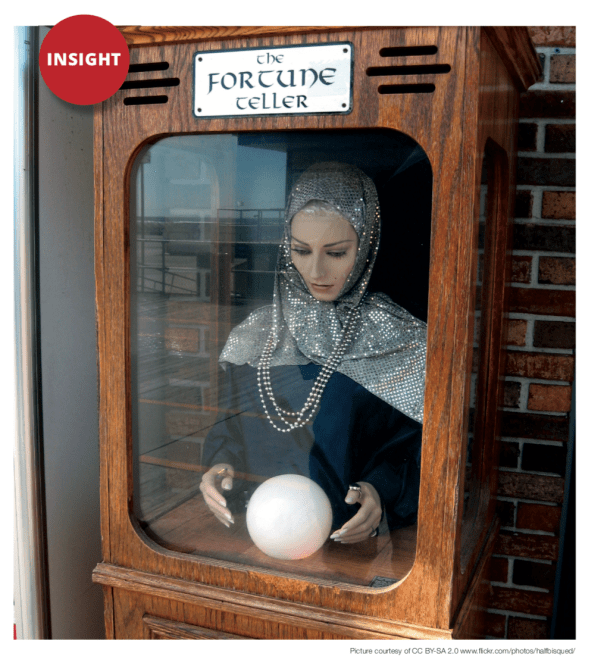
Picture of a mechanical fortune teller from CILIP's Information Professional Magazine, captioned with the word "insight"
Picture licensed CC BY-SA 2.0 from Flickr user halfbisqued

In this series, I’ll be looking at how we can push the boundaries of literacy in the 21st century, to encompass new areas of representation. What does it mean to read the future? To read risks? To read the forces that underpin our relationships and drive us psychologically? To read the signs and signals which exist in the natural world?

Join me, over four instalments in 2020, to explore some of these questions in the pages of Information Professional.

You can read the first column, which covers futures literacy and risk literacy, in this PDF download, or in the text below. Read more