Webinar: Intro to Scenario Planning for Information Professionals

On 18th March, at 12.30pm Greenwich Mean Time, you can join me for a webinar organised by the UK’s Chartered Institute of Librarians and Information Professionals.

We’ll be talking about scenario planning and foresight techniques which participants can employ in their organisations:

How can we prepare for an uncertain future? What part does good foresight play in resilience, organisational effectiveness, and community cohesion? If we can’t gather evidence from events which haven’t happened yet, and we don’t have a crystal ball to foretell what comes next, how can we complement evidence-based practice with sound strategic judgement?

This lively participatory session will introduce you to scenario planning, a method which allows us to examine the future by exploring the contexts which would most challenge our current assumptions – then deciding how to act in the present, based on what we have discovered.

Participants will learn the fundamentals of scenario planning and experiment with practical foresight tasks which can be immediately used after the session, across teams and organisations both large and small.

Find out more and book your place at the event’s homepage.

Scenario Planning: Interview with Stefan Hajkowicz

Stefan Hajkowicz is a principal scientist in strategic foresight at the Australian science organisation CSIRO, leading its Data61 foresight team. I interviewed Stefan for my recent piece on scenario planning in Australia’s magazine for civil servants, The Mandarin – and the full interview is included here.

Stefan Hajkowicz standing outdoors, facing the camera
Stefan Hajkowicz of Data61

I began by asking Stefan: What should readers know about Data 61?

We take data driven approaches to strategic foresight, using AI and machine intelligence to analyse data and turn it into stories that help you to make choices.

On an issue like climate change, for example, the science might be well and truly settled, but the social and cultural aspects of our response to the issue are still uncertain – and depending on these choices, we’ll come to inhabit very different futures. Scenarios help us to think through these outcomes.

Both reason and intuition have a part to play, and the best decisions combine both – though no model is 100% perfect. History is our dataset for the future. Although, to quote Mark Twain, history doesn’t repeat itself, it does rhyme. If we can gain the ability to look ahead twenty years, and bring the future forward to now, we can make better informed choices.


Read more

IMAJINE: Scenario Planning for Europe’s Regional Future

Since last year, I’ve been working as a foresight consultant on the IMAJINE project, a Horizon 2020 project exploring the future of regional equality and territorial cohesion across the European Union.

To help people understand how IMAJINE is using scenario planning to explore Europe’s future, Marie Mahon of NUI Galway and I have recorded a five-minute video introducing the scenario planning component of IMAJINE.

You can watch the video below or read more at the IMAJINE project website.

Scenarios of Heat, Light, and Power @ Energy Consumers Australia Foresighting Forum 2020

This week sees the 2020 Foresighting Forum hosted by Energy Consumers Australia (ECA).

The event brings together stakeholders from across the Australian energy sector, plus international guests, to talk about what lies in store for Australians and their future relationship to energy.

As part of this year’s forum, I’ve worked with ECA to create four scenarios set in the year 2050. Each offers a radically different vision of the Australian relationship to heat, light, and power, intended to enrich current assumptions and strategies by indicating new opportunities and unexpected challenges which may await.

The event takes place on 19 and 20 February at the University of Technology Sydney, and I’ll be contributing video presentations for attendees – but you can also follow along on social media via the hashtag #TakeCharge20.

The scenario documents and materials will be released publically following the event on ECA’s website – stay tuned for more information.

Risk literacy and futures literacy: New column

The first instalment of “Scripturient”, my new quarterly column for Information Professional magazine, is out now.

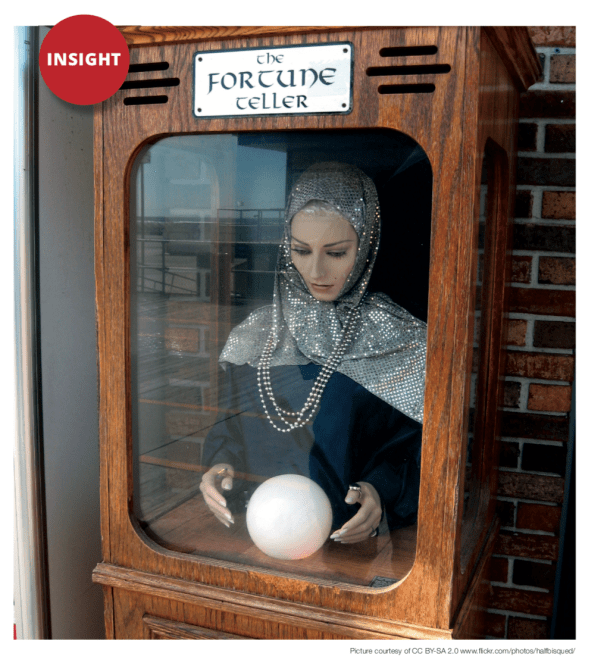
Picture of a mechanical fortune teller from CILIP's Information Professional Magazine, captioned with the word "insight"
Picture licensed CC BY-SA 2.0 from Flickr user halfbisqued

In this series, I’ll be looking at how we can push the boundaries of literacy in the 21st century, to encompass new areas of representation. What does it mean to read the future? To read risks? To read the forces that underpin our relationships and drive us psychologically? To read the signs and signals which exist in the natural world?

Join me, over four instalments in 2020, to explore some of these questions in the pages of Information Professional.

You can read the first column, which covers futures literacy and risk literacy, in this PDF download, or in the text below. Read more

2020 Foresighting Forum, Energy Consumers Australia

I’ll be appearing via video at next month’s 2020 Foresighting Forum hosted by Energy Consumers Australia, the national voice for residential and small business energy consumers in Australia.

The Forum brings together stakeholders from across Australia’s energy sector to explore long-term questions of heat, light, and power.

I’ll be presenting a group of scenarios, created with representatives of the Australian energy sector in 2019, which could help reframe curent perspectives on Australia’s energy future and the strategic decisions which must be made in the present.


The Mandarin: Scenario Planning for the Public Sector

My latest article has just been published in The Mandarin, Australia’s publication for public sector leaders.

File:Parliament House Canberra NS.jpg
Australia’s Federal Parliament house, by Wikipedia user JJ Harrison – (CC BY-SA 3.0)

We can’t predict the future, but scenario planning can identify what it might look like” explores the practice of scenario planning, including interviews with practitioners and clients from the OECD, Australia’s science organisation CSIRO, and leadership roles in government and policy bodies.

Visit the Mandarin website to read the article today.

Dots that I haven’t joined yet

I’m momentarily at rest in my beloved Brisbane, with the sun blazing down in December and bushfires on the news and Leila Taylor’s book Darkly to read.

IMG_8560.jpg

Taylor’s book, subtitled Black History and America’s Gothic Soul, blends memoir and criticism to explore the places where African-American history, culture, and experience meet the Gothic – from The Castle of Otranto through Edgar Allan Poe to Marilyn Manson.

I’m back in Australia helping organisations to look at their future and imagine what might await them in years to come, using scenario planning. This is a method by which, instead of trying to predict what’s coming, we co-create plausible visions of the future which challenge our current assumptions. Successful scenarios are not judged by whether they come to pass, but whether they trouble, complicate, and enrich our thinking.

And the dots which I can’t quite join yet became visible when I read this, in Darkly: “Gothic narratives were (and still are) a means of working through the discomfort of a changing world through the safety of fiction.”

Which is so close to what scenarios do as to blur the edges of the two concepts. In scenario planning we talk about avoiding the “brutal audit” of a crisis by rehearsing for the things you can’t, or don’t want to, see coming through your current framing of the world.

Read more

IMAJINE pilot workshops: the future of spatial justice

Our IMAJINE team working on scenario planning for the future of regional inequality and territorial cohesion in the European Union has held its first pilot workshops on the West Coast of Ireland.

Researchers and regional officials joined NUI Galway’s Marie Mahon and myself at the Teagasc Rural Economy Research Centre in Athenry. There, we trialled fast, practical foresight tools allowing participants to sketch roadmaps of the futures which may await them.

The Oxford Scenario Planning Approach, which we’re using to structure these sessions, allows us to identify and develop plausible scenarios which serve to test assumptions and reframe the way participants look at the future. By imagining the most difficult or surprising circumstances a community might face, we seek to develop a playbook of strategies for emergent issues in territorial inequality and spatial justice.

The IMAJINE project continues through 2021 and incorporates Europe-wide foresight alongside deeply local engagement with policymakers and other stakeholders. Stay tuned for more updates.

The Digitalisation of Education: Foresight Work at the University of Oslo

On 28 October, the University of Oslo Media & Communications Department brought together researchers, educators, publishers, and representatives of the tech sector & not-for-profits to begin the work of building scenarios that test assumptions about the future of education in Norway.

This slideshow requires JavaScript.

I facilitated an iterative process generating three visions of Norwegian society in years to come, exploring social, technological, cultural and economic change – always seeking to capture factors and possibilities which lay beyond the current framing of Norway’s educational future.

This workshop was only the beginning of an ambitious future-facing research programme at the Media & Communications Department, but I hope to be able to share materials with you in due course.