“Que sera, sera?” — anticipating change in a time of uncertainty

For the “One Thing” library thought leadership series convened by my colleague Brendan Fitzgerald, I wrote a piece on how libraries & information institutions can use scenario planning to address conditions that are turbulent, ambiguous, novel, or unpredictably uncertain.

Albert Bierstadt, A Storm in the Rocky Mountains, Mt. Rosalie

“Libraries are an institution with a long and storied global history, but their context is transforming too. Our societies’ relationships to fundamental notions of information and trust are subject to change. The social, economic, and political orders within which libraries have survived or thrived are not set in stone.

Library leaders seeking to make sound judgments need to be able to anticipate futures beyond those currently expected or predicted. By stretching our sense of what awaits, we can gain insights from the future before it arrives – rather than having to “learn the hard way” from the brutal audit of real crises and changes.”

Read more from my piece here.

Sustainability, Scenarios, and Spatial Justice: IMAJINE at Resilience.org

Over at Resilience.org, the blog of the Post-Carbon Institute, Marie Mahon of the National University of Ireland Galway, David Robertson of Monash Sustainable Development Institute, and I discuss the sustainability implications of the IMAJINE scenarios for the future of European regional inequality.

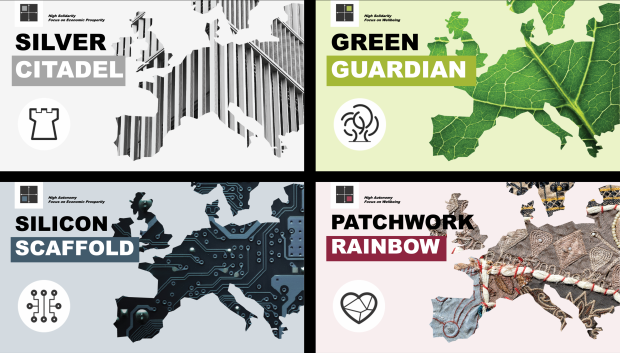
I especially valued David’s comments on the Metaverse-like SILICON SCAFFOLD scenario, where “Near-infinite virtual geographies undermine the notion of ‘limits’ or ‘planetary boundaries’[…and t]he resources we use as we navigate digital worlds are hidden from us.” Will notions of sustainability be fundamentally recast and reframed by the generations which succeed us? How will future circumstances cause those frames and the values which define them to change?

The mission of Resilience is to “envision a world of resilient communities and re-localized economies that thrive within ecological bounds.”

Read more about IMAJINE’s contribution to that discussion here.

New strategic plan for Reading Public Library, Pennsylvania

The new strategic plan for Reading Public Library, Pennsylvania has just been published.

I supported the Reading team through the early months of this year to devise a set of scenarios for the library’s future operating context, and use these scenarios to inform a new strategy. You can read about the process in my paper for the New Librarianship Symposium, “Mapping the Future: Scenario Planning for the Post-Pandemic Library“.

Reading is a fascinating library service which has a proud tradition of negotiating complex strategic circumstances; there’s a reason why the 1971 chronicle of its existence is called The Library That Would Not Die: The Turbulent History of the Reading Public Library. The challenges of COVID-19 and Pennsylvania’s hotly contested politics were only the latest to be faced in its 250-year history. It was my privilege to support the current team in planning for the next four years.

Reading Public Library’s Executive Director, Bronwen Gamble, writes:

“Creating a new strategic plan for RPL was overdue. Our 2013-2018 plan was modified for two years but the process for creating a new one met several obstacles. Enter the COVID-19 pandemic and virtual meetings. I attended the Pennsylvania Bureau of Library Development’s series of workshops facilitated by Matt Finch and was introduced to his Scenario & Foresight Planning process. Our Board of Trustees and library staff feel very fortunate we were able to engage Matt to lead us through our own library’s scenario and foresight planning with Matt in London and the library team in Reading, PA.

Using a mural app, and Zoom sessions, Matt facilitated our conversations around the collaborations, services, and transactions, which shape our work at every level. Matt acted as a guide, making suggestions and providing alternatives rather than telling us what to do or how to proceed. Our team members were enthusiastic and active participants. Imagination was encouraged and everyone had buy-in. Matt’s scenario & foresight planning process is much different than the usual SWOT analysis, and number crunching. We had fun and lively sessions!

Looking back, I believe it is a good thing our old strategic plan was allowed to languish.  The changes brought about by the pandemic would have made a strategic plan created in 2019 obsolete in 2020.  Our team has ownership of the Reading Public Library’s Scenario & Foresight Planning to Strategic Plan 2021-2025. We looked into the future, found three plausible outcomes, and crafted a plan that works for today and is flexible to accommodate whatever happens in the next five years. Thank you, Matt, for giving us the tools to move forward with confidence!”

New Librarianship Symposium: Scenarios for the COVID-affected world?

On November 18th, I’ll be joining the fourth of the New Librarianship Symposia convened by leading information professionals to explore key issues and new agendas for the COVID-affected world.

The symposia mark ten years since the publication of R. David Lankes’ Atlas of New Librarianship, and offer an opportunity to reinvigorate institutions’ approach to the ever-changing information environment.

In the panel on “Re-imagining the future”, I’ll be presenting a paper on “Mapping the future: scenario planning for the post-pandemic library” (PDF download), drawing on a case study of public library planning in the context of the coronavirus pandemic and America’s widening political rifts.

The paper explores both the use of scenarios, and the benefits of attending to value co-creation, in devising library strategy.

My contribution will be in dialogue with thought provoking papers from Seattle Pacific University’s Michael Paulus and a team at the OCLC library cooperative. We’ll consider what might await for information institutions and the communities they serve; how best to move forward in times characterised by turbulence, uncertainty, novelty, and ambiguity; and what it means to practice strategy at different levels, from the global to the deeply local.

Do join us for the fourth of the New Librarianship Symposia on November 18th, 2021.

Circulating Ideas: Scenario Planning With Reading Public Library

Bronwen Gamble, Executive Director of Pennsylvania’s Reading Public Library, appeared with me on the American library podcast Circulating Ideas to share our experiences of scenario planning during a pandemic.

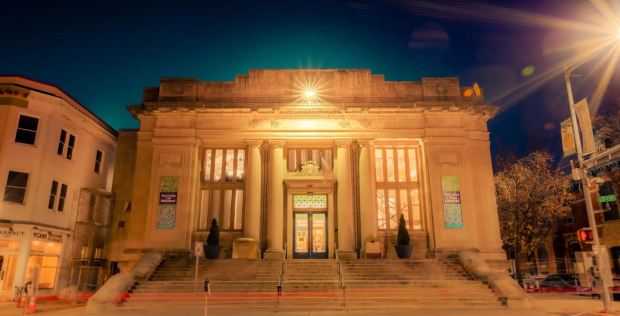
Reading Public Library, PA – Image Courtesy of Berks County Public Libraries

You can listen to the show, or check out a transcript, over at the Circulating Ideas website.

Reimagining the future of urban-rural balance

How will Europe’s urban-rural balance shift in years to come? In times of uncertainty, when tomorrow may not look like today, how can researchers and decision-makers best explore future relationships and dynamics between regions? In addition, how can such speculations be related back to pressing questions in the here and now?

In the new issue of the Regional Studies Association’s online magazine, IMAJINE‘s Marie Mahon and I share our experiences using scenario planning to explore the future of regional development in Europe, and answer the question: why are serious researchers spending time dreaming of futures which may never happen?

Read more in our article, “Reimagining the future of urban-rural balance: using scenarios to explore territorial inequality”.

Learning from futures you didn’t see coming? Scenario planning, education and the (post)pandemic world at CO:RE

It was my privilege to join the University of Oslo’s Niamh Ní Broin and Steffen Krueger at the website of CO:RE, the Children Online: Research and Evidence project funded by the European Commission, to write about last year’s scenarios for the future of Norwegian schools.

These explored different contexts for the digitalisation of education in Norway, considering how the relationship between learners, digital devices, and educational institutions might shift in times to come.

You can read our piece, “Learning from futures you didn’t see coming? Scenario planning, education and the (post)pandemic world”, here.

Tales of the times to come: the humanities and scenario planning

“What do the humanities have to offer strategists, policymakers, and decision-takers in the age of the algorithm? As machine intelligence and computational power increase, as we gather ever more data from ever more sources, do the humanities still offer a valuable perspective on times yet to come?”

Over at the website of the Irish Humanities Alliance, Marie Mahon and I have a piece on what our training in the humanities has brought to our work on the IMAJINE project for the future of European regional inequality.

Thinking with your non-dominant hand: ambidexterity and foresight

I wouldn’t say I have the best handwriting. It’s a bit of an unpretty scrawl, though people can mostly decipher it. I use my left hand to hold a pencil or pen, though I do everything else with my right; I can’t use left-handed scissors or can openers, and whenever it was I last played cricket or tennis, my right hand was dominant. I’m probably a natural righty who picked up the left-hand habit from copying a left-handed parent, back in those days when they first get you to clutch a crayon and make your mark.

M.C. Escher, Drawing Hands

This week, I was helping a group of people learn to use scenario planning. There are a lot of ways to define what a scenario is, but in the Oxford Scenario Planning Approach, scenarios are assessments of the future context, developed for a particular user and purpose, to contrast with the way that the future context is currently being framed. People engaged in scenario planning devise plausible futures in order to test assumptions, challenge existing framings, and enrich decision-making in the present.

Stretching your sense of the futures you may have to inhabit can feel like “thinking with your non-dominant hand”. We’re so used to trying to solve the problem in front of us, “get on with the job”, fix things, make them better, chart a course, steer the ship. The act of strategic reframing – creating plausible futures to stretch our understanding of a given context – can feel seriously counterintuitive.

Even clasping your hands or crossing your legs the opposite way round to usual can feel odd; using your non-dominant hand when playing sports, using scissors, or writing could feel even more so. So it’s not a surprise that scenario planning might feel strange when you first try it.

Yet releasing yourself from a dominant or habitual approach can bring all kinds of benefits. You may be forced to rethink processes from first principles, returning you to “beginner’s mind” and unpicking tightly woven assumptions. You may find that your engrained habits of thinking are patterns of comfort and convention, rather than the best way to address an issue. You may see things from a different angle when approaching from the left instead of the right, or vice versa.

In successful scenario planning engagements, people often feel a sudden moment of realisation – what the pioneering scenario planner Pierre Wack called an “a-ha” moment. “It does not simply leap at you,” Wack wrote in a 1985 issue of the Harvard Business Review. “It happens when your message reaches the microcosms of decision makers, obliges them to question their assumptions…and leads them to change and reorganise their inner models of reality.”

Once people have experienced this benefit of thinking from the “outside in” – starting with future contexts, then working back to an assessment of options and strategic possibilities, often in an iterative process which is enriched by multiple repetitions – they see the merits in going against the grain of habit.

The more they employ this approach, the better their “muscle memory” for scenario work. (A right-hander who tries playing the guitar left-handed just once might not get very far, but continued practice could yield competence and even virtuosity). Gradually it becomes possible to integrate “left-handed” and “right-handed” thinking into processes of assessment and decision-making, so that our perceptions, our judgment, and our capacity to act are enriched.

And in times of turbulence and uncertainty, when tomorrow will not be like yesterday or today, that could make all the difference.