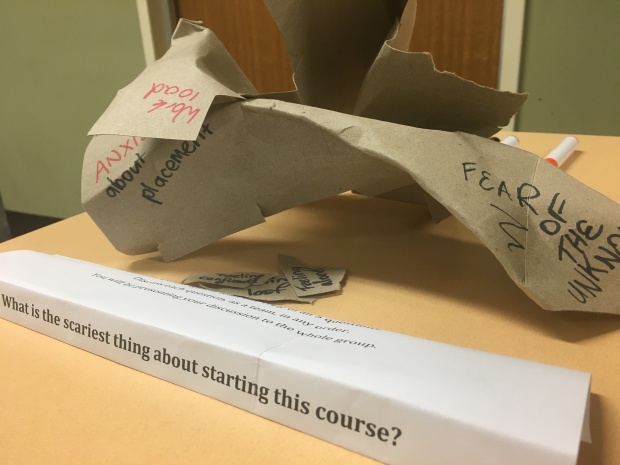
Who must we become to think the unthinkable?

Sometimes, there’s a thought out there, but we’re not yet the person who is able to think it.

Something comes to us as a glimmer or a hunch, an inkling, a vague intuition that we may or may not choose to pursue – or be capable of currently pursuing.

Let’s call such thoughts “unthunk”: it’s a satisfying sound.

Read more

Blink and You’ll Miss It: Surveillance, Society, Foresight, AI

“How can we use events which haven’t happened yet to help us understand surveillance and society?”

Over at the blog Blink on Medium, I have a short piece with colleagues Carissa Véliz, Malka Older, and Annina Lux, reflecting on how to think critically about automation and surveillance in a season “swarming with futures”.

The post ties in to our recent article for Surveillance & Society, “The Art of Strategic Conversation: Surveillance, AI, and the IMAJINE Scenarios“.

UNESCO Prospects Journal: Scenarios and the future of education

The question for teachers, learners, and the various organizations and communities in which they participate becomes “How will we adapt, evolve, and thrive even if uncertainties play out in ways for which we had not initially prepared?”

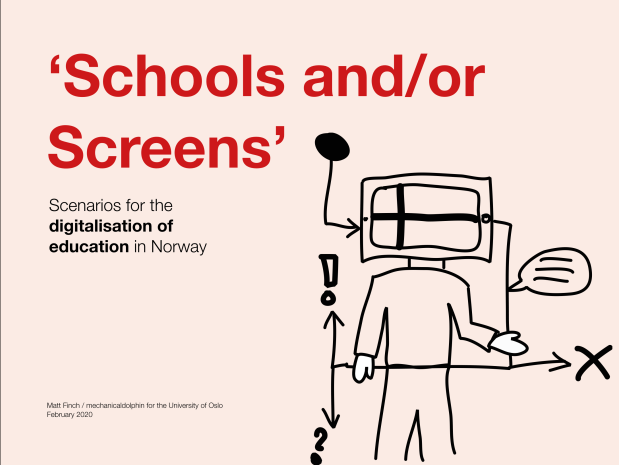
In the UNESCO International Bureau of Education’s journal Prospects, the University of Oslo’s Steffen Krüger, the University of Agder’s Niamh Ní Bhroin, and I discuss the “Schools and/or screens” scenario project for the digitalisation of education in Norway.

UNESCO Headquarters sign. (C) Matt Finch, 2023

We show how challenging issues raised in the context of distant imagined futures proved to be immediately pertinent in the developing Covid-19 pandemic, and, as a wide range of actors explore the possibility of a new social contract for education, we reflect on how future scenarios can provide fresh perspectives on issues that are difficult or even impossible to resolve within current frames of reference, including questions of equity and justice that may be construed differently in times to come.

Read “Unlearning, relearning, staying with the trouble: Scenarios and the future of education” at Prospects online.

ISF Threat Horizon Podcast: Exploring Cybersecurity Scenarios

On the latest episode of the Information Security Form (ISF) podcast, I speak with ISF’s Max Brook and Mark Ward about using scenarios to help security practitioners see beyond present problems: exploring uncertainty, attending to blind spots, and strategizing more effectively under conditions of uncertainty.

“An app is not going to solve our democracy; it’s something we have to solve ourselves.”

In the new issue of the journal Surveillance & Society, Oxford’s Carissa Véliz, sci-fi writer and aid worker Malka Older, and Capgemini Invent’s Annina Lux join me to talk about how future scenarios can inform discussion, debate, and decision-making about the relationship between artificial intelligence and surveillance.

Read “The Art of Strategic Conversation: Surveillance, AI, and the IMAJINE Scenarios” here.

Scripturient: AI and the future of intellectual property

The latest edition of Scripturient, my column for Information Professional magazine, features Alex Roberts of IP Australia, the government body responsible for administering intellectual property (IP) law in Australia.

As director of the agency’s IPAVentures unit, Alex leads a team dedicated to exploring what might be needed for the IP rights system of the future. They use foresight and innovation tools to consider how we regulate “creations of the mind”: everything from literary and artistic works to trademarks, brand names, and protected product designs.

Recently, IPAventures developed a set of scenarios exploring the impact of generative AI on intellectual property – ranging from ever more lengthy and elaborate patent specifications to accelerated ideations by inventors and even changes to the regulation of plant breeding.

You can read more about the scenarios, and IPAVentures’ work, in our interview from the latest issue of Information Professional magazine.

Human-Land Podcast: Spatial Justice and Realms of Citizenship

I joined the Swedish University of Agricultural Sciences’ Human-Land podcast to talk about social justice and foresight in spatial planning, and their links to environmental psychology.

As environmental psychologists explore the relationship between human beings and their environments – including how humans shape those environments and are shaped by them in turn – foresight work allows us to explore how that relationship might change in times to come, and how our ideas of what is fair or just in terms of access to different environments might also evolve.

Host Hannah Arnett and I spoke about the IMAJINE scenarios project and the possiblity of an approach to questions of space and justice that brings together a range of disciplines and perspectives on the common ground of the unwritten future.

You can listen to the episode now on Spotify and Soundcloud.

The Conversation: How activity in outer space will affect regional inequalities in the future

My latest piece in The Conversation explains how the IMAJINE scenarios used plausible futures to explore the relationship between European regional inequalities and activity in outer space.

You can read “How activity in outer space will affect regional inequalities in the future” here.

Photo by Pixabay on Pexels.com