On November 18th, I’ll be joining the fourth of the New Librarianship Symposia convened by leading information professionals to explore key issues and new agendas for the COVID-affected world.
The symposia mark ten years since the publication of R. David Lankes’ Atlas of New Librarianship, and offer an opportunity to reinvigorate institutions’ approach to the ever-changing information environment.
The paper explores both the use of scenarios, and the benefits of attending to value co-creation, in devising library strategy.
My contribution will be in dialogue with thought provoking papers from Seattle Pacific University’s Michael Paulus and a team at the OCLC library cooperative. We’ll consider what might await for information institutions and the communities they serve; how best to move forward in times characterised by turbulence, uncertainty, novelty, and ambiguity; and what it means to practice strategy at different levels, from the global to the deeply local.
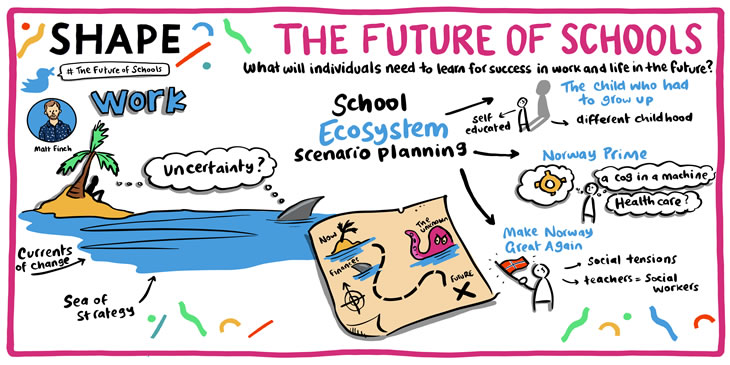
I spoke on the future of work and its implications for education with a panel including Bell Education’s Silvana Richardson, Cambridge University Press’ own Ben Knight, and Heather E. McGowan, author of The Adaptation Advantage.
We were also supported by live drawings from the brilliant Rebecca Osborne.
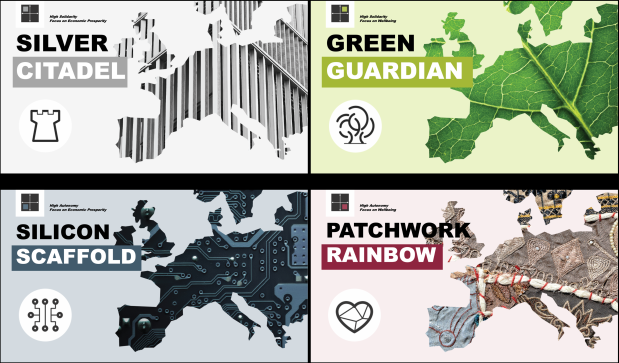
The four scenarios produced by the Horizon 2020 IMAJINE project to explore the future of European regional inequality have now been published.
The scenarios explore questions of territorial equality – Do EU citizens have equal rights and opportunities regardless of wherever they live? – and spatial justice – Are different places treated fairly? Is your ability to realise your rights compromised by where you live?
Questions of justice are defined socially and narratively – even when a court says it is considering “the balance of probabilities”, it adjudicates between competing stories told by the parties arguing a case. That means we can’t just run the numbers when it comes to the future of inequality, but must explore how notions of fairness and justice might change in times to come – and what those changing notions might tell us about issues in the present.
As Ursula K. Le Guin put it in the quote we chose for IMAJINE’s epigraph, “We will not know our own injustice if we cannot imagine justice. We will not be free if we do not imagine freedom.”
Each vision of Europe in 2048 offers a different perspective on these issues as they are emerging in the present, and offers an opportunity to reframe the discussion around regional development and inequality. The scenario set includes respondents from a wide range of sectors and institutions around the world, offering further insight into the implications of each scenario.
How will Europe’s urban-rural balance shift in years to come? In times of uncertainty, when tomorrow may not look like today, how can researchers and decision-makers best explore future relationships and dynamics between regions? In addition, how can such speculations be related back to pressing questions in the here and now?
In the new issue of the Regional Studies Association’s online magazine, IMAJINE‘s Marie Mahon and I share our experiences using scenario planning to explore the future of regional development in Europe, and answer the question: why are serious researchers spending time dreaming of futures which may never happen?
It was my privilege to join the University of Oslo’s Niamh Ní Broin and Steffen Krueger at the website of CO:RE, the Children Online: Research and Evidence project funded by the European Commission, to write about last year’s scenarios for the future of Norwegian schools.
These explored different contexts for the digitalisation of education in Norway, considering how the relationship between learners, digital devices, and educational institutions might shift in times to come.
“What do the humanities have to offer strategists, policymakers, and decision-takers in the age of the algorithm? As machine intelligence and computational power increase, as we gather ever more data from ever more sources, do the humanities still offer a valuable perspective on times yet to come?”
In advance of the conference, we got together for an informal chat covering five years of work pushing the boundaries of occupational therapy education, exploring what futures & foresight work can do for occupational therapists, and how learning from the futures which challenge our assumptions can complement the practical experience which comes from student placements.
I wouldn’t say I have the best handwriting. It’s a bit of an unpretty scrawl, though people can mostly decipher it. I use my left hand to hold a pencil or pen, though I do everything else with my right; I can’t use left-handed scissors or can openers, and whenever it was I last played cricket or tennis, my right hand was dominant. I’m probably a natural righty who picked up the left-hand habit from copying a left-handed parent, back in those days when they first get you to clutch a crayon and make your mark.
M.C. Escher, Drawing Hands
This week, I was helping a group of people learn to use scenario planning. There are a lot of ways to define what a scenario is, but in the Oxford Scenario Planning Approach, scenarios are assessments of the future context, developed for a particular user and purpose, to contrast with the way that the future context is currently being framed. People engaged in scenario planning devise plausible futures in order to test assumptions, challenge existing framings, and enrich decision-making in the present.
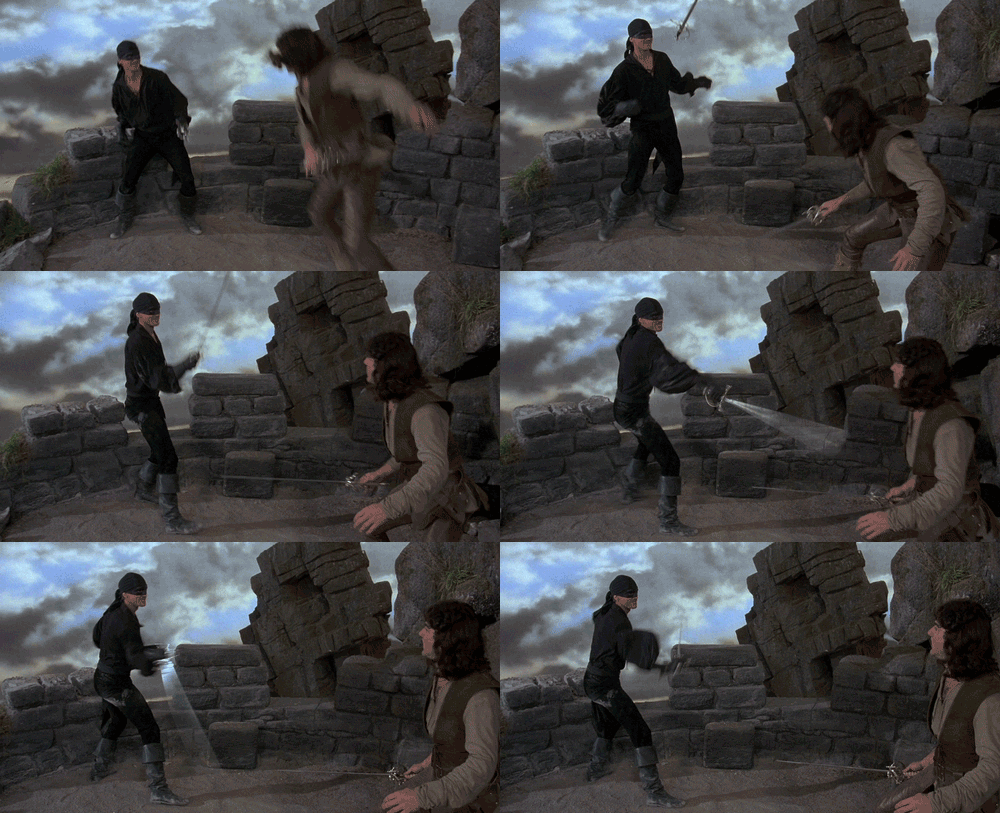
Stretching your sense of the futures you may have to inhabit can feel like “thinking with your non-dominant hand”. We’re so used to trying to solve the problem in front of us, “get on with the job”, fix things, make them better, chart a course, steer the ship. The act of strategic reframing – creating plausible futures to stretch our understanding of a given context – can feel seriously counterintuitive.
Even clasping your hands or crossing your legs the opposite way round to usual can feel odd; using your non-dominant hand when playing sports, using scissors, or writing could feel even more so. So it’s not a surprise that scenario planning might feel strange when you first try it.
Yet releasing yourself from a dominant or habitual approach can bring all kinds of benefits. You may be forced to rethink processes from first principles, returning you to “beginner’s mind” and unpicking tightly woven assumptions. You may find that your engrained habits of thinking are patterns of comfort and convention, rather than the best way to address an issue. You may see things from a different angle when approaching from the left instead of the right, or vice versa.
In successful scenario planning engagements, people often feel a sudden moment of realisation – what the pioneering scenario planner Pierre Wack called an “a-ha” moment. “It does not simply leap at you,” Wack wrote in a 1985 issue of the Harvard Business Review. “It happens when your message reaches the microcosms of decision makers, obliges them to question their assumptions…and leads them to change and reorganise their inner models of reality.”
Once people have experienced this benefit of thinking from the “outside in” – starting with future contexts, then working back to an assessment of options and strategic possibilities, often in an iterative process which is enriched by multiple repetitions – they see the merits in going against the grain of habit.
The more they employ this approach, the better their “muscle memory” for scenario work. (A right-hander who tries playing the guitar left-handed just once might not get very far, but continued practice could yield competence and even virtuosity). Gradually it becomes possible to integrate “left-handed” and “right-handed” thinking into processes of assessment and decision-making, so that our perceptions, our judgment, and our capacity to act are enriched.
And in times of turbulence and uncertainty, when tomorrow will not be like yesterday or today, that could make all the difference.




 matt finch / mechanical dolphin
