The earliest outputs from the IMAJINE scenario project, which explores the future of the Europe Union, have been released as “sketches”. These are rough drafts of the future contexts we’ll be exploring through the end of this year and into 2021.

The earliest outputs from the IMAJINE scenario project, which explores the future of the Europe Union, have been released as “sketches”. These are rough drafts of the future contexts we’ll be exploring through the end of this year and into 2021.

I’m not a big fan of the phrase “new normal”, but if there is one, then for me it involves a lot of Zoom calls, which means mostly seeing people’s heads and shoulders in a cropped little screen.
For my ELGL20 keynote to local government professionals, I grabbed a stepladder to try and find a different perspective, even in a world constrained by the limits of the laptop lens.
My ladder was a prop to remind people why we do foresight work. Sometimes, we think we know what the future holds and we take action in the present, just as confident as someone stepping onto the first rung of a ladder.
But that ladder comprises all the assumptions we are relying on about what the future holds, and what part we’ll play in it.
As Peter Scoblic and Philip Tetlock put it in an article for Foreign Affairs,
Every policy is a prediction. Tax cuts will boost the economy. Sanctions will slow Iran’s nuclear program. Travel bans will limit the spread of COVID-19. These claims all posit a causal relationship between means and ends. Regardless of party, ideology, or motive, no policymaker wants his or her recommended course of action to produce unanticipated consequences. This makes every policymaker a forecaster.
Scoblic & Tetlock, “A Better Crystal Ball”, Foreign Affairs
We might start climbing that ladder and then realise we need to step left, or right. We might find that the next rung is missing. We might have set off on our ascent quite happily, only to find that circumstances at the top have changed and it is really difficult for us to climb back down. We may even find we have to awkwardly perch half-way up the ladder (I ended up using mine as a chair while I spoke to the ELGL crowd).
Scenarios and other foresight techniques can help us examine the assumptions we are making about the future before we take that first step.
The ladder was also something of a gambit on my part. I hadn’t planned to include it as part of the keynote, but we were using a videoconferencing platform which made it difficult for the speaker to know how the audience were responding. Our host compared it to “speaking on a lit stage where you know the audience is out there, but it’s hard to see their faces”.
Around the halfway point of my session, I wasn’t confident that my message was getting across and I wanted to be sure to drive the point home. I dashed out of the study and fetched my stepladder from behind the kitchen door. Often the liveliest and most memorable parts of a workshop, or any human encounter, come when something doesn’t go according to plan. It’s important to remember that when events go astray, they can go better than we expected or intended, as well as worse – especially if we take advantage of the moment.
So that’s why I brought a ladder to a Zoom keynote. Even if you, too, are trapped by the boxes of the videoconference screen, what can you do to help yourself, and the people you speak with, find a fresh perspective on the futures which await?
How can we explore or shape the future of higher education when the times are so turbulent and uncertain?
The forthcoming “Digital Technology and the Post-Pandemic University” conference explores the new realities faced by higher education, and the part digital technology will play in those realities. I’ll be presenting a short paper on the use of scenario planning to explore future contexts for digitalised education.
You can read my paper – “Scenario Planning for Digitalised Education: Managing Uncertainties Through the Pandemic and Beyond” – at the Post-Pandemic University website. If you’d like to join us on Wednesday 21st October, 9am-6pm BST, you can register for the online conference here.

As part of the online Thinking Through Drawing 2020 symposium, October 16-18 2020, I’ll be presenting a 45-minute workshop “Cones, Grids, and Timelines”, exploring how future scenarios can be devised and represented visually. You can see a short video outline of the session below.
If you’d like to join me, and a vibrant community of researchers, artists, visual communicators, and educators, find out more at the TTD website.
Following our recent two-part discussion on this blog, you can hear Saskia Van Uffelen, Belgium’s Digital Champion, speaking with me on the OECD’s Government After Shock podcast in this week’s discussion.
During our interview, Saskia explores communication, leadership, and adaptation beyond crisis. If we pull on the “elastic” of our society and its institutions too far, it will break. Are we ready to fashion a new, more resilient world as the crises of 2020 demonstrate the old one’s limitations?
Saskia Van Uffelen is the Digital Champion for Belgium, tasked with promoting the benefits of digital society as part of the European Commission’s efforts to ensure every European citizen acquires the digital skills they need to remain productive, employable and enfranchised. After a career encompassing roles at Xerox, Compaq, HP, Arinso, Bull, and Ericsson, she is currently Corporate Vice President for the French group GFI, supervising developments in the Benelux countries. Saskia is also the author of Dare For Tomorrow: Leading, Working, Learning, and Living in a Digital World. You can read the first part of our interview here.
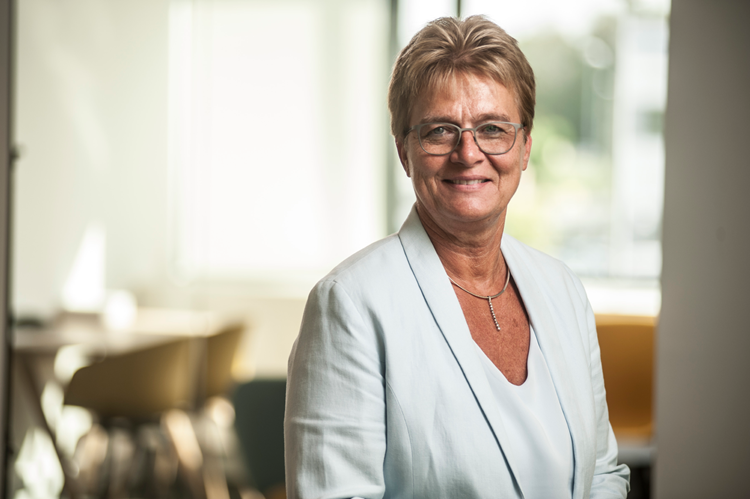
As Digital Champion, you have an interest in the future of the public library, an institution which is also very dear to my heart. The social changes you’re describing will have an impact on our civic information institutions, and the context they operate in.
You’ve said elsewhere that, “If anything has remained the same in your organisation (culture, processes, eco-systems), it will simply not work anymore. You need to adapt your company and your culture. Adapt or die.”
Are libraries too prone to thinking about what used to work, instead of looking strategically to the future and to forces outside their sector?
Read moreSaskia Van Uffelen is the Digital Champion for Belgium, tasked with promoting the benefits of digital society as part of the European Commission’s efforts to ensure every European citizen acquires the digital skills they need to remain productive, employable and enfranchised. After a career encompassing roles at Xerox, Compaq, HP, Arinso, Bull, and Ericsson, she is currently Corporate Vice President for the French group GFI, supervising developments in the Benelux countries. Saskia is also the author of Dare For Tomorrow: Leading, Working, Learning, and Living in a Digital World.
The crises of 2020 have moved many aspects of our lives online, not always without complications. I started by asking what this year looks like from the perspective of Belgium’s Digital Champion.
Read moreNext month, I’ll be joining the Engaging Local Government Leaders (ELGL) Network’s 2020 Oktoberfest, a month-long online conference for the best and brightest minds from all levels of local government worldwide.
My keynote will launch the Okoberfest’s Strategy & Innovation summit with a two-hour session on Wednesday, October 7 at 10:00 a.m. Pacific Time.

The highly participatory session will help attendees to develop skills in strategic foresight and decision-making, suitable for the uncertainties of 2020 and beyond. Tried and tested practical tools will be accompanied by international examples and case studies, including the current IMAJINE project examining the future of the European Union at a regional level.
The conference’s wider offer will also enable attendees to explore issues including creative placemaking, equity & anti-racism, efficiency, and happiness in local government.
Check out the full schedule, and register for the ELGL Oktoberfest, here.

On September 23rd, at 09:30 AM Eastern Time, I’ll be joining Erik Boekesteijn at the online CIL & IL Connect 2020 conference for a quick chat about foresight and futures for information professionals, their institutions, and the communities they serve. Erik is running a daily interview strand with a range of information professionals and their allies as part of the event.
You can see more about the session, “The Futures You Didn’t See Coming”, at the CIL & IL webpage, and find out more about the whole conference in the video below:
Early in August 2020, I ran two workshops as part of a three-day masterclass for emerging leaders at ASPAC, the Asia Pacific Network of Science and Technology Centres.
39 participants from across the Asia Pacific joined me for a day exploring the future environment for the region’s science and technology centres, and the use of design tools to create effective strategies.
Working together across the timezones, we produced mini-scenarios to explore uncertainties which might prove challenging or opportune in the future, and explored ways to structure and test our thinking when it came to new initatives for ASPAC and its member institutions.
Maria Isabel Garcia, Executive Director, ASPAC:
“In August 2020, we asked Matt to conduct two workshops as part of a masterclass for 40 emerging leaders in our Asia-Pacific network of science centres. The two workshops were ‘reimagining the future of science engagement’ and ‘redesigning science centres’, respectively.
Matt laid out very clearly and very generously how the participants were going to reimagine and redesign. The workshop was supremely engaging and Matt’s approach strongly motivated the participants to follow the process. The breakouts which were prompted by Matt’s questions allowed for heightened collaboration!
The “tributes” from Masterclass participants showed that they overwhelmingly felt Matt’s workshop made them push boundaries that they had not even previously acknowledged, or were afraid to cross. This was especially relevant during this pandemic and will be for a long, long time, if not forever. We have more courage now among our emerging leaders.”
You can read more about working online with me, as ASPAC did, here.
 matt finch / mechanical dolphin