BMJ Medical Humanities Podcast: Scenario Planning, Healthcare, and the Humanities with Professor Matthew Molineux

Years ago, casting around for a way to explore “applied medical humanities”, I read Matthew Molineux’s essay “A Labour in Vain”, a kind of intellectual history of occupational therapy which spoke directly to the fraught, pragmatic question of what good we really do, when we strive to help others. It’s one of my all-time favourite pieces of scholarly writing and you can find it as a free PDF download from publishers Wiley here.

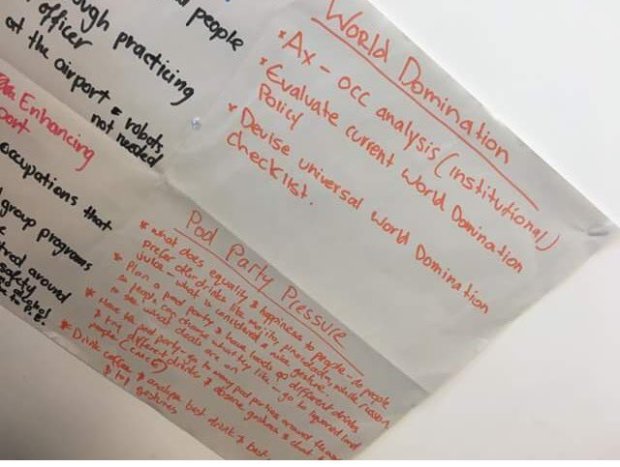
Working with Matthew in a collaboration between Griffith University and State Library of Queensland, I got to know him not just as a great writer, but a colleague and a friend. Combining a creative hands-on approach to occuaptional therapy education with foresight and psychodynamic work, we took Griffith students to distant futures — all in the service of exploring occupational therapists’ role in a changing world.

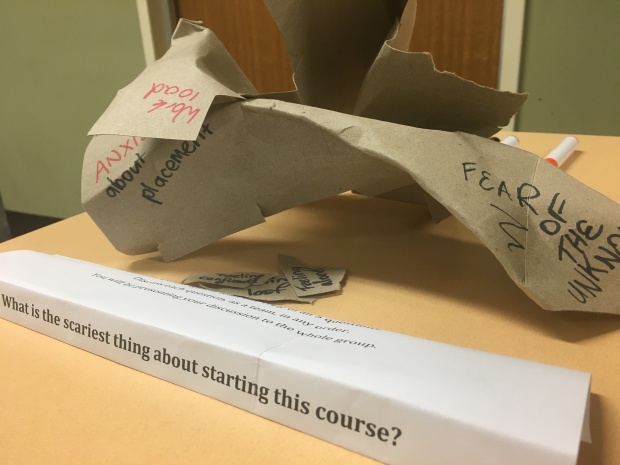
Toys, cake, and cardboard were just some of the materials which were brought into the work, which included a challenge to produce an edible presentation. The students were resourceful, empathetic, creative, good-humoured – exemplfying the best characteristics of their profession.

Now for The BMJ’s Medical Humanities podcast, Matthew and I join hosts Cristina Hanganu-Bresch and Brandy Schillace to explore scenario planning, healthcare, art, foresight, and the humanities.

Scenario Planning Blog at BMJ Medical Humanities

“Though it’s just a trick of the calendar, as the new year begins our thoughts inevitably turn to the future. Yet we cannot gather data from events that haven’t happened yet, and forecasts drawing on precedent can flounder when situations are unstable.”

For the BMJ Medical Humanities blog, I cover a few scenario planning basics as we make our way into 2024.

Jay Huang from Pleasanton, USA – Low Fog Sunrise @Golden Gate Bridge, CC BY 2.0.

Strategizing across organizations

“Capitalizing on big opportunities and solving systemic problems will require organizations to come together to develop strategies as a group.”

Together with Rafael Ramírez, Trudi Lang, Gail Carson, and Dale Fisher, I have a new piece in MIT Sloan Management Review exploring scenario-based strategy for networks of organizations addressing large-scale challenges, drawing on experiences during the COVID-19 pandemic with the Global Outbreak Alert and Response Network (GOARN).

You can find “Strategizing across organizations” at the MIT Sloan Management Review website.

You can also find the accepted version of the paper at Oxford University’s online ORA resource.

IMAJINE scenario response – Colette Marshall, Director of Operations at Diabetes UK

“Diabetes is an interesting condition to explore in these scenarios because it’s like the canary in the coal mine. Type 2 diabetes, in particular, tells you the general population health, while Type 1 diabetes tells us about how society is dealing with a smaller group of people who have a condition which is eminently curable or preventable with the right level of research over the next 20 years… So diabetes becomes an interesting bellwether for social inequalities in each scenario, and for good sharing and rollout of the latest advances in healthcare.”

At the IMAJINE project website, Colette Marshall of Diabetes UK explores the future of diabetes, its treatment and management, in each of IMAJINE’s four scenarios for European regional inequality in 2048.

I especially liked Colette’s definition of trust as “confidence that partners will not exploit each other’s vulnerability”. There’s something there that takes us beyond trust in expertise: it’s about mutual recognition of vulnerability, and the motive for action, whether it’s exploitative or not, the power dynamic, which seems highly relevant.

Read more at the IMAJINE website.

IMAJINE: Futures of Infectious Disease

COVID-19 has brought infectious disease, and the ways we fight or prevent it, to the forefront of discussion about the very biggest decisions our societies face. On issues ranging from economics, wellbeing, and sustainability to authoritarianism, democratic accountability, digital inclusion, privacy, and surveillance, the pandemic has become something we cannot ignore.

What might the future hold in terms of both infectious disease and the acts we take to counter it? For the IMAJINE project’s four scenarios for the future of Europe in 2048, Gail Carson of Oxford’s Nuffield Department of Medicine explores this question.

You can read her response to the scenarios at the IMAJINE website.

RCOT 2021: Scenarios, foresight, and occupational therapy

Next week, Griffith University’s Professor Matthew Molineux and I present on scenario planning for the 2021 conference of the Royal College of Occupational Therapists.

In advance of the conference, we got together for an informal chat covering five years of work pushing the boundaries of occupational therapy education, exploring what futures & foresight work can do for occupational therapists, and how learning from the futures which challenge our assumptions can complement the practical experience which comes from student placements.

OECD Government After Shock Podcast with Robert Hoge, Queensland Health

As part of the OECD’s Government After Shock project, I’m working with a team from their Observatory of Public Sector Innovation, interviewing public sector leaders & practitioners for a podcast series exploring their perspective on the crises of 2020, and implications for the future of government worldwide.

First up, Robert Hoge of Queensland Health talks about strategic health communications in a time of pandemic, coping with misinformation & disinformation, and lessons learned from the COVID-19 experience in Australia’s Sunshine State.

Future health: Oslo and the ‘a-ha’ moment

Our University of Oslo scenarios for the future of schools, out this week, surfaced health, and perceptions of health, as a battleground between parents and institutions in the education sector of 2050.

This was an “a-ha” moment for university researchers seeking new issues to explore around the digitalisation of education.

In scenario planning, we don’t aim to predict the future, but rather to generate plausible visions which can usefully inform present-day decision-making.

The future stories we create together are intended to highlight issues and drivers which exist in the present; the future scenario can then be set aside in order to focus on the issue at hand.

For the Oslo education researchers, a world in which parents and institutions warred over children’s health in a heavily-surveilled society – bickering with ‘the algorithm’ even over when to wipe your child’s nose – highlighted the extent to which their research should explore questions of health and wellbeing.

Today, in the Norwegian news, we see a parent-led Facebook group urging the city to close schools while the municipal authorities maintain that there is no reason yet to do so.

The campaigners argue that if businesses are sending staff home, then young children – who are less able to follow guidelines on infection control, like coughing into your elbow – should certainly go back to their families too.

Questions of distance learning, and education via screens and digital devices, may be sharpened by the current pandemic – even for the youngest children.

How will coronavirus affect the way we teach and learn, in the short and long term? Could it impact even the youngest children, irrespective of whether they contract the disease?

Good foresight work can help communities, institutions, and individuals navigate such turbulent and uncertain situations. You can read more about the Oslo education scenarios project here.

What exactly is Library Island anyway?

I’ve spent a fair chunk of the last two years working on something called “Library Island”. You might have seen photos, videos, or social media posts appearing online as university staff, health workers, museum professionals, students, and, yes, librarians take part in this interactive training activity.

Later this year, a free CC-licensed print-and-play kit for Library Island will be released, so that people anywhere can take this activity and use it with their institutions, companies, and communities.

But what exactly is Library Island? Read on to find out… Read more

Bex Twinley: The Dark Side of Occupation

Occupational therapists (OTs) are among my favourite professionals to work with. These allied health practitioners have a unique and often overlooked take on the world – the “occupational lens” – through which they understand human experience in terms of our occupations: the things we want, need, and have to do in our lives.

Today’s therapists and occupational scientists understand that human lives are comprised of occupations; that occupations can become dysfunctional and harmful; and that occupation itself can become a way of offering therapy and putting things right.

Bex (Rebecca) Twinley of Plymouth University is an occupational science researcher who coined the phrase “dark side of occupation”. Health professionals have traditionally and understandably focussed on occupations which they see as positive and productive for individuals, groups, and communities. Yet when we think of the total sum of human occupation, its many facets must include dark – meaning less explored – sides, too.

What happens when occupational science chooses not to look away from those facets, and instead pays attention to the darkness?

Bex:

Occupational therapy as a profession has always been focussed on links to health and wellbeing, identifying and supporting those occupations which are healthy to do.

The reality is that people don’t engage in positive occupations all of the time – yet these are not spoken about in our literature or explored in much of our practice. This limits the authenticity of the understanding between client and practitioner.

Matt:

I imagine that there is also some scope for debate about who gets to define health and wellbeing, and what institutional values are imposed by the health system. (It’s making me think of that Radiohead song, “Fitter Happier”).

What drew you to the notion of this “dark side” of occupation?

Read more