The team at Energy Consumers Australia have shared videos and resources from last month’s 2023 Foresighting Forum online.
You can watch a video recording of my interactive keynote for attendees on YouTube.
The team at Energy Consumers Australia have shared videos and resources from last month’s 2023 Foresighting Forum online.
You can watch a video recording of my interactive keynote for attendees on YouTube.
On 21st April, I’ll be joining a webinar hosted by the Singapore chapter of the International Society for Knowledge Organization to discuss scenario planning, strategic foresight, and knowledge management.
Hosted by Patrick Lambe, the session will include panellists Gary Klein of Macrocognition LLC and Susann Roth of the Asian Development Bank as well as myself.
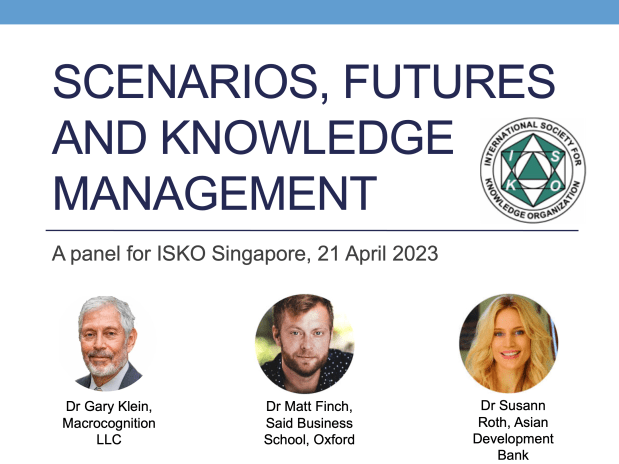
The online event takes place on Friday 21 April 2023, 7.00-8.30pm SGT (7.00am EDT, 12 midday UK, 7.00pm Manila) – find out more and register here.
The team at Energy Consumers Australia have released a short Q&A video covering aspects of my recent keynote on dealing with uncertainty in sociotechnical systems.
You can find more from the recent Energy Consumers Australia 2023 Foresighting Forum here.
As part of its OpenLearn free online learning offer, the Open University has released a planning course which incorporates Islands in the Sky, an adaptation of the Oxford Scenario Planning Approach developed during the height of the COVID-19 pandemic.
As the course notes explain, “Islands in the Sky is a situational awareness and scenario-based strategic planning tool that is especially useful for managing uncertainty. It is designed for structuring conversations about the future business environment to inform decision-making in the present.”
It was a privilege to develop the approach with a team from the Open University and other colleagues, and contribute to the video materials for the course. You can find more about the Open University’s version of Islands in the Sky at their website.
“Capitalizing on big opportunities and solving systemic problems will require organizations to come together to develop strategies as a group.”
Together with Rafael Ramírez, Trudi Lang, Gail Carson, and Dale Fisher, I have a new piece in MIT Sloan Management Review exploring scenario-based strategy for networks of organizations addressing large-scale challenges, drawing on experiences during the COVID-19 pandemic with the Global Outbreak Alert and Response Network (GOARN).
You can find “Strategizing across organizations” at the MIT Sloan Management Review website.
You can also find the accepted version of the paper at Oxford University’s online ORA resource.
On Saturday 25th February 2023, I’m presenting a paper, “The Ghosts We See From the Mountains: Scenario Planning and the Territorial Body in Time” at the University of Warwick conference “Territorial Bodies: World Culture in Crisis“.
As the conference organisers explain,
The concept of ‘territorial bodies’ takes inspiration from the Latin American feminist transnational concept of ‘body-territory’, which has been used as a ‘strategic’ tool to engender new forms of global solidarity, linking multi-form violence at various scales. More broadly, body-territory becomes a lens through which to critique overlapping forms of violence in an era of socio-ecological crisis. This conference encompasses wide-ranging perspectives on the concept of ‘territorial bodies’, from the extractive plunder and dispossession of land, to the violation of gendered bodies, to the exploitation of racialised bodies and uneven flows of migration. We aim to critically evaluate the interconnections between bodies and territories, using the framework of “territorial bodies” to generate new modes of understanding crisis in neoliberal culture.
My paper, drawing on the example of the IMAJINE project, explores how scenario planning can inform our discussion of the ‘body-territory’.
What do we learn about territorial bodies and their attendant inequalities when we examine them from the perspective of multiple imagined futures?
How does investigating the future of territory itself enrich our understanding of the bodies which inhabit said future, and the power relations in which they are enmeshed? How can that understanding in turn usefully inform action in the present?
And, insofar as scenarios themselves render time in spatial metaphors – with factors, actors, and uncertainties juxtaposed to explore the dynamics of times to come – what do we learn about the body-in-time when we consider it in territorial terms?
You can read the paper as a PDF here, or watch a partial preview on YouTube. Find the full conference programme online here.
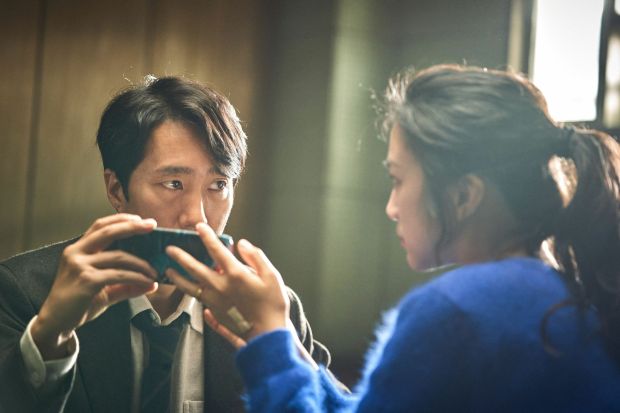
I recently watched Park Chan-wook’s tremendous new film Decision to Leave. Styled “a romantic thriller”, it deals with a detective who falls for a suspect in the murder investigation he is leading.
Hae-Jun, the insomniac detective, investigates the death of a former immigration officer in an apparent mountaineering accident. Suspicion falls on the officer’s Chinese wife, Seo-Rae, whom the cops think isn’t showing enough grief. As Seo-Rae and Hae-Jun become entangled beyond the scope of the investigation, the mystery deepens: who is snaring whom?
A 1960s song which recurs throughout Decision to Leave, “Mist” by Jung Hoon Hee, highlights some of the movie’s themes.
As director Park explains on the MUBI podcast:
The beautiful lyrics just hit my heart straight away, especially the part where it says, “Open your eyes in the mist.”
[…T]hroughout the song, you get this impression that the one that you love is leaving you, and you see them in silhouette, obscured in this deep fog; that’s the dominating image in the song.
And then, towards the end, you hear this lyric: “Open your eyes in the mist.” And that is a command to you, to open your eyes and take a straight look at that person.
So the command is, even though it’s misty, things are ambiguous, you have to make an effort to see clearly. Now, what is this song commanding you to take a look at straightforwardly? I think you can fill in the blank. It could be the person you love, or your own emotions, or just reality in general.
That was really the inspiration [for Decision to Leave]. It conjured the image of a detective, someone who always tries to take a clear look at his situation. And that’s when I decided to put in the scenes where the detective uses artificial tears. He always uses them to kind of clear his eyes, whenever there’s a decisive moment that he really wants to take a straightforward look at.
For so many of us in this era, we too find ourselves peering through the fog and mist of the so-called “TUNA conditions”, characterised by turbulence, unpredictable uncertainty, novelty, and ambiguity. No matter how hard we try to resolve these conditions, we cannot be fully sure of what is going on or what will happen next.
When I heard this interview with Park Chan-wook, I was intrigued by the story about the pop song which inspired the movie, but I was also startled by the term “artificial tears”. I’d never heard this phrase used to describe eye drops before. I loved it.
It made me think how, in TUNA times, we can look at the world around us, considering the uncertainties with the power to reshape our immediate environment, and create future scenarios to help us think about how those uncertainties might play out in times to come.
Those future scenarios are designed to challenge our assumptions – not to be dystopian or utopian necessarily, but to go beyond our already-existing expectations, hopes, and fears, so that we see from outside of our old frame of reference and, taking the vantage point of an imagined future, see our own here-and-now more clearly.
“Big whorls have little whorls which feed on their velocity,
Lewis Fry Richardson
And little whorls have lesser whorls and so on to viscosity“
These lines appear in Sarah Dry‘s tremendous book Waters of the World, a work of history which explores how scientists, researchers, and passionate amateurs gradually pieced together an understanding of our global climate system. The story spans continents and generations; some of its characters collaborate or compete, while others work alone, unaware of the wider context in which their endeavours might be received. Some don’t even live to see the difference that their research will make to the world. There are false starts and dead ends. Politics, from the sweep of colonialism to the pettiness of institutional squabbles, plays its part; and for all that this is a tale of systematic observation and theorisation, it’s no less deeply human for that. As one of Dry’s scientists, Joanne Simpson, put it:
“I think I am generally perceived as a pretty cool character. Nothing could be farther from the truth. To understand how a woman, or a man, for that matter, creates original work in any field, it is necessary to penetrate the emotional masks, and my masks have intentionally been hard to penetrate.”
Dry’s book, and particularly its chapter on “Fast Water”, exploring the currents of the ocean’s depths, makes me think of the ways that emotions can swirl around us and within us when we address difficult issues, alone or together.
Read moreThe landscape of our cities and regions today is characterised by turbulence, uncertainty, novelty, and ambiguity – the so-called ‘TUNA’ conditions. Forces that lie far beyond the places where we live and work influence choices close to home.
In our search for security and prosperity, where should we be looking when the future of our cities and regions is so uncertain?
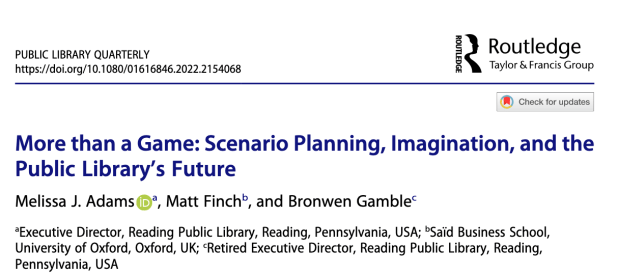
For Public Libraries Quarterly, Bronwen Gamble and Melissa Adams of the Reading Public Library co-wrote an article with me on our scenario planning journey through a leadership transition in the depths of the COVID-19 pandemic.
“More than a Game: Scenario Planning, Imagination, and the Public Library’s Future” explores the use of frugal, online scenario planning methods during the pandemic and the benefits of a scenarios process in times of leadership transition.
It builds on Dale Leorke and Danielle Wyatt’s notion, expressed in their book The Library as Playground, of the library as “a space and institutional order innately imbued with playful qualities” to consider how libraries may be the perfect hosts for scenario processes which “play with expectations, hopes, fears, and desires, in a strategically consequential game of ‘What if?'”




.jpg)
