The Important Thing Is Elsewhere

The Family Tree

Before all this, I went to my grandfather’s house in Spain. I’d never really liked it. It wasn’t the house he’d lived in as I grew up, which was just down the road from the new place. That had been the house of memories, the place where my grandmother had died before I was born.

He bought the new place when it was time to find a smaller, more manageable property, as he entered his eighties and I my twenties. I worked with him on both houses, helping him to do up the old one and improve the new. I painted walls white and coated tiles with red rubber sealant; mixed cement and ferried endless wheelbarrows of it to wherever he was working that day. He chided me for my cement mixing technique, for the way I handled a paintbrush or a pickaxe, the way I clambered up and down ladders and scaffolding, fetching tools and materials. It was the happiest time.

He died, digging over the garden of the new property with a rotorvator, when I was 23. He’d have been glad to go that way; he’d always talked of “falling off his perch” rather than a dreaded slow decline, and even when we were working together on the new place, he’d still pull stunts like climbing into the tree he was pruning, clinging to the branch above him while standing on the one below, which he was sawing off, jumping up and down to speed the process.

Read more

Life After Missions: Hindsight for the Next Big Thing

Societal challenges are complex. More complex than going to the moon, which was mainly a technical feat. To solve them requires attention to the ways in which socio-economic issues interact with politics and technology, to the need for smart regulation, and to the critical feedback processes that take place across the entire innovation chain.

Mariana Mazzucato, Mission-Oriented Research & Innovation In The European Union

Every strategy, every approach, every angle of attack that we take in life – whether individually or as a collective – has its moment. Insurgents become incumbents, if they succeed; and the most novel or surprising innovations will, in time, become yesterday’s news.

The UK’s Wellcome Trust has just launched a new strategy built around three global challenges.

Wellcome is far from the only organization taking this approach. Using challenges to structure strategy echoes the new trend towards “mission-led innovation”, where systemic public policies draw on grassroots and frontline knowledge to attain specific goals. Whether it’s clean air in congested cities, continued independence in a healthy old age, or the challenges of cancer, climate change, and digital exclusion, missions are intended to help us apply big thinking to big problems – setting a clear direction for innovation while still enabling bottom-up solutions.

I think the mission-led approach is really promising, and I’ve been pleased to collaborate with organisations like Business Finland and Nesta as they explore what mission-setting might look like for them. But I’m also realistic about the limits of any one approach to ever serve as a panacea for the ills of our time. Inevitably, even the best strategies will have gaps and blindspots; no human endeavour escapes the need for tradeoffs, and omniscience is still an attribute which eludes us.

Read more

Thinking Through Drawing 2020: Drawing Changes

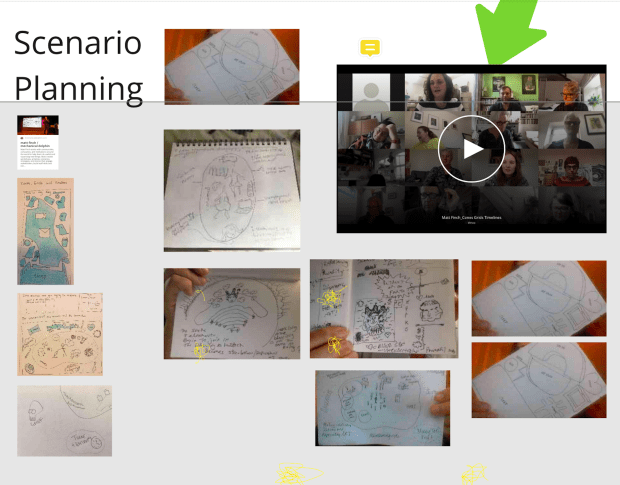
I was pleased to join the Thinking Through Drawing (TTD) community for their 2020 symposium, Drawing Changes, last week, and present some work on visual methods for scenario planning.

The TTD community explore links between drawing and cognition, and it was great to bring their perspective to bear on the question of how we might usefully draw the future to inform our decisions in the present.

The session was well received – here are some comments from attendees:

I was surprised by my choices and solutions.”
“It’s like drawing [scenarios] aids the process of giving permission to do the decision you really want to give attention to…”
“And drawing give us the physical cues as we draw – tension, chills, etc. Important info.”
“And you can examine the “players” as fictional characters, allowing for new insights.”
“For me the diagram is a process functional tool, this is illuminating in thinking of it in relation to decision making not just areas of charting or organising existing knowledge.”
“I allowed myself to think ‘worst case scenario’ in every area. Made me realise I would carry on even in black dog days.”
“The visual metaphors in a Gantt chart force your thinking, whereas this coaxes.”
“It made me reflect on a decision I thought was made, but I am actually still wavering on.”
“The process got me to think bigger. What started as a creative project became wanting to change a bad situation. I think the creative project is still important but imagining what I want to change is crucial.”

Read more

Unscripted Futures: 2020 OsloMet Urban Research Conference

I’ll be co-presenting two projects at next week’s “Storbykonferansen” Urban Research Conference, hosted by Oslo Metropolitan University.

The conference’s “Unscripted Futures” session seeks to:

“explore how radically open futures can be constructed and how we can secure that future scenarios are not locked into the premises of today. The aim is not to simply celebrate the openness of the future, but to create a space for developing experiments, for proposing alternative possibilities and constructing new futures, and then studying and discussing their implications and consequences ‘on the ground’.”

Marie Mahon of NUI Galway and I will discuss “Unscripting Europe”: Using Future Scenarios to Rethink EU Territorial Inequalities, exploring the scenarios being developed by the Horizon 2020 IMAJINE project.

Inequality isn’t just a question of measuring the current distance between the haves and have-nots, then checking whether that distance increases or decreases. It’s also about changing forms of privilege and injustice, changing values, and a changing social context. How can plausible imagined futures help us to better understand the nature of inequality?

Then, David Robertson of Monash University and I will talk about Playing With The Futures You Didn’t See Coming: High-Agency Participatory Scenario Activities, On and Offline.

David & I will be looking at what it means to create truly playful activities and encounters where participants can surprise the facilitators, formats can be broken or rebuilt during use, and new ideas can arise. We’ll talk about the infamous Library Island game, as well as some of its successor experiments from the era of Zoom and COVID lockdown.

You can read all the abstracts from the session at the Storbykonferansen website (PDF download), and I hope you’ll join us online for what promises to be a lively set of discussions. Find out more, and register for the conference, here.

The Sense of an Ending: Stories, Shapes, & Scenarios During COVID-19

Doesn’t it feel as if this pandemic might go on forever? Do you have any sense of whether we’re at the end of the beginning, or the beginning of the middle, or the beginning of the end?

Doesn’t it feel like everyone is yearning for something that gives these events shape, an arc, a trajectory, a sense that we will come eventually – by vaccine, or treatment, or policy, or simple resignation – to something that we can label as “the end of the COVID era”?

Even the phrase “the new normal” seems somehow plaintive, as if it only wished that we could settle on a final state of affairs which would mark the end of all this flux and uncertainty. Even if a single, solid “new normal” ever arrives, we’ll be paying the price for COVID for years to come.

Read more

Interview with Betty Sue Flowers, Part 3: Libraries, Little Voices, and the Hidden Common Ground

This is the final instalment of a three-part interview with Betty Sue Flowers – you can find the first part here, and read the whole piece as a PDF download here.

Betty Sue Flowers, Ph.D., is a writer, editor, and international business consultant, Emeritus Professor at the University of Texas, and former Director of the Lyndon Baines Johnson Library and Museum.

She has been a consultant for NASA and the CIA, Visiting Advisor to the Secretary of the Navy, Public Director of the American Institute of Architects, and editor of scenarios for organisations including Shell International, the OECD, the University of Oxford, and the World Business Council for Sustainable Development.

She has written scholarly works on Robert Browning, Adrienne Rich, and Christina Rossetti among others, as well as serving as a consultant to television series including PBS’s Joseph Campbell and the Power of Myth. You can see more of her work and her extensive publication history here.

In September 2020, I talked with Betty Sue about her career, her accomplishments, and her understanding of the diverse fields she’s worked in, from foresight and healthcare to poetry, literary studies, and library leadership.

Your work on a television tie-in book with Joseph Campbell led, indirectly to you working on scenarios at Shell. How did that come to pass?

After I’d written the Campbell tie-in, people were calling me all the time for help with their books, and I turned them all down except for one person, Joseph Jaworski.

He was writing a book on leadership, Synchronicity: The Inner Path of Leadership, and though I’d never met him, I decided to say yes to his proposal.

I’ve always gone by this little voice inside that says “Yes”, and if it says “Yes”, I never go against it. It’s gotten me into a lot of trouble – good trouble. I didn’t have time, I was running the honours program at UT, I was a professor, I had a small child, and I wasn’t interested in his topic either – he wanted to write a book about the American Leadership Forum.

Read more

Interview with Betty Sue Flowers, Part 2: From “Fire Alarm Time” to Generations of Love

This is part two of a three-part interview with Betty Sue Flowers – you can catch up on the first part here, and read the whole piece as a PDF download here.

Betty Sue Flowers, Ph.D., is a writer, editor, and international business consultant, Emeritus Professor at the University of Texas, and former Director of the Lyndon Baines Johnson Library and Museum.

She has been a consultant for NASA and the CIA, Visiting Advisor to the Secretary of the Navy, Public Director of the American Institute of Architects, and editor of scenarios for organisations including Shell International, the OECD, the University of Oxford, and the World Business Council for Sustainable Development.

She has written scholarly works on Robert Browning, Adrienne Rich, and Christina Rossetti among others, as well as serving as a consultant to television series including PBS’s Joseph Campbell and the Power of Myth. You can see more of her work and her extensive publication history here.

In September 2020, I talked with Betty Sue about her career, her accomplishments, and her understanding of the diverse fields she’s worked in, from foresight and healthcare to poetry, literary studies, and library leadership.

Just thinking of your own writing for a moment, with your early poems, with your teenage plays, did you have an ideal audience, or a specific reader in mind?

I wrote plays for my cousins to perform at Christmas, but actually as a teenager, a play I wrote was performed on television in my home town of Waco, Texas. It was a satire on the Kennedy administration. It was put on TV, and I thought it was quite funny, and obviously it was a political play, intended to be of relevance to the world; they were going to rebroadcast it, and then the assassination happened, and that was the end of it.

That shocking, moving event changed my sense of where I was heading. But my first published poem, which I wrote as a Brownie scout, was about meeting a beggar selling pencils on the street in Abilene, Texas. I was in my uniform, and I thought the appropriate thing to do was to give him the Brownie salute: to stop and acknowledge his humanity. I did this, and he saluted me back, and that was an interaction I wrote about. The little girl and the beggar. The point of the poem was to establish a human connection which overcame the way people were treating him on the street. Insofar as my writing has had an implicit purpose, it was something about opening eyes.

Can you talk a bit more about your process when you’re writing your own poetry?

Read more

Bringing a ladder to a Zoom call: Keynote to #ELGL20

I’m not a big fan of the phrase “new normal”, but if there is one, then for me it involves a lot of Zoom calls, which means mostly seeing people’s heads and shoulders in a cropped little screen.

For my ELGL20 keynote to local government professionals, I grabbed a stepladder to try and find a different perspective, even in a world constrained by the limits of the laptop lens.

My ladder was a prop to remind people why we do foresight work. Sometimes, we think we know what the future holds and we take action in the present, just as confident as someone stepping onto the first rung of a ladder.

But that ladder comprises all the assumptions we are relying on about what the future holds, and what part we’ll play in it.

As Peter Scoblic and Philip Tetlock put it in an article for Foreign Affairs,

Every policy is a prediction. Tax cuts will boost the economy. Sanctions will slow Iran’s nuclear program. Travel bans will limit the spread of COVID-19. These claims all posit a causal relationship between means and ends. Regardless of party, ideology, or motive, no policymaker wants his or her recommended course of action to produce unanticipated consequences. This makes every policymaker a forecaster.

Scoblic & Tetlock, “A Better Crystal Ball”, Foreign Affairs

We might start climbing that ladder and then realise we need to step left, or right. We might find that the next rung is missing. We might have set off on our ascent quite happily, only to find that circumstances at the top have changed and it is really difficult for us to climb back down. We may even find we have to awkwardly perch half-way up the ladder (I ended up using mine as a chair while I spoke to the ELGL crowd).

Scenarios and other foresight techniques can help us examine the assumptions we are making about the future before we take that first step.

The ladder was also something of a gambit on my part. I hadn’t planned to include it as part of the keynote, but we were using a videoconferencing platform which made it difficult for the speaker to know how the audience were responding. Our host compared it to “speaking on a lit stage where you know the audience is out there, but it’s hard to see their faces”.

Around the halfway point of my session, I wasn’t confident that my message was getting across and I wanted to be sure to drive the point home. I dashed out of the study and fetched my stepladder from behind the kitchen door. Often the liveliest and most memorable parts of a workshop, or any human encounter, come when something doesn’t go according to plan. It’s important to remember that when events go astray, they can go better than we expected or intended, as well as worse – especially if we take advantage of the moment.

So that’s why I brought a ladder to a Zoom keynote. Even if you, too, are trapped by the boxes of the videoconference screen, what can you do to help yourself, and the people you speak with, find a fresh perspective on the futures which await?

Interview with Betty Sue Flowers, Part 1: From Rhythmic Systems to Scenarios as Theatre

Betty Sue Flowers, Ph.D., is a writer, editor, and international business consultant, Emeritus Professor at the University of Texas, and former Director of the Lyndon Baines Johnson Library and Museum.

Betty Sue Flowers

She has been a consultant for NASA and the CIA, Visiting Advisor to the Secretary of the Navy, Public Director of the American Institute of Architects, and editor of scenarios for organisations including Shell International, the OECD, the University of Oxford, and the World Business Council for Sustainable Development.

She has written scholarly works on Robert Browning, Adrienne Rich, and Christina Rossetti among others, as well as serving as a consultant to television series including PBS’s Joseph Campbell and the Power of Myth. You can see more of her work and her extensive publication history here.

In September 2020, I talked with Betty Sue about her career, her accomplishments, and her understanding of the diverse fields she’s worked in, from foresight and healthcare to poetry, literary studies, and library leadership.

The interview will run in three parts on this blog, but you can also read the full transcript now as a PDF download.

You’ve had such a varied and accomplished career, it’s hard to know where to start. Then I saw one of the earliest and most curious entries on your CV: you were a lab assistant at something called the Rhythmic Systems Laboratory?

I started life off as a scientist. I put my way through college working in a zoology lab. I’m still in touch with my mentor, who went on to the University of Virginia. My love of poetry took me away from that path – I just kept following it in another direction.

Read more