UNESCO Prospects Journal: Scenarios and the future of education

The question for teachers, learners, and the various organizations and communities in which they participate becomes “How will we adapt, evolve, and thrive even if uncertainties play out in ways for which we had not initially prepared?”

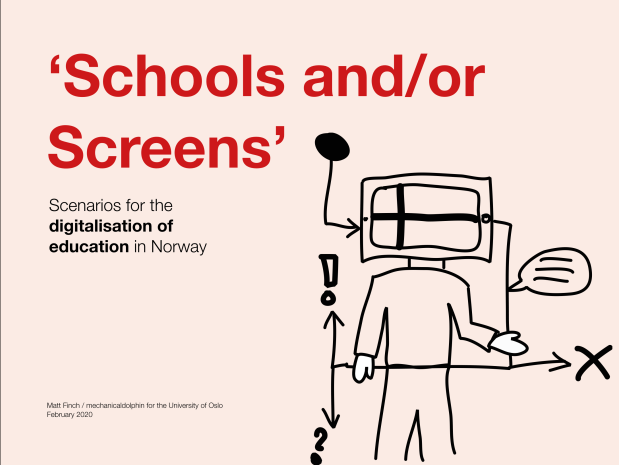
In the UNESCO International Bureau of Education’s journal Prospects, the University of Oslo’s Steffen Krüger, the University of Agder’s Niamh Ní Bhroin, and I discuss the “Schools and/or screens” scenario project for the digitalisation of education in Norway.

UNESCO Headquarters sign. (C) Matt Finch, 2023

We show how challenging issues raised in the context of distant imagined futures proved to be immediately pertinent in the developing Covid-19 pandemic, and, as a wide range of actors explore the possibility of a new social contract for education, we reflect on how future scenarios can provide fresh perspectives on issues that are difficult or even impossible to resolve within current frames of reference, including questions of equity and justice that may be construed differently in times to come.

Read “Unlearning, relearning, staying with the trouble: Scenarios and the future of education” at Prospects online.

SHAPE Education: Schools, Work, and the Adaptation Advantage

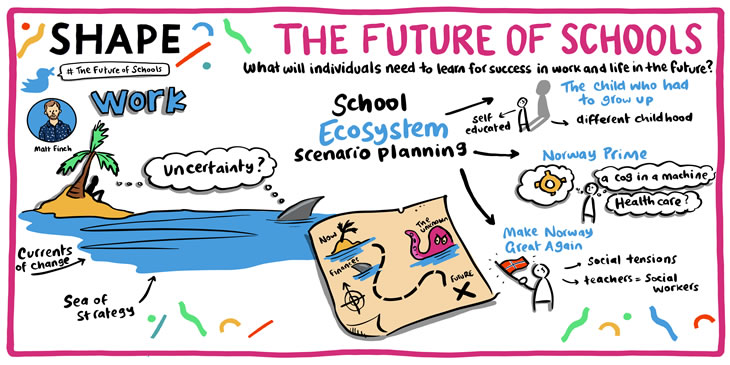
The archive from this summer’s SHAPE Education event, organised by Cambridge University Press and the Judge Business School, is now online.

I spoke on the future of work and its implications for education with a panel including Bell Education’s Silvana Richardson, Cambridge University Press’ own Ben Knight, and Heather E. McGowan, author of The Adaptation Advantage.

We were also supported by live drawings from the brilliant Rebecca Osborne.

SHAPE Education: Matt Finch's talk

You can find more about the SHAPE conference series online, and explore the University of Oslo “Schools and/or Screens” scenarios, which I discussed during the panel, here.

Learning from futures you didn’t see coming? Scenario planning, education and the (post)pandemic world at CO:RE

It was my privilege to join the University of Oslo’s Niamh Ní Broin and Steffen Krueger at the website of CO:RE, the Children Online: Research and Evidence project funded by the European Commission, to write about last year’s scenarios for the future of Norwegian schools.

These explored different contexts for the digitalisation of education in Norway, considering how the relationship between learners, digital devices, and educational institutions might shift in times to come.

You can read our piece, “Learning from futures you didn’t see coming? Scenario planning, education and the (post)pandemic world”, here.

SHAPE Education: Schooling, Skills, and the Future of Work

I’ll be speaking at the SHAPE Education 2021 conference on Wednesday 14th July, joining the panel “What will individuals need to learn for success in work and life in the future?” alongside Heather E. McGowan and Silvana Richardson.

We’ll be asking, what skills, knowledge and characteristics will employers need and be looking for in future? How will education systems help people develop these within and beyond schools? And will relationships between schools and employers change?

You can join our panel, and other sessions from the week-long SHAPE event, for free.

Future health: Oslo and the ‘a-ha’ moment

Our University of Oslo scenarios for the future of schools, out this week, surfaced health, and perceptions of health, as a battleground between parents and institutions in the education sector of 2050.

This was an “a-ha” moment for university researchers seeking new issues to explore around the digitalisation of education.

In scenario planning, we don’t aim to predict the future, but rather to generate plausible visions which can usefully inform present-day decision-making.

The future stories we create together are intended to highlight issues and drivers which exist in the present; the future scenario can then be set aside in order to focus on the issue at hand.

For the Oslo education researchers, a world in which parents and institutions warred over children’s health in a heavily-surveilled society – bickering with ‘the algorithm’ even over when to wipe your child’s nose – highlighted the extent to which their research should explore questions of health and wellbeing.

Today, in the Norwegian news, we see a parent-led Facebook group urging the city to close schools while the municipal authorities maintain that there is no reason yet to do so.

The campaigners argue that if businesses are sending staff home, then young children – who are less able to follow guidelines on infection control, like coughing into your elbow – should certainly go back to their families too.

Questions of distance learning, and education via screens and digital devices, may be sharpened by the current pandemic – even for the youngest children.

How will coronavirus affect the way we teach and learn, in the short and long term? Could it impact even the youngest children, irrespective of whether they contract the disease?

Good foresight work can help communities, institutions, and individuals navigate such turbulent and uncertain situations. You can read more about the Oslo education scenarios project here.
Team Waitangi: Teaching against the grain in West London

Team Waitangi, a group of West London teachers, dress up as the cast of Cinderella

Ngā mihi o te Kirihimete, West London

Team Waitangi got its name five years ago, just before Christmas. I was teaching what the Brits call infants – 4 to 7 years old, specifically Year 1 or 1st Grade – in a deprived suburban corner of West London. Our staff were pretty diverse, with teachers from New Zealand, South Africa, and Australia. The school served a diverse community, too: most kids were from families that didn’t speak English at home, new migrants who had come to us from Somalia, Iraq, Sri Lanka. Celebrations like Ramadan and Diwali were more important to our kids than, say, Easter. Even more than usual, this meant I did as much listening as talking, as much learning as teaching.

Read more

Reader-in-Residence article in SCAN Magazine

Parkes High School’s teacher librarian Tracy Dawson has an article in the latest SCAN magazine about the Reader-in-Residence role which I held in Parkes across late 2013 and early 2014.

The role was designed to link the school and wider community in a celebration of storytelling, literacy, and culture in all its forms. Events included teen publishing workshops, our biggest ever zombie roleplay, urban myth writing, and the inaugural Central West Comics Fest, which will be returning in 2015. I also mentored high school students, led sessions for the Parkes writers’ group, and worked with the school’s special needs unit.

Tracy gives a teacher’s perspective on how trying new things, pushing boundaries, and reaching out to a wider community also yielded great benefits to students at the high school. You can also read her guest posts on this site about Auckland’s XXUnmasked project and the work of a teacher librarian.

SCAN magazine is a refereed journal published by the New South Wales Department of Education, focussed “on the interaction between information in a digital age and effective student learning.” You have to subscribe for recent issues, but the archive is publicly available – I’ll let readers know when the current issue moves into the free archive.

Award-winners Parkes Shire Library share the secrets of their library programming

Last night, Parkes Shire Library won the Australian library association ALIA’s Bess Thomas award for innovative work with children and young people. I’ve been working with the Parkes community for some years now, and I’m proud to have played a part in their journey to national recognition.

This slideshow requires JavaScript.

It’s great for Parkes’ librarians, serving a community of just 15000 out in Central West New South Wales, to have their daring work celebrated by peers at a national level.

If you want to steal some of the Parkes magic, you can find “how-to” articles and resources for some of our most exciting programmes online:

Keep your eyes peeled for more surprises as Parkes kicks off the 2014 season of activities this month…