Interview with Nate Crowley, Part 2: “Theft, but wet” and other people’s toys

In the final weeks of 2020, I spoke with the writer Nate Crowley, videogames journalist and author of works including The Death and Life of Schneider Wrack, 100 Best Video Games (That Never Existed), tie-in fiction for the Warhammer 40k universe, and the infamous Twitter thread Daniel Barker’s Birthday.
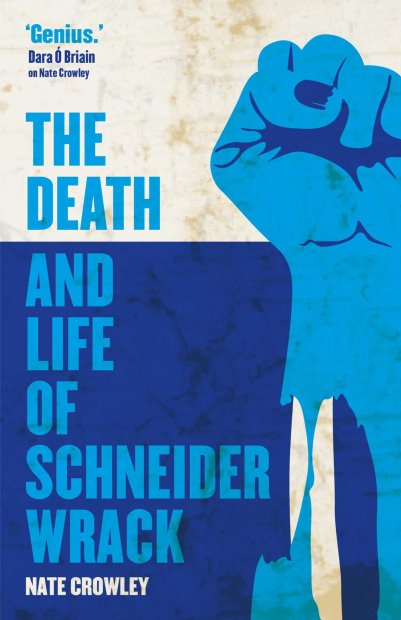
Nate’s new book, Notes from Small Planets, is a fictional travel guide which takes the reader through nine archetypal worlds of fantasy and science fiction, poking fun at well-worn tropes and questioning some of the assumptions which underpin the lands of make-believe.

In the first part of our conversation, Nate and I talked about world-building, map-making, gateways to fantasy, and the political choices woven through genre fiction. In today’s instalment, we talk about piracy, capitalism, empire, and what it’s like to “play with other people’s toys” in franchises such as Warhammer 40k.

Read more

Interview with Nate Crowley, Part 1: First worlds, imaginary maps

In the final weeks of 2020, I spoke with the writer Nate Crowley, videogames journalist and author of works including The Death and Life of Schneider Wrack, 100 Best Video Games (That Never Existed), tie-in fiction for the Warhammer 40k universe, and the infamous Twitter thread Daniel Barker’s Birthday.

Nate’s new book, Notes from Small Planets, is a fictional travel guide which takes the reader through nine archetypal worlds of fantasy and science fiction, poking fun at well-worn tropes and questioning some of the assumptions which underpin the lands of make-believe. In our conversation, Nate and i talked about world-building, map-making, gateways to fantasy, and the political choices woven through genre fiction.

*

What were the first fictional worlds that you fell into? I know that elsewhere you’ve mentioned Stephen Baxter’s The Time Ships, which itself was playing with H.G. Wells’ existing universe from The Time Machine. What made that your gateway to fantasy and science fiction?

Read more

The Important Thing Is Elsewhere

The Family Tree

Before all this, I went to my grandfather’s house in Spain. I’d never really liked it. It wasn’t the house he’d lived in as I grew up, which was just down the road from the new place. That had been the house of memories, the place where my grandmother had died before I was born.

He bought the new place when it was time to find a smaller, more manageable property, as he entered his eighties and I my twenties. I worked with him on both houses, helping him to do up the old one and improve the new. I painted walls white and coated tiles with red rubber sealant; mixed cement and ferried endless wheelbarrows of it to wherever he was working that day. He chided me for my cement mixing technique, for the way I handled a paintbrush or a pickaxe, the way I clambered up and down ladders and scaffolding, fetching tools and materials. It was the happiest time.

He died, digging over the garden of the new property with a rotorvator, when I was 23. He’d have been glad to go that way; he’d always talked of “falling off his perch” rather than a dreaded slow decline, and even when we were working together on the new place, he’d still pull stunts like climbing into the tree he was pruning, clinging to the branch above him while standing on the one below, which he was sawing off, jumping up and down to speed the process.

Read more

Interview with The Writing Platform

I think one of the hard things about trying something new is figuring out how to work with people’s expectations. When you click that link, do you want to be told a good story? Do you want to be given a good puzzle, with the satisfaction of finding the “right” solution? How much effort should you be expected to put in? How much uncertainty should you experience?

I spoke with Simon Groth of The Writing Platform about my most recent interactive text, The Library of Last Resort.

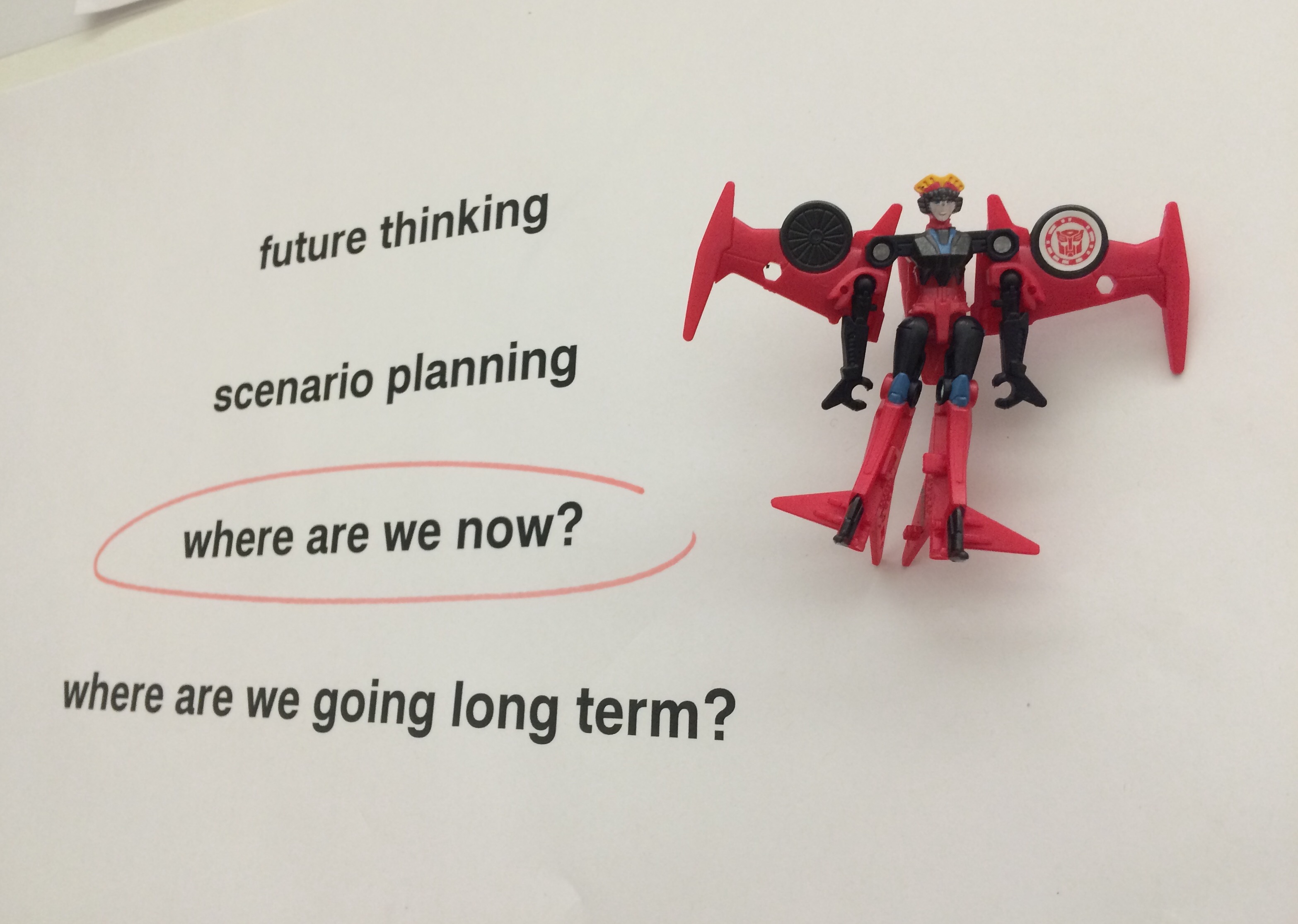
Windblade toy on the planning wall at State Library of Queensland

We talked about strategy and foresight, audience and agency, libraries and information (inevitably), and also learning from the wonder, freedom, and richness of children’s play.

It was a good chat. Check it out over at the Writing Platform website.

Dots that I haven’t joined yet

I’m momentarily at rest in my beloved Brisbane, with the sun blazing down in December and bushfires on the news and Leila Taylor’s book Darkly to read.

IMG_8560.jpg

Taylor’s book, subtitled Black History and America’s Gothic Soul, blends memoir and criticism to explore the places where African-American history, culture, and experience meet the Gothic – from The Castle of Otranto through Edgar Allan Poe to Marilyn Manson.

I’m back in Australia helping organisations to look at their future and imagine what might await them in years to come, using scenario planning. This is a method by which, instead of trying to predict what’s coming, we co-create plausible visions of the future which challenge our current assumptions. Successful scenarios are not judged by whether they come to pass, but whether they trouble, complicate, and enrich our thinking.

And the dots which I can’t quite join yet became visible when I read this, in Darkly: “Gothic narratives were (and still are) a means of working through the discomfort of a changing world through the safety of fiction.”

Which is so close to what scenarios do as to blur the edges of the two concepts. In scenario planning we talk about avoiding the “brutal audit” of a crisis by rehearsing for the things you can’t, or don’t want to, see coming through your current framing of the world.

Read more

Tell us your story: Libraries’ global storytelling manual

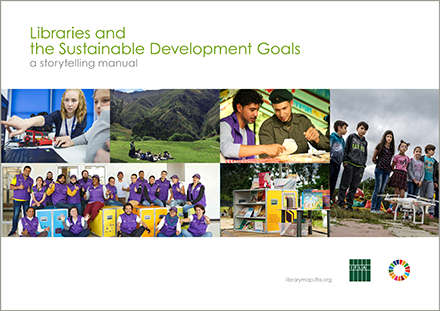
The International Federation of Library Associations, IFLA, has released a new guide designed to help librarians and library advocates to tell compelling stories about library activities, projects and programmes, showing their impact on communities and people’s lives.

sdg-storytelling-manual

Libraries and the Sustainable Development Goals” is a practical document and storytelling tool, linked to the United Nations goals which IFLA uses to demonstrate libraries’ global relevance.

You can check out the manual at the IFLA website.

Marvellous Finale

It’s the final edition of Curious, Mysterious, Marvellous, Electrical today – the newsletter I’ve used to capture stories and secret histories from Australasia and beyond over the last two years.

This slideshow requires JavaScript.

We started out by walking the coasts near Lisbon back in January 2016 and we finish the journey more or less where we began, exploring the history of one of Portugal’s most illustrious artistic families.

In the intervening years, highlights included:

And that’s not even including the drug counsellors, the Nazi hunting comedians, the dancer turned paramedic, the time travelling arts worker, or the Argentinian sisters running a horror-themed cake shop out on the tropic of Capricorn

…or the pastry.

Check out the complete Marvellous, Electrical on Google Maps.

All Things Good and Strange

I love TV, and I don’t think I watch enough of it.

I’d watch more but it’s so slow*.  You can spend weeks of your life trying to hammer through season after season of just one show.  In Douglas Coupland’s 1993 novel Microserfs, characters “blitz” movies by watching videos on fast-forward with subtitles switched on.** My friend Katie, equally impatient, listens to audiobooks on chipmunk speed, but I don’t think I could sustain either approach for a full season of TV.

I watch television to get ideas for work. TV shows and community experiences like the ones I design have a lot in common. You need a central conceit which draws people in, and on which you can hang a series of recurring episodes. Action-adventure, problem solving, and play are closely entwined. This year’s non-speaking, musical keynote was inspired by dialogue-free sequences in the TV show Legion.

The teams I work with are pretty explicit about this link between TV and the events we run. The working title for Ann Arbor’s Wondrous Strange event was ‘Weirder Things’.

tumblr_oay00gcixt1qm5glso1_400

Stranger Things is a difficult one for me because I’m not super into it, and that makes me feel bad. It’s so popular, I feel like I’m missing something. Like I’m out of touch. It’s doubly bad because I grew up immersed in – and totally in love with – the late 80s/early 90s world of Stephen King novels and pirate horror movies on VHS.

Read more

It’s the Tyrell Corporation Comedy Hour!

On Friday, 20th October, I was the guest storyteller at Brisbane improv troupe Big Fork Theatre’s “Cool Story Bro“.

At “Cool Story Bro,” the guest storyteller shares tales from their past, based on audience prompts, which then become fuel for improv sketches by the troupe. It’s an interesting format with roots in the work of the Upright Citizens Brigade, which has been home to the likes of Amy Poehler, Donald Glover, and Aziz Ansari.

You can watch Tina Fey doing this kind of storytelling here:

https://www.youtube.com/watch?v=aJjtLmIO6hQ

I’m no Tina Fey, but I did my best. My stories came from the audience call-outs “cats”, “whales” (or “Wales”), and “first kiss”. As always with these things, it was entirely terrifying & nerve-wracking right up until the moment you stepped on stage and just had to do it.

I’ve been getting all excited about memories lately – how they blur the bounds between fact and fiction, how they might be shared or transplanted between us. And I like challenging myself to get out of my comfort zone.

I found stories from my life and told them messily and honestly, with plenty of detail for the improv troupe to riff off. In turn, they made skits about talking meteorites, a school for nervous possums, and TV cookery shows. It was fun to see your experiences reworked into something that preserved only the vibe; details warped and reworked into new contexts, themes you hadn’t spotted in your own tale coming to the fore.

Read more