I think one of the hard things about trying something new is figuring out how to work with people’s expectations. When you click that link, do you want to be told a good story? Do you want to be given a good puzzle, with the satisfaction of finding the “right” solution? How much effort should you be expected to put in? How much uncertainty should you experience?
We talked about strategy and foresight, audience and agency, libraries and information (inevitably), and also learning from the wonder, freedom, and richness of children’s play.
“The body’s reaction under critical incident stress has almost nothing to do with how you think rationally. Instead it has almost everything to do with ingrained responses, be they trained ones or instinctive ones. The amygdala will choose. It has the chemical authority to override your conscious thoughts and decisions. It also has the chemical authority to enforce its decision despite your conscious will.”
Guthrie gives the example of scuba divers who drown despite having full oxygen tanks; in a moment of crisis, the amygdala reacted by driving them to clear their airways, spitting out their breathing tube despite the diver being consciously aware that they were underwater.
“Deeply ingrained reactions are far more likely than conscious decisions,” Guthrie writes. “And don’t even get me started on how much training you have to do to override and replace your body’s instinctive responses with new ones. Regardless, you won’t be selecting an option from a menu of choices calmly and rationally like you do in the training hall. Your body is going to pick its own response in a maelstrom[.]”
Organizations aren’t precisely like organisms, and the way we think when we work collectively isn’t quite like the dramatic individual encounters which trigger our adrenal glands. Often an organizational crisis is measured in hours, days, or weeks, rather than seconds and minutes. It will involve discussion, policy, and procedure, with a pace and structure quite different from the amygdala prompting an unreasoned – and possibly counterproductive – survival response.
Still, organizations can go into a panic just as much as individuals can, and when they do so, they may start making harmful or counterproductive decisions. Significant among the situations which trigger such panic are “feral futures“. In these situations, we think we have tamed the environment we are operating in, but misunderstand what is going on, and our action based on false premises or data in fact makes things gravely worse. Read more →
I’ll be talking with Canada’s Rebecca Jones as part of the “Nexter” webinar series next month.
This slideshow requires JavaScript.
We’ll be discussing questions of leadership for information professionals in these times of strategic uncertainty. How do we rethink community access to information, knowledge, and culture through the COVID era and beyond?
We discussed different foresight methodologies, the particular challenges and opportunities in working on futures with trade unions, and, inevitably, COVID-19, but our conversation began with Aída’s sporting career, and the lessons it taught her about coping with turbulence and uncertainty.
Matt:
What was your journey to becoming a foresight practitioner? You were a lawyer, and a competitive open-water swimmer – how did that lead you to work on foresight, and how did it prepare you for the role?
Aída:
In many ways I saw myself as a swimmer first and everything else second! I studied and practiced law, completed a doctorate. As an open water swimmer I competed at international level, also racing in Open Water World Cups. Read more →
I recently had the opportunity to speak with Steve Thomas of the American library podcast Circulating Ideas and Ian Anstice of the UK’s Public Libraries News. Both conversations were released online this week.
Ian asked me some questions about the COVID-19 pandemic, libraries’ response to it, and what might be on the horizon for our societies and the institutions that serve them.
Like any good foresight practitioner, I sought to offer questions of my own, and provocations more than prophecy. We discussed resilience, anticipation, and both the dangers and opportunities that organisations face during a prolonged, indefinite season of turbulence and uncertainty. I think the points will be useful for people outside of the library and information sector. You can read our conversation at the Public Libraries News site.
Great piece on library futures @DrMattFinch Yes! Let's "find new ways to measure and communicate the difference libraries make to their communities and…(enable) previously marginalized voices and communities to be heard and recognized." https://t.co/8GYzPBw5NV
Last week, I put together this one-hour video session for America’s Engaging Local Government Leaders network, ELGL.
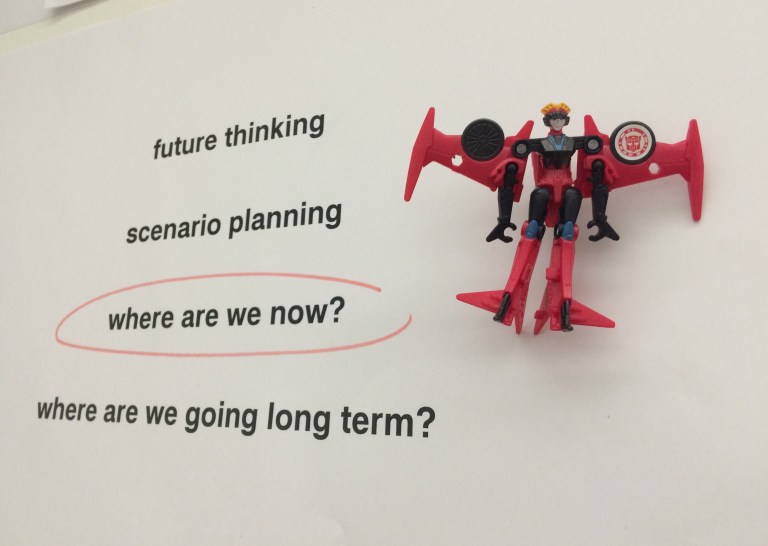
It’s a straightforward foresight and strategy starter pack, no nonsense, no jargon, helping to answer the questions “Where are we going?” and “What should we do?”
The session is aimed at US local government leaders, but should work for a wide range of institutions, communities, and settings.
‘Never assume the future will be an extension of the past’ Scenario planning in the Age of COVID-19
Matt Finch sat down with Trudi Lang, a senior fellow in management practice at Oxford University’s Saïd Business School. Lang is a researcher and strategist with particular expertise in scenario planning, a foresight methodology that seeks not to predict the future but to usefully challenge our assumptions about what’s coming next.
“The key challenge of government is to prepare for a future in which we will be surprised time and again,” said Peter Ho, then Singapore’s top civil servant, in 2009.
Few people at the start of 2020 would have anticipated an enormous symmetric shock affecting the entire world, demanding drastic interventions from the state — yet experts had been warning of a pandemic for considerable time. Indeed, as the New York Times reported in March, the US federal government had rehearsed for a pandemic three times over the last four years.
With the world plunged into uncertainty, how do we navigate the turmoil of the current pandemic and look beyond the crisis, into a future that is hard to picture clearly? Read more →
The Great Wave off Kanagawa, by Katsushika Hokusai
It’s the first ever virtual #LocalGovCamp, and in my workshop, we’ll consider the distinction between risk and uncertainty, explore straightforward ways to identify our strategic blindspots, and try out a range of tools intended to help an organisation and its stakeholders have richer, smarter conversations about their future decisions, on or offline.
We’ll refer to some practical case studies, and have time for questions and discussion of what it means to plan your way through the current pandemic and beyond.
Join us on Tuesday 12 May, 11.15am – 12 noon British Summer Time.
Late last year, I joined Alex Glennie of the UK-based innovation foundation Nesta on a short project in Helsinki.
Alex & I were supporting the Finnish innovation agency, Business Finland, as they explored the concept of “mission-oriented innovation”, where innovation policy is linked to societal missions.
Using ‘fast facilitation’ methods to swiftly elicit key ideas and pressing challenges, we asked participants to consider their mission in terms of the value created by their relationships with stakeholders in the innovation ecosystem.
On Tuesday 5th May, 8am Pacific / 11am Eastern / 4pm in the UK, I’m teaming up with ELGL (Engaging Local Government Leaders) to talk foresight, scenarios, and planning for uncertainty in local government.