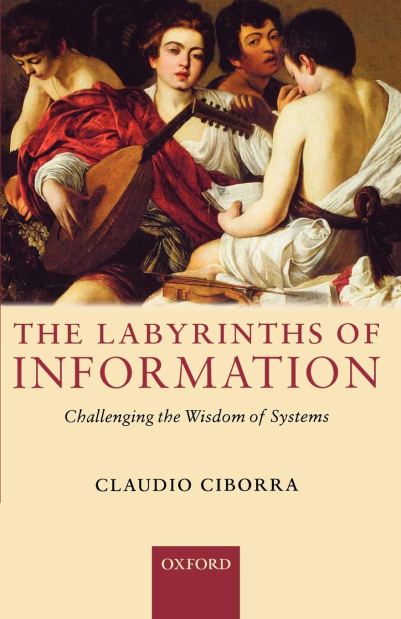
The late Claudio Ciborra (1951-2005) was an information systems researcher, organizational theorist, and Chair in Risk Management at the London School of Economics. Energetic, pioneering, unafraid to take a contrarian position, his work remains thought-provoking for readers today – even though he wrote on information, communication technologies, and organizational theory for a pre-smartphone age.
The Labyrinths of Information, published three years before Ciborra’s death, is a slim but densely written volume which sets out to “challenge the wisdom of systems”. It puts the complex and ambiguous realities of human existence and interaction at the heart of research into information systems and business processes.
Among other questions, Ciborra asks: Why are systems ambiguous? Why do they not give us more time to do things? Is there strategic value in tinkering even in high-tech settings? Are age-old practices valuable for dealing with new technologies? What is the role of moods and emotional concerns in influencing how we think and act?
As he reminds us, “the very definition of information systems as a set of technical […] and human resources devoted to the management of information in organizations spells out the composite nature of the field.” Humanity is always woven into the fabric of information systems.
Ciborra challenges our tendency to describe how information technology is used in terms of rationality and formal method. Academics, management consultants, journalists and other commentators tend to frame what is happening in business in terms of established concepts, neat little pigeonholes for the messy business of the world.
They tend to share basic assumptions: “there is a complex problem to be solved or a task to be executed; a corresponding strategy is deployed to achieve the goals and solve the problem; and a new structure is put in place to implement the solution.”
“To be sure,” Ciborra goes on to say, “decision makers would admit that day-to-day management is run in a more organic, ad-hoc fashion, and that textbooks and journal articles seldom seem to capture the intertwining of market events and managerial responses.”
Often rationalizations are brought in after the fact, and the “gap between what theoretical, ex post explanations and models can deliver and the actual garbage-can style of managerial choice is considered to be a fact of life by practitioners, and an unavoidable result of the limitations of any modelling approach[.]”
Yet Ciborra wants to move away from this approach, attending precisely to what he calls “the hidden or dark side of information systems […] focussing on the obvious, the workaday, and the very well known to any practitioner in the field.” He’s not excited by the latest management buzzwords or theories, and he’s disdainful of their “hospitality on PowerPoint slides by consultants and practitioners.”
Ciborra seeks improvisations, hacks, awkward real-life experiences, and the hard work involved in taking care of complex systems. He probes at the blank space papered over in presentations by phrases such as “You know no organizational model will fully capture the actual flow of events”, “The strategy was well laid out, but then, as you know, life is interesting because it is full of surprises”, and, simply: “You know what I mean.”
He builds his collection of essays around seven words, deliberately chosen for their unfamiliarity to English speakers – words that are meant to stop us in our tracks, shake us out of routine thinking, and apprehend the world of organizations and information systems anew.
No précis can fully do Ciborra’s rich, complex little book justice. But I can take you through a tour of those seven magic words to get you started. Magic for beginners, if you like.
Read more →