Human-Land Podcast: Spatial Justice and Realms of Citizenship

I joined the Swedish University of Agricultural Sciences’ Human-Land podcast to talk about social justice and foresight in spatial planning, and their links to environmental psychology.

As environmental psychologists explore the relationship between human beings and their environments – including how humans shape those environments and are shaped by them in turn – foresight work allows us to explore how that relationship might change in times to come, and how our ideas of what is fair or just in terms of access to different environments might also evolve.

Host Hannah Arnett and I spoke about the IMAJINE scenarios project and the possiblity of an approach to questions of space and justice that brings together a range of disciplines and perspectives on the common ground of the unwritten future.

You can listen to the episode now on Spotify and Soundcloud.
More than a Game: Scenario Planning, Imagination, and the Public Library’s Future

For Public Libraries Quarterly, Bronwen Gamble and Melissa Adams of the Reading Public Library co-wrote an article with me on our scenario planning journey through a leadership transition in the depths of the COVID-19 pandemic.

More than a Game: Scenario Planning, Imagination, and the Public Library’s Future” explores the use of frugal, online scenario planning methods during the pandemic and the benefits of a scenarios process in times of leadership transition.

It builds on Dale Leorke and Danielle Wyatt’s notion, expressed in their book The Library as Playground, of the library as “a space and institutional order innately imbued with playful qualities” to consider how libraries may be the perfect hosts for scenario processes which “play with expectations, hopes, fears, and desires, in a strategically consequential game of ‘What if?'”

Find out more about “frugal” scenario planning on the Oxford model from Rafael Ramirez and Trudi Lang at Saïd Business School, University of Oxford here.

Everyday resilience: Rural communities as agents of change

I’m very pleased to have played a small part in this work on the future of Irish peatlands: geographers Kate Flood, Marie Mahon, and John McDonagh of the University of Galway have published a new article on “Everyday resilience: Rural communities as agents of change in peatland social-ecological systems“.

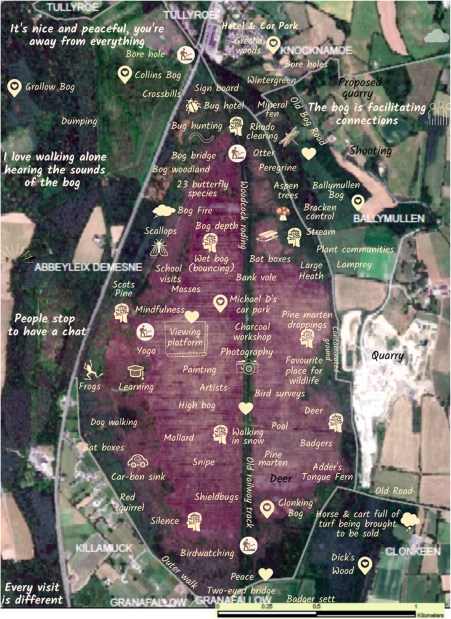
Their project included “Bog Scenarios” developed frugally with local communities. These used the past, present, and future of the peatlands to explore change through time including past events at the site; how the bog is currently changing; and hopes for the future.

Read more in the Journal of Rural Studies.

Community map of Abbeyleix Bog reflecting local knowledge and experiences

IMAJINE: Visions of the Rural in a Globalised World

In the latest response to the IMAJINE scenarios for the future of European inequality, Professor Esther Peeren of the University of Amsterdam explores the representation of the rural in each scenario, relating these visions back to concerns and challenges in the present day.

Drawing on Donna Haraway’s work, she reminds us that, “Rather than seeking to predict the future or escape from the present, these are ways of ‘staying with the trouble’ in the present, for the future.”

Esther highlights “the dangers inherent to the fantasy of the rural idyll as an isolated paradise shaped by a homogenous community, as well as underlining that such isolated worlds are not exclusive to the rural but may also exist in urban areas and online”; and she reminds us that even when the urban-rural divide seems to be overcome, its inequalities can be displaced “to the global and even interplanetary scale”.

Find Esther Peeren’s response to the IMAJINE scenarios here.

The full IMAJINE scenario set can be found here.

The RURALIMAGINATIONS project “Imagining the Rural in a Globalised World”, which Esther heads, can be found here.

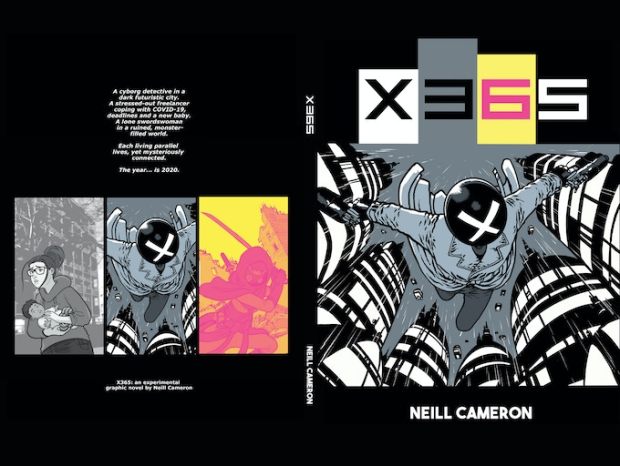
X365: The Graphic Novel, by Neill Cameron

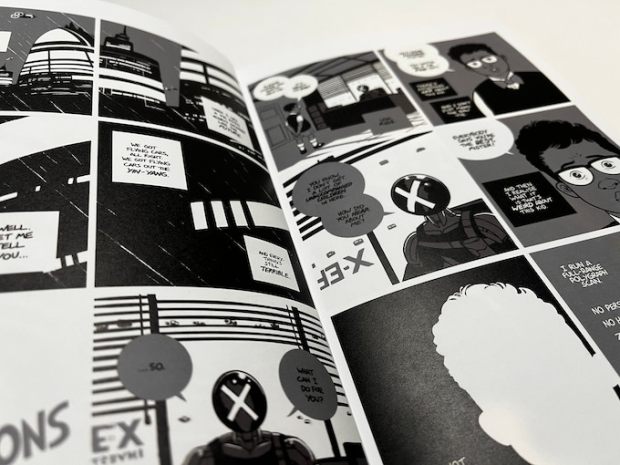
In early 2020, acclaimed comic creator Neill Cameron began to write and draw the one-panel-a-day comic X365: “No plan going in, no preparation. I’d just make a story up and see where it took me.”

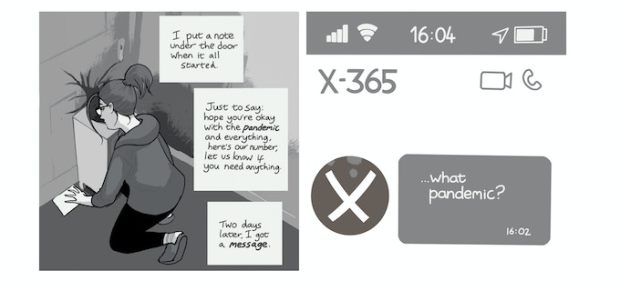
When the pandemic hit, it reshaped the tale Neill was telling, of parallel worlds entwined.

The full story is now being produced in a collected edition on Kickstarter, including an interview I conducted with Neill about the project as it reached its conclusion.

See more at the Kickstarter project page for X365: The Graphic Novel.

Scripturient: Computing Taste – Interview with Nick Seaver

For the latest issue of Information Professional magazine, my Scripturient column features an interview with Nick Seaver, Assistant Professor of Anthropology at Tufts University.

Nick’s new book Computing Taste uses ethnographic fieldwork to explore how the makers of music recommendation algorithms understand and go about their work – from product managers thinking about their relationship with users to scientists theorising the act of listening itself as a kind of data processing and engineers for whom the world of music is a geography to be cared for and controlled.

You can read the latest Scripturient column featuring Nick as a PDF download here, and there’s a full transcript of our conversation, digging even deeper into these issues and other elements of Nick’s research, below.

Read more

Preservation for All: Whose Future?

“We need to meet this inflection point with a more expansive imagination of what conservation work could be…The tools of the conservator can remind us of the fundamental human need for creativity, most especially under difficult or dehumanising conditions.”

In this short video for America’s National Gallery of Art, Sanchita Balachandran of The Johns Hopkins University speaks about “preservation for all” and strategising under TUNA conditions of turbulence, uncertainty, novelty, and ambiguity.

PUSH SUMMIT Podcast with Rowan Drury, Malin Leth, Anders Mildner

Altitude Meetings’ PUSH Summit on climate and democracy is currently taking place in the Swedish city of Malmö and online.

I joined sustainability consultant Rowan Drury, Malin Leth from Håll Sverige Rent – the Keep Sweden Tidy organisation, and Altitude’s own Anders Mildner to discuss issues of system change, futures thinking, strategy, and sustainability.

You can listen to the half-hour podcast here and watch my short online presentation to PUSH SUMMIT here.

Tomorrow’s Inequalities: Discussion with Mattia Vettorello

The designer and foresight practitioner Mattia Vettorello generously allowed me to join him for the final instalment of his podcast The Briefing Today.

During the episode, we talked about questions of foresight, changing social values, inequality, and injustice, using the IMAJINE scenarios as a case study.

You can hear previous instalments of the 22-episode series at Mattia’s website.

Ideas on Ghosts: Scenarios and the Spectral Metaphor

Did you just ghost me?

I just read Catie Disabato’s U Up?, a strange little mystery novel set in contemporary L.A.

Eve is a researcher for an app called LA By Foot which offers “definitive walking guides to the secret history, hidden paths, pedestrian staircases, and beautiful architecture of Los Angeles”. A historian at UCLA highlights notable locations in the city, then Eve visits them, photographs them, and writes the copy.

“I could do it all myself,” Eve explains, “research the history of Los Angeles by reading any or all of the many books James Danielson has published, but he has something I don’t have: the social power that comes from having a masculine name that starts with a J.”

So Eve walks the city, through hangovers and simmering California heat, all the while keeping another secret: on her iPhone, she texts her friend Miguel, who died by suicide a year before. And Miguel’s ghost texts back.

The novel follows the events around the first anniversary of Miguel’s death, when Ezra, who was Miguel’s friend and Eve’s, goes suddenly missing. As she tries to discover whether Ezra is merely avoiding her or something more sinister has happened, Eve is forced to confront what is going on within and between their circle of friends.

Disabato’s book addresses different kinds of spectrality with delicacy and deftness. In this world, there’s little difference between a supernatural revenant like Miguel’s ghost and a living friend who Eve is messaging, “trapped inside my useless idiotic lump of an iPhone.”

Read more