New Librarianship Symposium: Scenarios for the COVID-affected world?

On November 18th, I’ll be joining the fourth of the New Librarianship Symposia convened by leading information professionals to explore key issues and new agendas for the COVID-affected world.

The symposia mark ten years since the publication of R. David Lankes’ Atlas of New Librarianship, and offer an opportunity to reinvigorate institutions’ approach to the ever-changing information environment.

In the panel on “Re-imagining the future”, I’ll be presenting a paper on “Mapping the future: scenario planning for the post-pandemic library” (PDF download), drawing on a case study of public library planning in the context of the coronavirus pandemic and America’s widening political rifts.

The paper explores both the use of scenarios, and the benefits of attending to value co-creation, in devising library strategy.

My contribution will be in dialogue with thought provoking papers from Seattle Pacific University’s Michael Paulus and a team at the OCLC library cooperative. We’ll consider what might await for information institutions and the communities they serve; how best to move forward in times characterised by turbulence, uncertainty, novelty, and ambiguity; and what it means to practice strategy at different levels, from the global to the deeply local.

Do join us for the fourth of the New Librarianship Symposia on November 18th, 2021.

SHAPE Education: Schools, Work, and the Adaptation Advantage

The archive from this summer’s SHAPE Education event, organised by Cambridge University Press and the Judge Business School, is now online.

I spoke on the future of work and its implications for education with a panel including Bell Education’s Silvana Richardson, Cambridge University Press’ own Ben Knight, and Heather E. McGowan, author of The Adaptation Advantage.

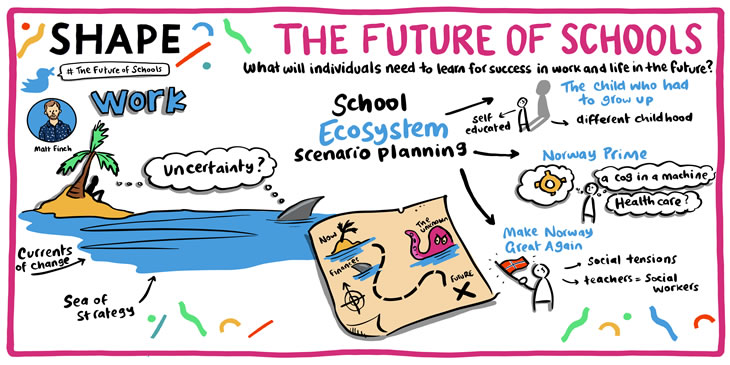
We were also supported by live drawings from the brilliant Rebecca Osborne.

SHAPE Education: Matt Finch's talk

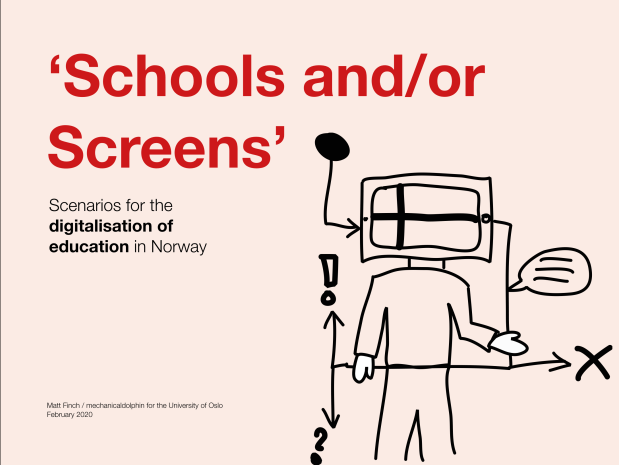
You can find more about the SHAPE conference series online, and explore the University of Oslo “Schools and/or Screens” scenarios, which I discussed during the panel, here.

Publication of the IMAJINE Scenarios for the Future of European Regional Inequality

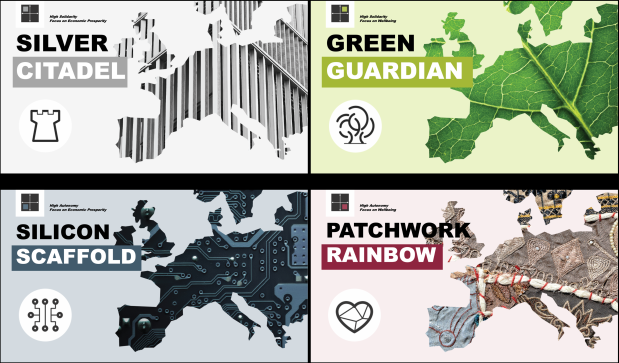
The four scenarios produced by the Horizon 2020 IMAJINE project to explore the future of European regional inequality have now been published.

The scenarios explore questions of territorial equality – Do EU citizens have equal rights and opportunities regardless of wherever they live? – and spatial justice – Are different places treated fairly? Is your ability to realise your rights compromised by where you live?

Questions of justice are defined socially and narratively – even when a court says it is considering “the balance of probabilities”, it adjudicates between competing stories told by the parties arguing a case. That means we can’t just run the numbers when it comes to the future of inequality, but must explore how notions of fairness and justice might change in times to come – and what those changing notions might tell us about issues in the present.

As Ursula K. Le Guin put it in the quote we chose for IMAJINE’s epigraph, “We will not know our own injustice if we cannot imagine justice. We will not be free if we do not imagine freedom.”

Each vision of Europe in 2048 offers a different perspective on these issues as they are emerging in the present, and offers an opportunity to reframe the discussion around regional development and inequality. The scenario set includes respondents from a wide range of sectors and institutions around the world, offering further insight into the implications of each scenario.

You can download the IMAJINE scenario document as a PDF from the project website – and there’ll be further updates and expert responses at the IMAJINE homepage as the scenarios are rolled out over the coming months.

Circulating Ideas: Scenario Planning With Reading Public Library

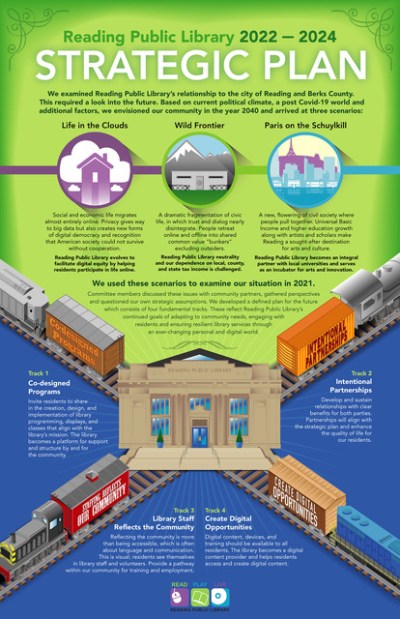
Bronwen Gamble, Executive Director of Pennsylvania’s Reading Public Library, appeared with me on the American library podcast Circulating Ideas to share our experiences of scenario planning during a pandemic.

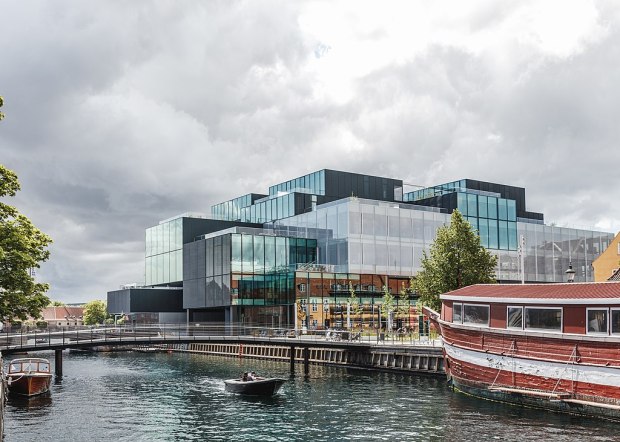
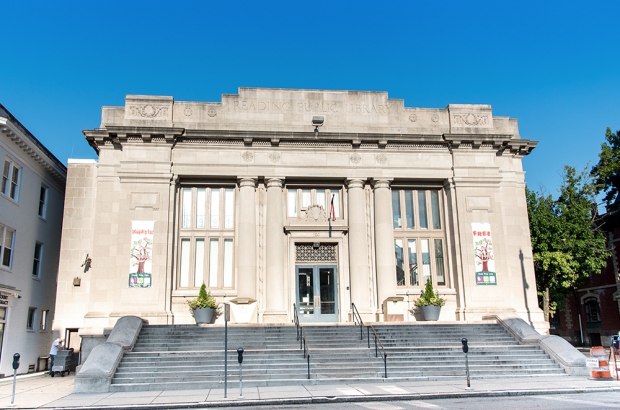
Reading Public Library, PA – Image Courtesy of Berks County Public Libraries

You can listen to the show, or check out a transcript, over at the Circulating Ideas website.

Learning from futures you didn’t see coming? Scenario planning, education and the (post)pandemic world at CO:RE

It was my privilege to join the University of Oslo’s Niamh Ní Broin and Steffen Krueger at the website of CO:RE, the Children Online: Research and Evidence project funded by the European Commission, to write about last year’s scenarios for the future of Norwegian schools.

These explored different contexts for the digitalisation of education in Norway, considering how the relationship between learners, digital devices, and educational institutions might shift in times to come.

You can read our piece, “Learning from futures you didn’t see coming? Scenario planning, education and the (post)pandemic world”, here.

Tales of the times to come: the humanities and scenario planning

“What do the humanities have to offer strategists, policymakers, and decision-takers in the age of the algorithm? As machine intelligence and computational power increase, as we gather ever more data from ever more sources, do the humanities still offer a valuable perspective on times yet to come?”

Over at the website of the Irish Humanities Alliance, Marie Mahon and I have a piece on what our training in the humanities has brought to our work on the IMAJINE project for the future of European regional inequality.

SHAPE Education: Schooling, Skills, and the Future of Work

I’ll be speaking at the SHAPE Education 2021 conference on Wednesday 14th July, joining the panel “What will individuals need to learn for success in work and life in the future?” alongside Heather E. McGowan and Silvana Richardson.

We’ll be asking, what skills, knowledge and characteristics will employers need and be looking for in future? How will education systems help people develop these within and beyond schools? And will relationships between schools and employers change?

You can join our panel, and other sessions from the week-long SHAPE event, for free.

RCOT 2021: Scenarios, foresight, and occupational therapy

Next week, Griffith University’s Professor Matthew Molineux and I present on scenario planning for the 2021 conference of the Royal College of Occupational Therapists.

In advance of the conference, we got together for an informal chat covering five years of work pushing the boundaries of occupational therapy education, exploring what futures & foresight work can do for occupational therapists, and how learning from the futures which challenge our assumptions can complement the practical experience which comes from student placements.

“Why would you write it if you’ve already solved it?”: Interview with Chana Porter, Part 3

Playwright, novelist, and education activist Chana Porter joined me to talk about her new novel The Seep

In the book, Porter imagines an alien invasion of an unusual kind. The Seep find their way into the Earth’s ecosystem and cause every living being on the planet to become connected. “Capitalism falls, hierarchies and barriers are broken down; if something can be imagined, it is possible.”

You can read the first part and second part of our interview here, or check out the complete text now as a PDF download. In this instalment, Chana talks about loss, change, her goals as a writer, and the histories of secret writing in her own family.

M: The book is so steeped in grief, and it’s a theme we see elsewhere in your writing; the play Phantasmagoria has this question, for example, “Do the dead truly leave us?”

How did grief come to the forefront in this particular novel?

C: Don’t you think that ageing is a kind of grief? We betray our younger selves, our ideas of who we were or what we wanted, as we move on in time. I’ve lost some dear people who are close to me, people who died suddenly and young, so I have a little more of that shock of grief than some — but I think that in any kind of long-term relationship, what people don’t tell you about marriage is that there is a slow betrayal of whoever you were on your wedding day. I think that if there’s not, you’re doing it wrong! 

You need to become another person when you make this commitment, and you’re very lucky if you can change alongside your partner in a way that you get to rediscover one another. I don’t really know how we manage to promise anyone else anything, except to be clear, and true, and kind.

Read more