#NotEnoughSciFi is an occasional series looking at works of science fiction and fantasy which I think might be useful for organisations, institutions, companies and communities which are trying to get ready for the shape of things to come. See previous entries here.
Girls who loved the strangeness of pulp SF have grown up and seen that strangeness as a tool for inventing futures where women are free (or become free).
Calling all aspiring writers! We’re offering in-depth fiction and non fiction workshops with award winning local and international authors – including Jasper Fforde! In partnership with QLD Writers Centre. 5 – 8 September 2019. State Library of QLD. https://t.co/TRR2wTroVspic.twitter.com/438z5UOj1S
Fforde is known for eclectic genre-bending novels including the Thursday Next series, which follow the exploits of a woman who is able to cross the boundary between literature and her reality.
I was interested to see if Fforde’s work could be useful for strategists and foresight professionals trying to craft evocative visions of the futures we might inhabit. Although his stories tend to be set in wild and comic universes, his workshop had more than a few nuggets of wisdom for people trying to imagine futures they could strategically act on.
#NotEnoughSciFi is an occasional series looking at works of science fiction and fantasy which I think might be useful for organisations, institutions, companies, and communities which are trying to get ready for the shape of things to come.
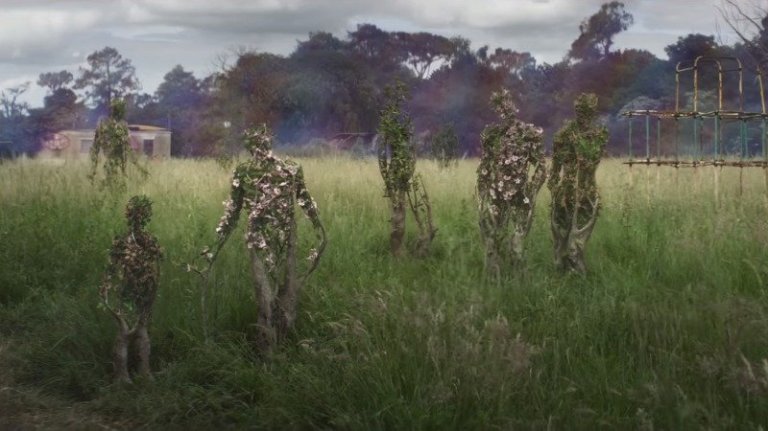
This week’s entry focusses on Jeff Vandermeer’s “Southern Reach Trilogy”, the first book of which was adapted into the Netflix movie Annihilation last year. See previous entries from #NotEnoughSciFi here.
The most common source of management mistakes is not the failure to find the right answers. It is the failure to ask the right questions. Nothing is more dangerous in business than the right answer to the wrong question.
– Peter Drucker
After a mysterious event, an unknown force takes over a backwater of the southeastern US coast. Warded from the outside world by a barrier that defies physicists’ understanding, the so-called “Area X” begins to distort the environment in ways which are difficult to study, record, or comprehend.
Over a period of years, a government agency tasked with understanding and controlling the zone sends in countless expeditions, to little avail. The latest group, composed entirely of women, also succumbs to the zone’s weird dangers. The sole returning survivor, a taciturn biologist, is compromised by her encounter with Area X – but what has happened to her? And what does it mean for the affected zone – or for life as we know it on Earth?
This is the world of Jeff Vandermeer’s “Southern Reach Trilogy” – Annihilation, Authority, and Acceptance – the first instalment of which was filmed by Netflix, with Natalie Portman in the lead role, last year.
Netflix’s Annihilation is a visually sumptuous adventure which challenges sci-fi’s traditional gender imbalances by following an all-women team of explorers into the mysterious zone. But there are even richer pickings to be found in Vandermeer’s trilogy.
The “Southern Reach” books offer a complex exploration of institutional and personal encounters with unknown or uncontrollable phenomena. Their refusal to offer easy answers, their dissection of office politics and power relations, and their critique of the structures by which we seek to make sense of and control the world, all make them valuable fodder for a special edition of #NotEnoughScifi. Read more →
It’s been a while since the last #NotEnoughSciFi, an occasional series looking at works of science fiction and fantasy which I think might be useful for organisations, institutions, companies, and communities which are trying to get ready for the shape of things to come. See previous entries here.
I had a glorious time with a book last week. Something that hadn’t happened since I was a kid.
I was busy at work and didn’t have much time for leisure reading. So when I started Ian Tregillis‘ novel The Mechanical, I only expected to manage a half-hour or so a night before falling asleep.
Instead, I stayed up through the night to finish the book. The next evening, I started the second volume of the trilogy which The Mechanical begins. On the third night, bleary but compelled, I finished Tregillis’ series. I spent my nights lost in his world. It was heaven on earth.
The series – called The Alchemy Wars trilogy – is a work of fantasy, not science fiction. It is set in an alternate version of the year 1926 which owes as much to the 17th century as the 20th, where the Dutch and French are the warring European powers whose conflict has shaped global history.
So why does it have anything to teach us in 2019? Read more →
#NotEnoughSciFi is an occasional series looking at works of science fiction and fantasy which I think might be useful for organisations, institutions, companies and communities which are trying to get ready for the shape of things to come. See previous entries here.
These days, it can feel as if reason, facts, and truth themselves are under assault. As if the institutions and professions – the academy, journalism, research, librarianship – which have allowed many of us to understand and discuss the world on common ground are beleaguered.
In pop culture, can we find new ways of imagining these figures for the coming world? Do science fiction, fantasy, and the study of our society overlap and can this overlap help us?
Rich is an exceptional storyteller and advocate for libraries, and alongside his comms work he has created the Ann Arbor Stories podcast and a spinoff publication, The Book of Ann Arbor.
I began by asking Rich how he came to join the team at AADL.
It’s the final edition of Curious, Mysterious, Marvellous, Electrical today – the newsletter I’ve used to capture stories and secret histories from Australasia and beyond over the last two years.
Pop stars at the fall of Communism. A man who builds imaginary tools to solve problems that never were. A mining engineer who made a ten-tonne truck disappear through a metre-wide tunnel.
Approaching the end of the year and the final instalments of Marvellous, Electrical, we’re joined by two humble figures with secret artistic careers.
Andy MacDonald, factory supervisor at Queensland’s Cobb + Co Museum, recounts a life spanning mining, sculpture, stage design, and jet fighter maintenance in Part 1 of The Fitter And The Handyman.
At “Cool Story Bro,” the guest storyteller shares tales from their past, based on audience prompts, which then become fuel for improv sketches by the troupe. It’s an interesting format with roots in the work of the Upright Citizens Brigade, which has been home to the likes of Amy Poehler, Donald Glover, and Aziz Ansari.
You can watch Tina Fey doing this kind of storytelling here:
I’m no Tina Fey, but I did my best. My stories came from the audience call-outs “cats”, “whales” (or “Wales”), and “first kiss”. As always with these things, it was entirely terrifying & nerve-wracking right up until the moment you stepped on stage and just had to do it.
I found stories from my life and told them messily and honestly, with plenty of detail for the improv troupe to riff off. In turn, they made skits about talking meteorites, a school for nervous possums, and TV cookery shows. It was fun to see your experiences reworked into something that preserved only the vibe; details warped and reworked into new contexts, themes you hadn’t spotted in your own tale coming to the fore.


 matt finch / mechanical dolphin