UNESCO Prospects Journal: Scenarios and the future of education

The question for teachers, learners, and the various organizations and communities in which they participate becomes “How will we adapt, evolve, and thrive even if uncertainties play out in ways for which we had not initially prepared?”

In the UNESCO International Bureau of Education’s journal Prospects, the University of Oslo’s Steffen Krüger, the University of Agder’s Niamh Ní Bhroin, and I discuss the “Schools and/or screens” scenario project for the digitalisation of education in Norway.

UNESCO Headquarters sign. (C) Matt Finch, 2023

We show how challenging issues raised in the context of distant imagined futures proved to be immediately pertinent in the developing Covid-19 pandemic, and, as a wide range of actors explore the possibility of a new social contract for education, we reflect on how future scenarios can provide fresh perspectives on issues that are difficult or even impossible to resolve within current frames of reference, including questions of equity and justice that may be construed differently in times to come.
Read “Unlearning, relearning, staying with the trouble: Scenarios and the future of education” at Prospects online.

“An app is not going to solve our democracy; it’s something we have to solve ourselves.”

In the new issue of the journal Surveillance & Society, Oxford’s Carissa Véliz, sci-fi writer and aid worker Malka Older, and Capgemini Invent’s Annina Lux join me to talk about how future scenarios can inform discussion, debate, and decision-making about the relationship between artificial intelligence and surveillance.

Read “The Art of Strategic Conversation: Surveillance, AI, and the IMAJINE Scenarios” here.

IMAJINE: Digital Futures

Citizens gaming artificially intelligent policy mechanisms, a telepresence Luddite movement, ecological damage from cyberattacks, corporations supplanting governments, & rights for intelligent software agents – Caroline Baylon of the UK’s All-Party Parliamentary Group for Future Generations explores potential implications for the digital world, cybersecurity, and AI in the IMAJINE scenarios.

You can read Caroline’s response to the scenarios at the IMAJINE website.

Fandom & Information Literacy: Discussion with Ludi Price

Sometimes – often – the most interesting ideas comes from the margins. The status quo is best challenged from the borderlands and fringes, the shadows, anywhere that is overlooked.

In our digitalised world, new ways to create, manage, and share information are emerging all the time. The most innovative and rewarding approaches might not come from the institutions that are longest established, have the best trained staff, or the most substantial budget.

They might come from places where people are driven by passion to experiment with something new.

I recently sat down for a chat with Dr. Ludi Price, China & Inner Asia Librarian at London’s School of Oriental and African Studies, and an Honorary Visiting Fellow at City University’s School of Library & Information Science. Her research has focussed on fan information behaviour: the ways in which communities of people with a shared passion for pop culture have managed, organised, and distributed information relating to their fandom.

What can information professionals, the institutions and communities they serve, learn from the way that fans deal with the same challenges and opportunities faced by those who deal with information for a living? Ludi has some answers.

OECD Government After Shock Podcast with Saskia Van Uffelen

Following our recent two-part discussion on this blog, you can hear Saskia Van Uffelen, Belgium’s Digital Champion, speaking with me on the OECD’s Government After Shock podcast in this week’s discussion.

During our interview, Saskia explores communication, leadership, and adaptation beyond crisis. If we pull on the “elastic” of our society and its institutions too far, it will break. Are we ready to fashion a new, more resilient world as the crises of 2020 demonstrate the old one’s limitations?

“The first, the fast, and the least reluctant to change will succeed”: Interview with Saskia Van Uffelen, Digital Champion for Belgium, Part 2

Saskia Van Uffelen is the Digital Champion for Belgium, tasked with promoting the benefits of digital society as part of the European Commission’s efforts to ensure every European citizen acquires the digital skills they need to remain productive, employable and enfranchised. After a career encompassing roles at Xerox, Compaq, HP, Arinso, Bull, and Ericsson, she is currently Corporate Vice President for the French group GFI, supervising developments in the Benelux countries. Saskia is also the author of Dare For Tomorrow: Leading, Working, Learning, and Living in a Digital World. You can read the first part of our interview here.

Image

As Digital Champion, you have an interest in the future of the public library, an institution which is also very dear to my heart. The social changes you’re describing will have an impact on our civic information institutions, and the context they operate in.

You’ve said elsewhere that, “If anything has remained the same in your organisation (culture, processes, eco-systems), it will simply not work anymore. You need to adapt your company and your culture. Adapt or die.”

Are libraries too prone to thinking about what used to work, instead of looking strategically to the future and to forces outside their sector?

Read more

“We have stretched our society to breaking point…These issues are the responsibility of all of us”: Interview with Saskia Van Uffelen, Digital Champion for Belgium Part 1

Saskia Van Uffelen is the Digital Champion for Belgium, tasked with promoting the benefits of digital society as part of the European Commission’s efforts to ensure every European citizen acquires the digital skills they need to remain productive, employable and enfranchised. After a career encompassing roles at Xerox, Compaq, HP, Arinso, Bull, and Ericsson, she is currently Corporate Vice President for the French group GFI, supervising developments in the Benelux countries. Saskia is also the author of Dare For Tomorrow: Leading, Working, Learning, and Living in a Digital World.

Image

The crises of 2020 have moved many aspects of our lives online, not always without complications. I started by asking what this year looks like from the perspective of Belgium’s Digital Champion.

Read more

Interview with The Writing Platform

I think one of the hard things about trying something new is figuring out how to work with people’s expectations. When you click that link, do you want to be told a good story? Do you want to be given a good puzzle, with the satisfaction of finding the “right” solution? How much effort should you be expected to put in? How much uncertainty should you experience?

I spoke with Simon Groth of The Writing Platform about my most recent interactive text, The Library of Last Resort.

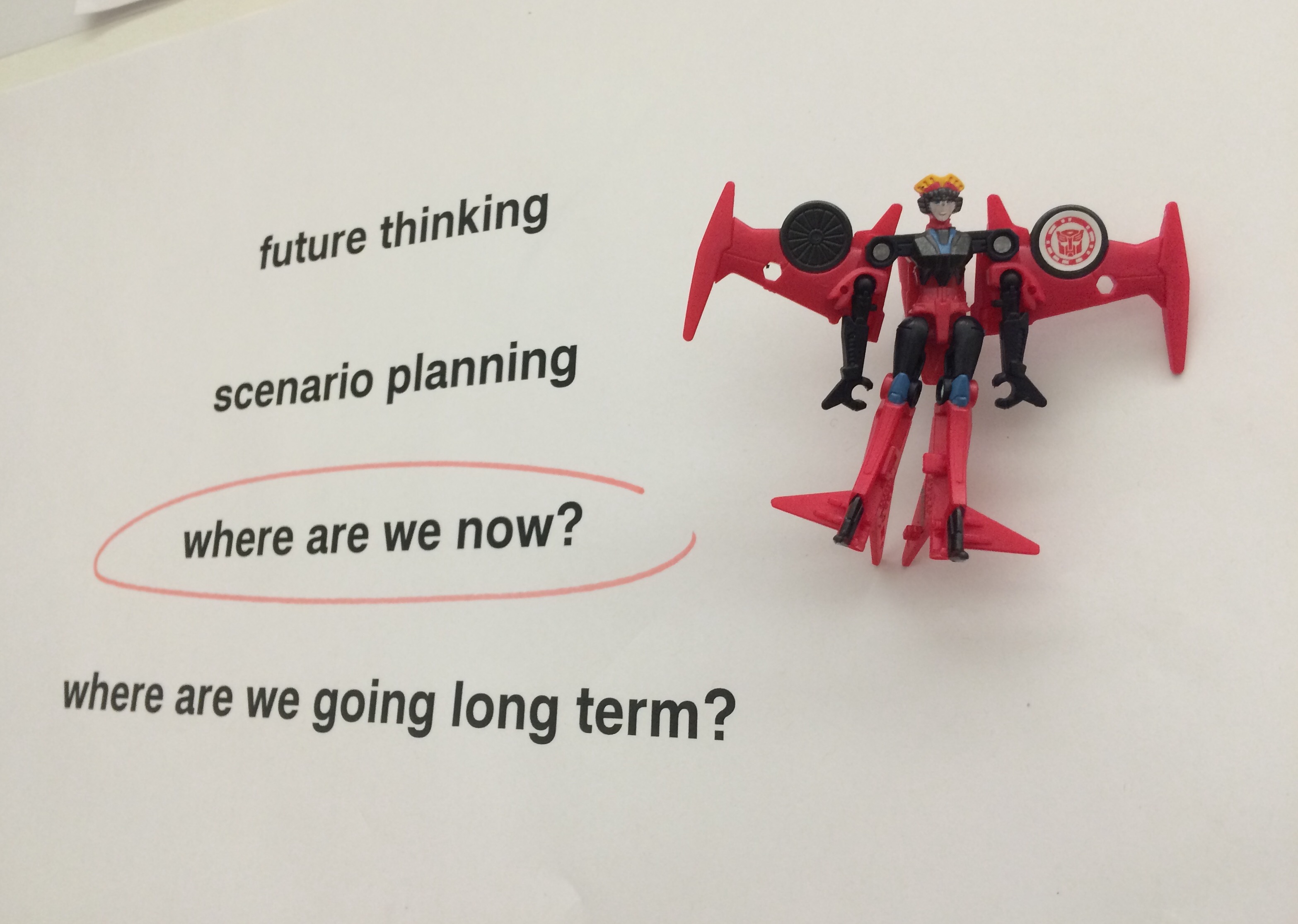
Windblade toy on the planning wall at State Library of Queensland

We talked about strategy and foresight, audience and agency, libraries and information (inevitably), and also learning from the wonder, freedom, and richness of children’s play.

It was a good chat. Check it out over at the Writing Platform website.