“What’s after archives?”: Kate Eichhorn and the End of Forgetting

I’m proud to present a Q&A transcript with the New School for Social Research’s Professor Kate Eichhorn, author of The End of Forgettting.

We spoke earlier this year to discuss who gets to tell their own story in the age of social media, what are the consequences to such stories being shared, and what power do we have to forget or be forgotten in this new digital era? This conversation formed the basis for an instalment of “Scripturient”, my column in Information Professional magazine, but now you can read a Q&A expanding on that text, below.
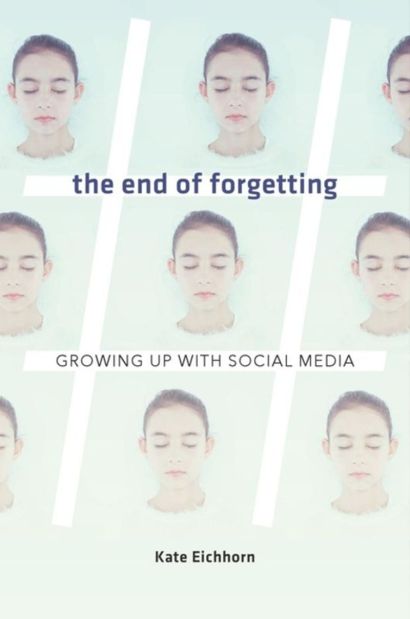
Matt: When did the idea for The End of Forgetting coalesce?

Kate: Prior to working on this book, I had been thinking about and writing about archives for many years. There was a moment when I literally asked myself, what’s after archives? I immediately thought, it’s forgetting. But all of my colleagues who work in archives were very quick to remind me that the archive and forgetting are inextricably linked. So, this book was a kind of natural extension of my earlier work on archives. But the book, while not a personal book, is informed by personal circumstances. On the one hand, when I started working on the book, my kids were maybe 11 and 13, so I was certainly thinking about the tween girls and their relationship to social media. As a parent, I also started to think about how different my life would have been had I been on social media when I was their age. I am almost certain that I would have either said or done things I would have regretted and that there would have been consequences. 

Read more
Scripturient: The End of Forgetting

The latest installment of my “Scripturient” column for Information Professional magazine features the New School’s Kate Eichhorn, author of The End of Forgetting.

Together, we discussed: Who gets to tell their own story in the age of social media? What are the consequences of such stories being shared? 

How will digital media transform the ways we remember and are remembered, now and in times to come?

Will old deeds, old relationships, and our own former selves become inescapable thanks to new technologies and the capitalist frameworks in which they are deployed?

Read more in “Owning your own story” (PDF download).

Wilfred Bion’s DAZED AND CONFUSED

There’s been a feeling lately of things coming full circle for me.

There’s been a period in which the links between the scenario work I do today and the art of moviemaking, which obsessed me as a kid, became very evident – you can see some of this in my recent writing on Decision to Leave, Burden of Dreams, and The Limey.

And I found myself training as a group facilitator at the Tavistock and Portman NHS Trust, a specialist mental health organization in the UK.

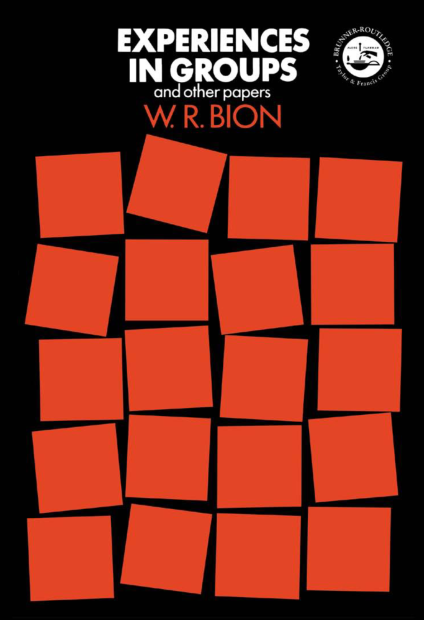
This is a journey I probably should have seen coming ever since a colleague, Steffen Krüger, sat down with me after a scenario planning workshop which had left Post-It notes strewn across a number of whiteboards, and showed me the strangely resonant cover of the psychoanalyst Wilfred Bion’s book Experiences in Groups.

Read more

Exploring Photography with Wendy Catling, Dr. Natasha Barrett, and Jonathan Bart

Last month, I invited three photographers to discuss how their medium is used for art, research, and storytelling in families, communities, and institutions.

Joining me for the conversation were Australian artist Wendy Catling, Research Librarian Dr. Natasha Barrett of the Alexander Turnbull Library (National Library of New Zealand Te Puna Mātauranga o Aotearoa), and British filmmaker Jonathan Bart.

Do photographs offer a collection of scattered moments or an unbroken connection to the past? From first pictures taken through “memories of memories”, stories of migration and famiy secrets, questions of colonialism, agency, and power, my three guests talk candidly about their personal, professional, and artistic relationships to this unique and powerful medium.

You can listen to the discussion on Soundcloud or YouTube.

Would you like to find out more about my guests?

Wendy Catling’s work appears at her own website and the site for her most recent project Nightshade, discussed in the podcast. (She is currently fundraising for the Nightshade photobook).

Read more about Dr. Natasha Barrett’s research at the University of Leicester website, and you can also find Natasha on Twitter.

Jonathan Bart’s work appears at his own website. You can also find Jonathan on Instagram, Behance, Vimeo, and Flickr.

The Important Thing Is Elsewhere

The Family Tree

Before all this, I went to my grandfather’s house in Spain. I’d never really liked it. It wasn’t the house he’d lived in as I grew up, which was just down the road from the new place. That had been the house of memories, the place where my grandmother had died before I was born.

He bought the new place when it was time to find a smaller, more manageable property, as he entered his eighties and I my twenties. I worked with him on both houses, helping him to do up the old one and improve the new. I painted walls white and coated tiles with red rubber sealant; mixed cement and ferried endless wheelbarrows of it to wherever he was working that day. He chided me for my cement mixing technique, for the way I handled a paintbrush or a pickaxe, the way I clambered up and down ladders and scaffolding, fetching tools and materials. It was the happiest time.

He died, digging over the garden of the new property with a rotorvator, when I was 23. He’d have been glad to go that way; he’d always talked of “falling off his perch” rather than a dreaded slow decline, and even when we were working together on the new place, he’d still pull stunts like climbing into the tree he was pruning, clinging to the branch above him while standing on the one below, which he was sawing off, jumping up and down to speed the process.

Read more

Afterlives of Evidence: A Response from @katbhave

New Zealand-based librarian Kat Moody read my post on Afterlives of Evidence, archives, and grief last week. She offers this response, exploring military history, natural disasters, landscape and memory.

20180205_182124
Photograph by Kat Moody

Recently I had the opportunity at work to attend a course on character strengths run by the Mental Health Education Resource Centre. It’s great that these opportunities for healthcare professional development are being opened up to librarians. Last year I went to one of their courses on grief. This was an incredibly valuable session where I learnt a lot; one thing that stood out to me was that we don’t just grieve for people, we also grieve for places and things, particularly in times of change. Sometimes these aspects are inextricably linked.

Because I work in the centre of Christchurch, I am surrounded by sites of memory and sites of mourning. Read more

It’s the Tyrell Corporation Comedy Hour!

On Friday, 20th October, I was the guest storyteller at Brisbane improv troupe Big Fork Theatre’s “Cool Story Bro“.

At “Cool Story Bro,” the guest storyteller shares tales from their past, based on audience prompts, which then become fuel for improv sketches by the troupe. It’s an interesting format with roots in the work of the Upright Citizens Brigade, which has been home to the likes of Amy Poehler, Donald Glover, and Aziz Ansari.

You can watch Tina Fey doing this kind of storytelling here:

https://www.youtube.com/watch?v=aJjtLmIO6hQ

I’m no Tina Fey, but I did my best. My stories came from the audience call-outs “cats”, “whales” (or “Wales”), and “first kiss”. As always with these things, it was entirely terrifying & nerve-wracking right up until the moment you stepped on stage and just had to do it.

I’ve been getting all excited about memories lately – how they blur the bounds between fact and fiction, how they might be shared or transplanted between us. And I like challenging myself to get out of my comfort zone.

I found stories from my life and told them messily and honestly, with plenty of detail for the improv troupe to riff off. In turn, they made skits about talking meteorites, a school for nervous possums, and TV cookery shows. It was fun to see your experiences reworked into something that preserved only the vibe; details warped and reworked into new contexts, themes you hadn’t spotted in your own tale coming to the fore.

Read more

Memory Squad!

What does it mean to have a creative relationship with the past?

How do 21st century institutions manage our cultural heritage?

I asked Jacinta Sutton, Gavin Bannerman, and Laura Daenke of the State Library of Queensland.

Call them the Memory Squad.

tumblr_n6iv53qq8z1sa11jco1_500

Read about their work over at Library as Incubator today.