For the “One Thing” library thought leadership series convened by my colleague Brendan Fitzgerald, I wrote a piece on how libraries & information institutions can use scenario planning to address conditions that are turbulent, ambiguous, novel, or unpredictably uncertain.
Albert Bierstadt, A Storm in the Rocky Mountains, Mt. Rosalie
“Libraries are an institution with a long and storied global history, but their context is transforming too. Our societies’ relationships to fundamental notions of information and trust are subject to change. The social, economic, and political orders within which libraries have survived or thrived are not set in stone.
Library leaders seeking to make sound judgments need to be able to anticipate futures beyond those currently expected or predicted. By stretching our sense of what awaits, we can gain insights from the future before it arrives – rather than having to “learn the hard way” from the brutal audit of real crises and changes.”
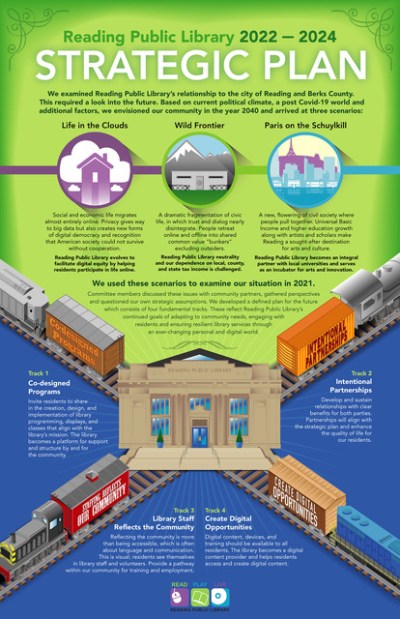
I supported the Reading team through the early months of this year to devise a set of scenarios for the library’s future operating context, and use these scenarios to inform a new strategy. You can read about the process in my paper for the New Librarianship Symposium, “Mapping the Future: Scenario Planning for the Post-Pandemic Library“.
Reading is a fascinating library service which has a proud tradition of negotiating complex strategic circumstances; there’s a reason why the 1971 chronicle of its existence is called The Library That Would Not Die: The Turbulent History of the Reading Public Library. The challenges of COVID-19 and Pennsylvania’s hotly contested politics were only the latest to be faced in its 250-year history. It was my privilege to support the current team in planning for the next four years.
Reading Public Library’s Executive Director, Bronwen Gamble, writes:
“Creating a new strategic plan for RPL was overdue. Our 2013-2018 plan was modified for two years but the process for creating a new one met several obstacles. Enter the COVID-19 pandemic and virtual meetings. I attended the Pennsylvania Bureau of Library Development’s series of workshops facilitated by Matt Finch and was introduced to his Scenario & Foresight Planning process. Our Board of Trustees and library staff feel very fortunate we were able to engage Matt to lead us through our own library’s scenario and foresight planning with Matt in London and the library team in Reading, PA.
Using a mural app, and Zoom sessions, Matt facilitated our conversations around the collaborations, services, and transactions, which shape our work at every level. Matt acted as a guide, making suggestions and providing alternatives rather than telling us what to do or how to proceed. Our team members were enthusiastic and active participants. Imagination was encouraged and everyone had buy-in. Matt’s scenario & foresight planning process is much different than the usual SWOT analysis, and number crunching. We had fun and lively sessions!
Looking back, I believe it is a good thing our old strategic plan was allowed to languish. The changes brought about by the pandemic would have made a strategic plan created in 2019 obsolete in 2020. Our team has ownership of the Reading Public Library’s Scenario & Foresight Planning to Strategic Plan 2021-2025. We looked into the future, found three plausible outcomes, and crafted a plan that works for today and is flexible to accommodate whatever happens in the next five years. Thank you, Matt, for giving us the tools to move forward with confidence!”
In the latest instalment of Information Professional‘s ‘Scripturient‘ column, guest writer Sanchita Balachandran tells the story of meeting her late maternal grandfather for the first time among the collections of a colonial archive.
Born in Nagercoil, South India and trained in forest management at the University of Edinburgh in the early 1930s, her grandfather’s journey is part of a wider network of relationships spanning the generations, and stretching from the Indian state of Travancore to Baltimore and beyond.
In her column, Sanchita explores the resonances between her grandfather’s work as a conservator of forests and her own role as Associate Director of the Johns Hopkins Archaeological Museum; she reflects on the necessary, mundane, often invisible work of cultural heritage professionals; and she considers the complex emotions experienced when “harm and recovery, disconnection and reunion” are entangled in our experience of the colonial archive.
What do we owe to the families and loved ones of the long deceased? How do objects bear witness to our lives, and how is that act of witnessing complicated by questions of power, justice, and belonging?
On November 18th, I’ll be joining the fourth of the New Librarianship Symposia convened by leading information professionals to explore key issues and new agendas for the COVID-affected world.
The symposia mark ten years since the publication of R. David Lankes’ Atlas of New Librarianship, and offer an opportunity to reinvigorate institutions’ approach to the ever-changing information environment.
The paper explores both the use of scenarios, and the benefits of attending to value co-creation, in devising library strategy.
My contribution will be in dialogue with thought provoking papers from Seattle Pacific University’s Michael Paulus and a team at the OCLC library cooperative. We’ll consider what might await for information institutions and the communities they serve; how best to move forward in times characterised by turbulence, uncertainty, novelty, and ambiguity; and what it means to practice strategy at different levels, from the global to the deeply local.
For the latest edition of Information Professional magazine, I interviewed MIT’s Rodrigo Ochigame about researching and building alternative systems to search, index, and filter the information we want, need, or require.
For the latest edition of Information Professional magazine, I interviewed singer-songwriter Jonatha Brooke about her experiences creating an album of new songs from Woody Guthrie’s archives.
Matt: Guthrie’s archive is a blend of images and words, sketches and paintings – it’s not just a collection of texts, let alone ready-made lyrics waiting to be put to music. What surprised you when you started to explore what he’d left behind?
To consume media today means using the same tools and skills as it takes to produce; the device in your pocket is capable of both and its platforms are built with this in mind. This is a profound shift, even from the assumptions that underlie the web, and it’s a landscape in which, superficially, the book does not seem to have an obvious place.
In the latest edition of his newsletter, marginalia, Australia’s Simon Groth describes the closure of if:book Australia, the Brisbane-based “institute for the future of the book” which explored new forms of literature and the changing relationship between writers and readers in the digital age.
Simon’s elegaic piece recounts his journey with if:book as “one of being swept up by larger shifts in current that made it possible—if only for a brief moment in time—to create interesting experiences and opportunities for a small number of writers and readers to engage with each other”.
The anxieties and excitement around digital literature in the 2010s, back when some thought that “the ebook spelled the end of civilisation as we know it”, created an opportunity for the if:book community to surf for a while on some of the more challenging and remote parts of Australia’s literary coastline. No matter how many people were standing on the shore to bear witness, those surfers know what they achieved. The tricks and techniques they discovered will continue to teach all of us who are interested in the future of the written word, both digital and physical.
Today, Simon notes, if:book Australia has no web presence:
Its various project sites have all vanished, their domains no longer point to active sites. Its social media accounts are deleted. If not for the Internet Archive, there would be almost no online evidence that any of it had happened. Maybe this was how it was meant to be. Memory Makes Us had already anticipated disappearance as the logical end for digital literary projects. Such is the nature of the web and digital media more broadly: the threat of data rot is much more aggressive and immediate than the slow degradation of the page.
[…] Ten years on from its initial flurry of activity, its bold charge to explore and investigate how technology was set to expand our conception of the book, all that’s left of if:book Australia is a collection of printed, bound pages.
Last month, I invited three photographers to discuss how their medium is used for art, research, and storytelling in families, communities, and institutions.
Joining me for the conversation were Australian artist Wendy Catling, Research Librarian Dr. Natasha Barrett of the Alexander Turnbull Library (National Library of New Zealand Te Puna Mātauranga o Aotearoa), and British filmmaker Jonathan Bart.
Do photographs offer a collection of scattered moments or an unbroken connection to the past? From first pictures taken through “memories of memories”, stories of migration and famiy secrets, questions of colonialism, agency, and power, my three guests talk candidly about their personal, professional, and artistic relationships to this unique and powerful medium.





 matt finch / mechanical dolphin