Over the next two weeks, I’ll be presenting free lunchtime webinars for New York’s MNYLC, helping people through these turbulent times with a brief introduction to simple tools that help us address issues of uncertainty at an organizational and strategic level.
Over the two hour-long sessions, we’ll look at mapping the uncertainties within a given operating environment, identifying areas of opportunity or concern, and using structured questions to prioritise and develop actions that address those uncertainties. The sessions take place 1-2pm EST on 10th & 17th November.
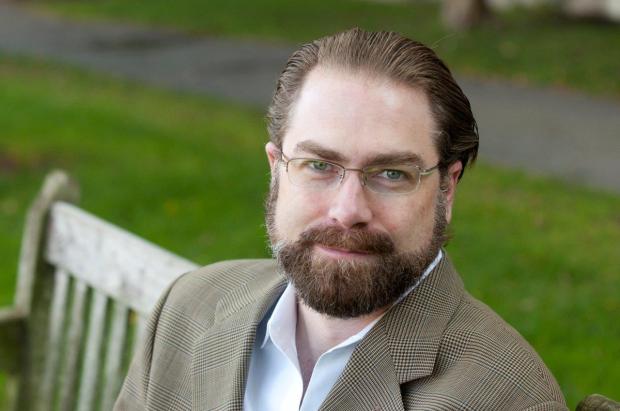
Dr. Peter Scoblic is a co-founder and principal of the strategic foresight consultancy Event Horizon Strategies. A former executive editor at The New Republic and Foreign Policy who has written on foresight for publications including the New York Times, The Washington Post, Science, and Harvard Business Review, Peter is also a senior fellow with the International Security Program at New America, and an instructor for the Professional Development Program at Harvard University. Previously, he was deputy staff director of the Senate Committee on Foreign Relations, where he worked on approval of the New START agreement and was the chief foreign policy speechwriter for Chairman John Kerry.
On the eve of a particularly fraught election and a turbulent moment in US political history, Peter joined me for a discussion about his career, ranging from post-Cold War nuclear arms policy to the relationship between policymaking and pop culture, plus the practical question of how and to what extent we can usefully predict the future.The interview will appear on this blog in three parts, and you can read the first part here – but you can also read the interview in its entirety as a PDF download.
Is there anything you uncovered in your doctoral research which hasn’t come up in coverage of your work?
Scenario planning can be used to challenge assumptions and the mental models people have of the world, but it also has its own models and assumptions baked into it: how time works, how the future relates to the present and past.
One of the things I found interesting was that, among the Coast Guard for example, scenario participants found that the process didn’t just change their mental model of how the organization went about its mission and operations; it also changed the way they thought about time.
Dr. Peter Scoblic is a co-founder and principal of the strategic foresight consultancy Event Horizon Strategies. A former executive editor at The New Republic and Foreign Policy who has written on foresight for publications including the New York Times, The Washington Post, Science, and Harvard Business Review, Peter is also a senior fellow with the International Security Program at New America, and an instructor for the Professional Development Program at Harvard University. Previously, he was deputy staff director of the Senate Committee on Foreign Relations, where he worked on approval of the New START agreement and was the chief foreign policy speechwriter for Chairman John Kerry.
On the eve of a particularly fraught election and a turbulent moment in US political history, Peter joined me for a discussion about his career, ranging from post-Cold War nuclear arms policy to the relationship between policymaking and pop culture, plus the practical question of how and to what extent we can usefully predict the future.The interview will appear on this blog in three parts, but you can read it in its entirety as a PDF download here.
I began by asking Peter if he’d always been ambitious to work in foreign policy.
Foreign policy is something I’ve always been interested in, especially national security work, and particularly nuclear weapons work. There’s been a wonky streak running through me over the years, often focussed on these dark existential issues.
It goes back to being a child of the 80s; I believe the second movie I ever saw was War Games, starring Matthew Broderick, in which a teen hacks into the computers of NORAD, the aerospace defence command. I was probably too young to see it and the experience, combined with the actual headlines of that decade, planted a seed which I was able to explore as a student at Brown.
Before all this, I went to my grandfather’s house in Spain. I’d never really liked it. It wasn’t the house he’d lived in as I grew up, which was just down the road from the new place. That had been the house of memories, the place where my grandmother had died before I was born.
He bought the new place when it was time to find a smaller, more manageable property, as he entered his eighties and I my twenties. I worked with him on both houses, helping him to do up the old one and improve the new. I painted walls white and coated tiles with red rubber sealant; mixed cement and ferried endless wheelbarrows of it to wherever he was working that day. He chided me for my cement mixing technique, for the way I handled a paintbrush or a pickaxe, the way I clambered up and down ladders and scaffolding, fetching tools and materials. It was the happiest time.
He died, digging over the garden of the new property with a rotorvator, when I was 23. He’d have been glad to go that way; he’d always talked of “falling off his perch” rather than a dreaded slow decline, and even when we were working together on the new place, he’d still pull stunts like climbing into the tree he was pruning, clinging to the branch above him while standing on the one below, which he was sawing off, jumping up and down to speed the process.
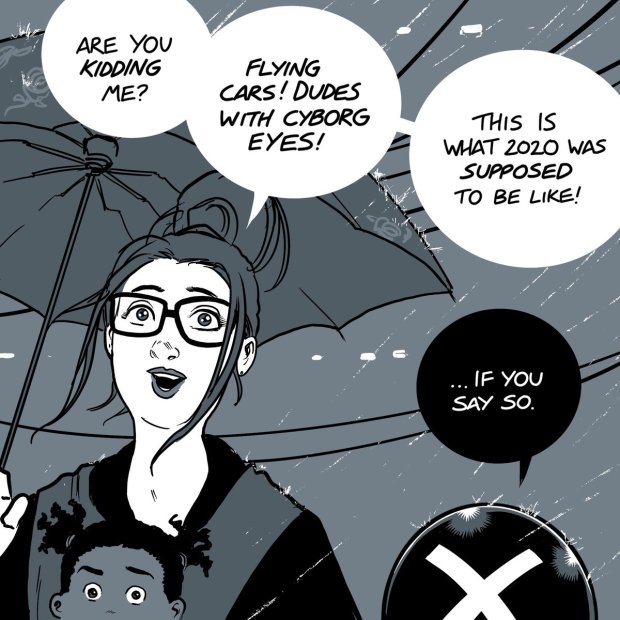
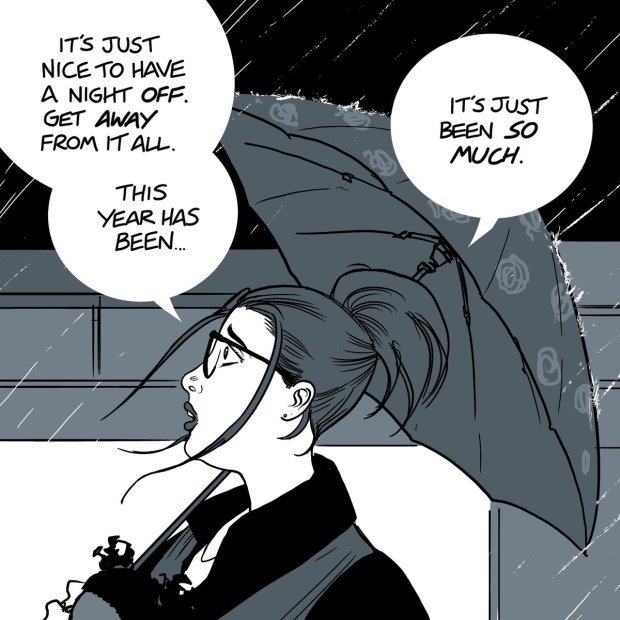
In this two-part interview, I’m joined by the British comics creator Neill Cameron, whose comics for children include Pirates of Pangea, Tamsin of the Deep, Mo-Bot High, How To Make Awesome Comics, and three volumes of Mega Robo Bros – as well as an ongoing daily webcomic for older readers, X365, which has been appearing throughout 2020.
This comic features “A cyborg detective in a dark futuristic city. A stressed-out freelancer coping with COVID-19, deadlines and a new baby. A lone swordswoman in a ruined, monster-filled world”, each living parallel lives, yet mysteriously connected. But the pandemic pulled the comic off course from Neill’s original intent.
Insofar as I had an idea for X365 before starting it, it came from the idea that 2020 had been a fictional year that loomed large in my childhood imaginary universe. I thought it would be fun to honour that, or mark the occasion, by making a story built on the contrasts between the 2020 we were not promised, but strongly led to believe would arrive in our childhood reading — and the one that arrived.
I was a 2000AD kid and also a fan of other things like Marvel UK’s output, Sleeze Brothers, and Death’s Head, and at least some of these comics were set in the year 2020. There was a general late-80s, early-90s cyberpunky future which permeated our consciousness through anime and comics, and yet 2020 didn’t seem that far away. You were thinking, are we really all going to have cyborg eyes by this point?
Given where we are, it felt like an opportunity to reflect on the future we’d been shown, and where we’ve ended up.
In this interview, I’m joined by the British comics creator Neill Cameron, whose books for young readers include Pirates of Pangea, Tamsin of the Deep, Mo-Bot High, How To Make Awesome Comics, and three volumes of the acclaimed Mega Robo Bros – as well as an ongoing daily webcomic for older readers, X365, which has been appearing throughout 2020.
We talked about creating convincing future and fantasy worlds, getting to know imagined places by drawing them, and the contrasts between the vision of 2020 we were promised as children – and the turbulent realities of the year as we’re experiencing it.
Societal challenges are complex. More complex than going to the moon, which was mainly a technical feat. To solve them requires attention to the ways in which socio-economic issues interact with politics and technology, to the need for smart regulation, and to the critical feedback processes that take place across the entire innovation chain.
Every strategy, every approach, every angle of attack that we take in life – whether individually or as a collective – has its moment. Insurgents become incumbents, if they succeed; and the most novel or surprising innovations will, in time, become yesterday’s news.
Wellcome is far from the only organization taking this approach. Using challenges to structure strategy echoes the new trend towards “mission-led innovation”, where systemic public policies draw on grassroots and frontline knowledge to attain specific goals. Whether it’s clean air in congested cities, continued independence in a healthy old age, or the challenges of cancer, climate change, and digital exclusion, missions are intended to help us apply big thinking to big problems – setting a clear direction for innovation while still enabling bottom-up solutions.
I think the mission-led approach is really promising, and I’ve been pleased to collaborate with organisations like Business Finland and Nesta as they explore what mission-setting might look like for them. But I’m also realistic about the limits of any one approach to ever serve as a panacea for the ills of our time. Inevitably, even the best strategies will have gaps and blindspots; no human endeavour escapes the need for tradeoffs, and omniscience is still an attribute which eludes us.
The TTD community explore links between drawing and cognition, and it was great to bring their perspective to bear on the question of how we might usefully draw the future to inform our decisions in the present.
The session was well received – here are some comments from attendees:
“I was surprised by my choices and solutions.” “It’s like drawing [scenarios] aids the process of giving permission to do the decision you really want to give attention to…” “And drawing give us the physical cues as we draw – tension, chills, etc. Important info.” “And you can examine the “players” as fictional characters, allowing for new insights.” “For me the diagram is a process functional tool, this is illuminating in thinking of it in relation to decision making not just areas of charting or organising existing knowledge.” “I allowed myself to think ‘worst case scenario’ in every area. Made me realise I would carry on even in black dog days.” “The visual metaphors in a Gantt chart force your thinking, whereas this coaxes.” “It made me reflect on a decision I thought was made, but I am actually still wavering on.” “The process got me to think bigger. What started as a creative project became wanting to change a bad situation. I think the creative project is still important but imagining what I want to change is crucial.”
The conference’s “Unscripted Futures” session seeks to:
“explore how radically open futures can be constructed and how we can secure that future scenarios are not locked into the premises of today. The aim is not to simply celebrate the openness of the future, but to create a space for developing experiments, for proposing alternative possibilities and constructing new futures, and then studying and discussing their implications and consequences ‘on the ground’.”
Marie Mahon of NUI Galway and I will discuss “Unscripting Europe”: Using Future Scenarios to Rethink EU Territorial Inequalities, exploring the scenarios being developed by the Horizon 2020 IMAJINE project.
Inequality isn’t just a question of measuring the current distance between the haves and have-nots, then checking whether that distance increases or decreases. It’s also about changing forms of privilege and injustice, changing values, and a changing social context. How can plausible imagined futures help us to better understand the nature of inequality?
Then, David Robertson of Monash University and I will talk about Playing With The Futures You Didn’t See Coming: High-Agency Participatory Scenario Activities, On and Offline.
David & I will belooking at what it means to create truly playful activities and encounters where participants can surprise the facilitators, formats can be broken or rebuilt during use, and new ideas can arise. We’ll talk about the infamous Library Island game, as well as some of its successor experiments from the era of Zoom and COVID lockdown.
Peter Morville is one of the pioneers of information architecture and user experience, working with clients including AT&T, Cisco, Harvard, IBM, the Library of Congress, Macy’s, the National Cancer Institute, and Vodafone. His books include Information Architecture for the World Wide Web, Intertwingled, Search Patterns, Ambient Findability and, most recently, Planning for Everything: The Design of Paths and Goals.
With a background like that – and more than a quarter of a century’s experience in helping people and organizations to plan – I was keen to talk with Peter about what he was learning from the turbulence of the COVID era. We spoke early in October 2020.
Peter Morville
A man writes a book called Planning for Everything…How has this year affected your paths and goals?
2020 is a special year, in all sorts of terrifying ways, but I think that the trends towards unpredictability have been growing for us in recent years. It’s not just 2020, right?
In my book, Planning for Everything, one of the biggest encouragements is for people to be mindful of the balance that we strike between planning and improvisation. Even though it’s a book about planning, part of my message is that we should have humility when we think about the future, and our ability to predict or control it.
I remember several years back talking with a friend who was spending some time in Rwanda. She said that, when she was there, it was a country where it was harder to plan that it was in the United States. There were more unexpected things that happened, you couldn’t count on stability, even down to the level of deciding that next Wednesday was going to be a good day for your coffee date, because something might come up.
Stability has been unevenly distributed around the world, probably forever. In countries such as the UK and the United States, many of us have been fortunate to enjoy significant amounts of stability and predictability, where we can say, “I’m going to plan a vacation in three months, or a wedding in nine months.” Many of us have a lifetime of experiencing that the things we plan, happen!
The last few years have really eroded our sense of confidence in our ability to plan for the future. I would say in the United States right now, I’ve never experienced a period where there’s so much uncertainty, whether that’s from COVID-19, climate change and wildfires, the upcoming presidential election, civil unrest…Planning a vacation three months from now seems a bit crazy!
Sometimes instability creates opportunity as well as jeopardy. Obviously one wouldn’t wish this pandemic on the world, but can you see opportunities arising from the current moment?