Unscripted Futures: 2020 OsloMet Urban Research Conference

I’ll be co-presenting two projects at next week’s “Storbykonferansen” Urban Research Conference, hosted by Oslo Metropolitan University.

The conference’s “Unscripted Futures” session seeks to:

“explore how radically open futures can be constructed and how we can secure that future scenarios are not locked into the premises of today. The aim is not to simply celebrate the openness of the future, but to create a space for developing experiments, for proposing alternative possibilities and constructing new futures, and then studying and discussing their implications and consequences ‘on the ground’.”

Marie Mahon of NUI Galway and I will discuss “Unscripting Europe”: Using Future Scenarios to Rethink EU Territorial Inequalities, exploring the scenarios being developed by the Horizon 2020 IMAJINE project.

Inequality isn’t just a question of measuring the current distance between the haves and have-nots, then checking whether that distance increases or decreases. It’s also about changing forms of privilege and injustice, changing values, and a changing social context. How can plausible imagined futures help us to better understand the nature of inequality?

Then, David Robertson of Monash University and I will talk about Playing With The Futures You Didn’t See Coming: High-Agency Participatory Scenario Activities, On and Offline.

David & I will be looking at what it means to create truly playful activities and encounters where participants can surprise the facilitators, formats can be broken or rebuilt during use, and new ideas can arise. We’ll talk about the infamous Library Island game, as well as some of its successor experiments from the era of Zoom and COVID lockdown.

You can read all the abstracts from the session at the Storbykonferansen website (PDF download), and I hope you’ll join us online for what promises to be a lively set of discussions. Find out more, and register for the conference, here.

Interview with Peter Morville: Planning for Everything in Times of COVID-19

Peter Morville is one of the pioneers of information architecture and user experience, working with clients including AT&T, Cisco, Harvard, IBM, the Library of Congress, Macy’s, the National Cancer Institute, and Vodafone. His books include Information Architecture for the World Wide Web, Intertwingled, Search Patterns, Ambient Findability and, most recently, Planning for Everything: The Design of Paths and Goals.

With a background like that – and more than a quarter of a century’s experience in helping people and organizations to plan – I was keen to talk with Peter about what he was learning from the turbulence of the COVID era. We spoke early in October 2020.

Peter Morville

A man writes a book called Planning for EverythingHow has this year affected your paths and goals?

2020 is a special year, in all sorts of terrifying ways, but I think that the trends towards unpredictability have been growing for us in recent years. It’s not just 2020, right?

In my book, Planning for Everything, one of the biggest encouragements is for people to be mindful of the balance that we strike between planning and improvisation. Even though it’s a book about planning, part of my message is that we should have humility when we think about the future, and our ability to predict or control it.

I remember several years back talking with a friend who was spending some time in Rwanda. She said that, when she was there, it was a country where it was harder to plan that it was in the United States. There were more unexpected things that happened, you couldn’t count on stability, even down to the level of deciding that next Wednesday was going to be a good day for your coffee date, because something might come up.

Stability has been unevenly distributed around the world, probably forever. In countries such as the UK and the United States, many of us have been fortunate to enjoy significant amounts of stability and predictability, where we can say, “I’m going to plan a vacation in three months, or a wedding in nine months.” Many of us have a lifetime of experiencing that the things we plan, happen! 

The last few years have really eroded our sense of confidence in our ability to plan for the future. I would say in the United States right now, I’ve never experienced a period where there’s so much uncertainty, whether that’s from COVID-19, climate change and wildfires, the upcoming presidential election, civil unrest…Planning a vacation three months from now seems a bit crazy!

Sometimes instability creates opportunity as well as jeopardy. Obviously one wouldn’t wish this pandemic on the world, but can you see opportunities arising from the current moment?

Read more

The Sense of an Ending: Stories, Shapes, & Scenarios During COVID-19

Doesn’t it feel as if this pandemic might go on forever? Do you have any sense of whether we’re at the end of the beginning, or the beginning of the middle, or the beginning of the end?

Doesn’t it feel like everyone is yearning for something that gives these events shape, an arc, a trajectory, a sense that we will come eventually – by vaccine, or treatment, or policy, or simple resignation – to something that we can label as “the end of the COVID era”?

Even the phrase “the new normal” seems somehow plaintive, as if it only wished that we could settle on a final state of affairs which would mark the end of all this flux and uncertainty. Even if a single, solid “new normal” ever arrives, we’ll be paying the price for COVID for years to come.

Read more

Bringing a ladder to a Zoom call: Keynote to #ELGL20

I’m not a big fan of the phrase “new normal”, but if there is one, then for me it involves a lot of Zoom calls, which means mostly seeing people’s heads and shoulders in a cropped little screen.

For my ELGL20 keynote to local government professionals, I grabbed a stepladder to try and find a different perspective, even in a world constrained by the limits of the laptop lens.

My ladder was a prop to remind people why we do foresight work. Sometimes, we think we know what the future holds and we take action in the present, just as confident as someone stepping onto the first rung of a ladder.

But that ladder comprises all the assumptions we are relying on about what the future holds, and what part we’ll play in it.

As Peter Scoblic and Philip Tetlock put it in an article for Foreign Affairs,

Every policy is a prediction. Tax cuts will boost the economy. Sanctions will slow Iran’s nuclear program. Travel bans will limit the spread of COVID-19. These claims all posit a causal relationship between means and ends. Regardless of party, ideology, or motive, no policymaker wants his or her recommended course of action to produce unanticipated consequences. This makes every policymaker a forecaster.

Scoblic & Tetlock, “A Better Crystal Ball”, Foreign Affairs

We might start climbing that ladder and then realise we need to step left, or right. We might find that the next rung is missing. We might have set off on our ascent quite happily, only to find that circumstances at the top have changed and it is really difficult for us to climb back down. We may even find we have to awkwardly perch half-way up the ladder (I ended up using mine as a chair while I spoke to the ELGL crowd).

Scenarios and other foresight techniques can help us examine the assumptions we are making about the future before we take that first step.

The ladder was also something of a gambit on my part. I hadn’t planned to include it as part of the keynote, but we were using a videoconferencing platform which made it difficult for the speaker to know how the audience were responding. Our host compared it to “speaking on a lit stage where you know the audience is out there, but it’s hard to see their faces”.

Around the halfway point of my session, I wasn’t confident that my message was getting across and I wanted to be sure to drive the point home. I dashed out of the study and fetched my stepladder from behind the kitchen door. Often the liveliest and most memorable parts of a workshop, or any human encounter, come when something doesn’t go according to plan. It’s important to remember that when events go astray, they can go better than we expected or intended, as well as worse – especially if we take advantage of the moment.

So that’s why I brought a ladder to a Zoom keynote. Even if you, too, are trapped by the boxes of the videoconference screen, what can you do to help yourself, and the people you speak with, find a fresh perspective on the futures which await?

Post-Pandemic University, 21st October: Scenario Planning for Digitalised Education

How can we explore or shape the future of higher education when the times are so turbulent and uncertain?

The forthcoming “Digital Technology and the Post-Pandemic University” conference explores the new realities faced by higher education, and the part digital technology will play in those realities. I’ll be presenting a short paper on the use of scenario planning to explore future contexts for digitalised education.

You can read my paper – “Scenario Planning for Digitalised Education: Managing Uncertainties Through the Pandemic and Beyond” – at the Post-Pandemic University website. If you’d like to join us on Wednesday 21st October, 9am-6pm BST, you can register for the online conference here.

Image
Photo by Katie Moum on Unsplash

Workshop – Cones, Grids, and Timelines: A Visual Approach to Scenario Planning

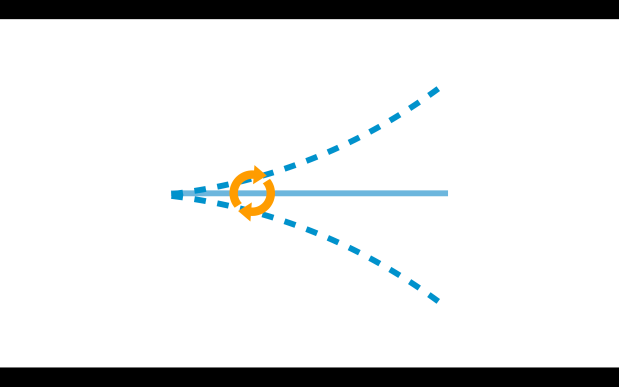
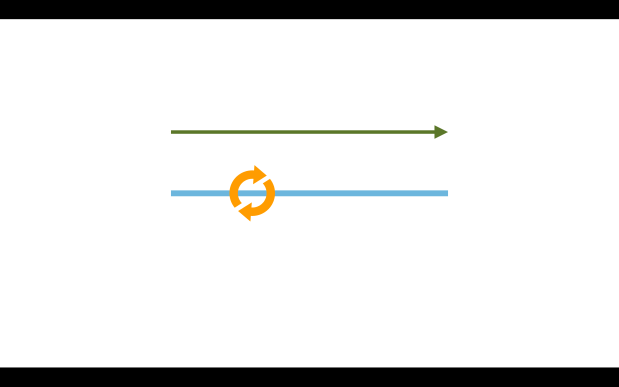
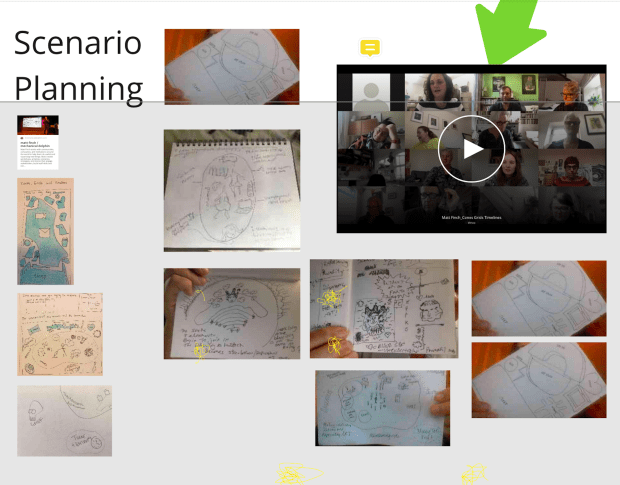
As part of the online Thinking Through Drawing 2020 symposium, October 16-18 2020, I’ll be presenting a 45-minute workshop “Cones, Grids, and Timelines”, exploring how future scenarios can be devised and represented visually. You can see a short video outline of the session below.

If you’d like to join me, and a vibrant community of researchers, artists, visual communicators, and educators, find out more at the TTD website.

OECD Government After Shock Podcast with Saskia Van Uffelen

Following our recent two-part discussion on this blog, you can hear Saskia Van Uffelen, Belgium’s Digital Champion, speaking with me on the OECD’s Government After Shock podcast in this week’s discussion.

During our interview, Saskia explores communication, leadership, and adaptation beyond crisis. If we pull on the “elastic” of our society and its institutions too far, it will break. Are we ready to fashion a new, more resilient world as the crises of 2020 demonstrate the old one’s limitations?

“The first, the fast, and the least reluctant to change will succeed”: Interview with Saskia Van Uffelen, Digital Champion for Belgium, Part 2

Saskia Van Uffelen is the Digital Champion for Belgium, tasked with promoting the benefits of digital society as part of the European Commission’s efforts to ensure every European citizen acquires the digital skills they need to remain productive, employable and enfranchised. After a career encompassing roles at Xerox, Compaq, HP, Arinso, Bull, and Ericsson, she is currently Corporate Vice President for the French group GFI, supervising developments in the Benelux countries. Saskia is also the author of Dare For Tomorrow: Leading, Working, Learning, and Living in a Digital World. You can read the first part of our interview here.

Image

As Digital Champion, you have an interest in the future of the public library, an institution which is also very dear to my heart. The social changes you’re describing will have an impact on our civic information institutions, and the context they operate in.

You’ve said elsewhere that, “If anything has remained the same in your organisation (culture, processes, eco-systems), it will simply not work anymore. You need to adapt your company and your culture. Adapt or die.”

Are libraries too prone to thinking about what used to work, instead of looking strategically to the future and to forces outside their sector?

Read more

“We have stretched our society to breaking point…These issues are the responsibility of all of us”: Interview with Saskia Van Uffelen, Digital Champion for Belgium Part 1

Saskia Van Uffelen is the Digital Champion for Belgium, tasked with promoting the benefits of digital society as part of the European Commission’s efforts to ensure every European citizen acquires the digital skills they need to remain productive, employable and enfranchised. After a career encompassing roles at Xerox, Compaq, HP, Arinso, Bull, and Ericsson, she is currently Corporate Vice President for the French group GFI, supervising developments in the Benelux countries. Saskia is also the author of Dare For Tomorrow: Leading, Working, Learning, and Living in a Digital World.

Image

The crises of 2020 have moved many aspects of our lives online, not always without complications. I started by asking what this year looks like from the perspective of Belgium’s Digital Champion.

Read more