“What do the humanities have to offer strategists, policymakers, and decision-takers in the age of the algorithm? As machine intelligence and computational power increase, as we gather ever more data from ever more sources, do the humanities still offer a valuable perspective on times yet to come?”
In advance of the conference, we got together for an informal chat covering five years of work pushing the boundaries of occupational therapy education, exploring what futures & foresight work can do for occupational therapists, and how learning from the futures which challenge our assumptions can complement the practical experience which comes from student placements.
I wouldn’t say I have the best handwriting. It’s a bit of an unpretty scrawl, though people can mostly decipher it. I use my left hand to hold a pencil or pen, though I do everything else with my right; I can’t use left-handed scissors or can openers, and whenever it was I last played cricket or tennis, my right hand was dominant. I’m probably a natural righty who picked up the left-hand habit from copying a left-handed parent, back in those days when they first get you to clutch a crayon and make your mark.
M.C. Escher, Drawing Hands
This week, I was helping a group of people learn to use scenario planning. There are a lot of ways to define what a scenario is, but in the Oxford Scenario Planning Approach, scenarios are assessments of the future context, developed for a particular user and purpose, to contrast with the way that the future context is currently being framed. People engaged in scenario planning devise plausible futures in order to test assumptions, challenge existing framings, and enrich decision-making in the present.
Stretching your sense of the futures you may have to inhabit can feel like “thinking with your non-dominant hand”. We’re so used to trying to solve the problem in front of us, “get on with the job”, fix things, make them better, chart a course, steer the ship. The act of strategic reframing – creating plausible futures to stretch our understanding of a given context – can feel seriously counterintuitive.
Even clasping your hands or crossing your legs the opposite way round to usual can feel odd; using your non-dominant hand when playing sports, using scissors, or writing could feel even more so. So it’s not a surprise that scenario planning might feel strange when you first try it.
Yet releasing yourself from a dominant or habitual approach can bring all kinds of benefits. You may be forced to rethink processes from first principles, returning you to “beginner’s mind” and unpicking tightly woven assumptions. You may find that your engrained habits of thinking are patterns of comfort and convention, rather than the best way to address an issue. You may see things from a different angle when approaching from the left instead of the right, or vice versa.
In successful scenario planning engagements, people often feel a sudden moment of realisation – what the pioneering scenario planner Pierre Wack called an “a-ha” moment. “It does not simply leap at you,” Wack wrote in a 1985 issue of the Harvard Business Review. “It happens when your message reaches the microcosms of decision makers, obliges them to question their assumptions…and leads them to change and reorganise their inner models of reality.”
Once people have experienced this benefit of thinking from the “outside in” – starting with future contexts, then working back to an assessment of options and strategic possibilities, often in an iterative process which is enriched by multiple repetitions – they see the merits in going against the grain of habit.
The more they employ this approach, the better their “muscle memory” for scenario work. (A right-hander who tries playing the guitar left-handed just once might not get very far, but continued practice could yield competence and even virtuosity). Gradually it becomes possible to integrate “left-handed” and “right-handed” thinking into processes of assessment and decision-making, so that our perceptions, our judgment, and our capacity to act are enriched.
And in times of turbulence and uncertainty, when tomorrow will not be like yesterday or today, that could make all the difference.
The “Instructions…” emerge from theIMAJINE project exploring the future of European regional inequality. The text experiments with a second-person perspective, inviting the reader to dream themselves into the bodies of four very different figures drawn from early drafts of IMAJINE’s four scenarios for the future of Europe in 2048.
Information architects design, organize, and label digital artefacts and services like websites, intranets, and software to help people find and use the information they want and need. Recently, Peter Morville, one of the “founding fathers” of IA, proposed a new definition: “the design of language and classification systems to change the world”. (You can read my interview with Peter here). In uncertain times, information architects need tools to think about the futures which their work may have to inhabit. That’s where scenario planning comes in.
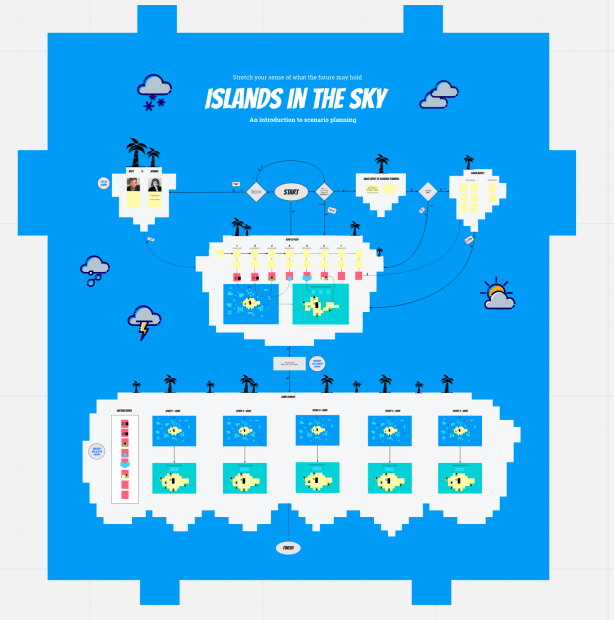
Our interactive conference session invites attendees to try their hand at the basics of scenario planning, in a playful and thought-provoking online setting. It’s a successor of sorts to the in-person Library Island game which was so well-received in pre-COVID times.
We’ll report back from our experiments at the IA Conference and keep you updated as the Islands evolve.
Walter Benjamin wrote a few famous lines about Paul Klee’s artwork Angelus Novus. You may know them:
A Klee painting named ‘Angelus Novus’ shows an angel looking as though he is about to move away from something he is fixedly contemplating. His eyes are staring, his mouth is open, his wings are spread. This is how one pictures the angel of history. His face is turned toward the past. Where we perceive a chain of events, he sees one single catastrophe which keeps piling wreckage and hurls it in front of his feet. The angel would like to stay, awaken the dead, and make whole what has been smashed. But a storm is blowing in from Paradise; it has got caught in his wings with such a violence that the angel can no longer close them. The storm irresistibly propels him into the future to which his back is turned, while the pile of debris before him grows skyward. This storm is what we call progress.
-Walter Benjamin, “On The Concept of History”
Imagine the plight of Benjamin’s angel today. The winds are more turbulent than ever. The ground on which the angel walks has become, perhaps, more unstable. Each step, however small, is taken in extreme uncertainty.
Perhaps the angel has come to realise that they are no longer alone. Other angels, with other perspectives and other understandings of what has gone before or where they are headed, also stagger against the storm. However much they wish to stay with the past that has gone before them, they are constantly driven onwards.
I was privileged to be Dr. Pani Farvid‘s guest at The New School’s SexTech Lab this week, talking about how researchers of gender, sexuality, and identity can work with the imagined future to understand the present and challenge its assumptions.
In addition to continuing my work as a facilitator with the award-winnning Oxford Scenarios Programme, I’m teaching scenario planning on the Saïd’s MBA and Executive MBA programmes.
‘Dreaming Spires’, by Flickr User JJBullock – Copyright JJ Bullock 2010
It’s great to be working alongside such a brilliant, collegial team and I’m looking forward to the next step in the adventure.
Niamh ni Broin and Steffen Kruger of the University of Oslo convened the project and recruited me to help a group of key stakeholders develop the scenarios. Today Steffen, a psychoanalytic researcher and senior lecturer in the university’s Department of Media and Communication, joins me to talk about the project, taboo futures, pop culture, and questions of fate and destiny in foresight work.
Delany writes, of his preference for science fiction over stories of the everyday:
“I think what happens with mundane or naturalist fiction is that these characters succeed or fail in what they try to do, but they succeed or fail against the background of the real world so that their successes are always some form of adjusting to the real world. Their failures are always a matter of being defeated by the real world.”
For those of us who help people make better decisions by telling stories of the future, this “real world” is like the perspective of a decisionmaker who thinks themselves utterly pragmatic and realistic.
Their assumptions are those commonly held in their time and context; their decisions are based on the seemingly firm ground of evidence and data; they see the world through a frame which is widely held by their peers to be “right” for the present moment. They see their successes and failures as being a matter of how well or poorly they adjust to meet this reality.
Yet it cannot be the whole story. If everyone in your peer group is looking through the same frame, they will all have the same blind spot. If you rely on numbers – the reduction of complexity to countable simplicity – you will lose valuable information; quantitative indicators are, after all, not objective facts, but tools designed for specific functions, with all the benefits and limitations that implies. The practices which make you feel comfortable in your decisionmaking will also bind and limit you, both in terms of what you can see might happen and what you might choose to do.






.png)