“Nexter” Webinar with Canadian information professionals, August 13th

I’ll be talking with Canada’s Rebecca Jones as part of the “Nexter” webinar series next month.

This slideshow requires JavaScript.

We’ll be discussing questions of leadership for information professionals in these times of strategic uncertainty. How do we rethink community access to information, knowledge, and culture through the COVID era and beyond?
 

José Esteban Muñoz: Foresight and Cruising Utopia

“Queerness is primarily about futurity and hope. That is to say that queerness is always in the horizon.” – José Esteban Muñoz

1: Future blindspots in gender, identity, and sexuality

I’ve been spending most of my time on foresight and strategy for several years now. It’s challenging, lively work, helping people and organisations to look at the future and seek out their blindspots to support better decisionmaking. Often we construct scenarios, imagined future contexts, to inform that work, creating plausible futures which challenge current assumptions and provide a unique vantage point on the present.

Late last year, I wrote about the whiteness of foresight and the ways in which this kind of work, and its practitioners, might be blinkered by lack of diversity.  But those aren’t the only kind of blinkers we encounter when we turn our gaze towards the future.

Before lockdown, I attended a scenarios workshop constructing big global futures, intended to explore fundamental questions about the ways our societies will be organised in decades to come.

The project generated a number of visions of the world in 2050, with huge changes not only to how we live and work together, but even the ways in which technology might be integrated into our own bodies. Yet despite all this radical transformation, people shied away from reimagining the personal relationships which underpinned this world. In the finished scenarios, featuring a number of personas from each imagined future, there was little sense of the ways in which family life and its related intimacies might have changed or been changed by the forces at work in each version of 2050.

Looking around the room at the workshop participants – largely white, European, degree-educated, mostly presenting as straight – I wondered what questions we had refused to ask ourselves, or address, as a result of our own identities and points of view, the life experiences and perspectives we had brought to the workshop by mere virtue of who we were. Read more

Post-normal science in the time of COVID-19: Discussion with Jerome Ravetz

Over the last few weeks, I’ve been speaking and exchanging e-mails with the philosopher of science Jerome Ravetz, one of the originators of the notion of Post-Normal Science. This is an approach to science which addresses the wider social context in which scientists and their institutions operate, intended to serve in situations where high-stakes decisions must be made and the environment is characterised by deep uncertainty.

JerryRavetz
Jerry Ravetz, by Wikipedia user Saltean – CC BY-SA 4.0

Given that definition, what could be more “post-normal” than our experience of 2020? Jerome and I had a long chat which covered the pandemic and our response to it, warring traditions of folk and elite science, philosophy, gender, science fiction, truth & reconciliation, and electoral politics.

You can read the full transcript of our chat as a PDF download here, but some extended highlights appear below.

Matt:
So, what does an exponent of post-normal science make of the current pandemic?

Jerry:
For a while, the uncertainties and complexities diagnosed by the post-normal science approach have been coming in from the margins, until right now they’re almost in the mainstream of thought and discussion. Once that happens, it will open new possibilities – and new problems. Read more

Nesta interview: Using scenarios to reimagine our strategic decisions

Earlier this year, I took part in the ‘Scenarios and the Future of Work’ project, hosted by the Danish Design Centre in conjunction with the innovation foundation Nesta.

Rain on the Mountain

Nesta’s Juan Casasbuenas interviewed me about the experience, and the benefits of scenario planning, for their blog.

“Scenarios should stretch your thinking and challenge you to reimagine where you’re headed strategically, but they’re always grounded in the here and now: looking at the weather on the mountain to understand what might happen in the valley below.”

We also talked about technology, fear, and the surprising history of photographic manipulation which lies behind deepfakes.

This slideshow requires JavaScript.


You can read “Using scenarios to reimagine our strategic decisions” here.

Public Libraries, Police Abolition, and Serving Your Community in a Time of Change

If we abolish the police and reimagine the ways in which our societies cope with disorder, violence, and transgression, what else will have to shift? How radically could public libraries change, if we reimagined the institutions of information as profoundly as we might reimagine the institutions of justice?

I led strategy workshops last month with some very senior librarians in Australia, and at the beginning of these sessions, we gave an Acknowledgment of Country, acknowledging the Traditional Custodians of the land we were on and paying our respects to Elders past, present, and emerging.

We didn’t just speak these words as a formula and then move on. We talked about what it meant to acknowledge country in digital space, when each of us was in a different location, from Australia to the UK. We talked about acknowledging the histories which have led us to a world in which I could speak the traditional language used for generations in the place where I was born, and not make any effort to adapt the way I speak for audiences in Australia, Aotearoa New Zealand, the US, Canada, or many other nations.

We talked about what it would mean for the institutions represented in the workshop not just to acknowledge these histories, or to carry out the work of recognising and remedying them through diversity and inclusion efforts, acts of reconciliation and decolonisation, and so on. We talked about what it would mean for these institutions to become explicitly antiracist.

It was important to talk about this, because for some public institutions, it proves hard to take a stand against injustice. The political environment in which public library services and other organisations operate is shaped by the elected governments which determine their funding and policies, and this can make it challenging for institutions to do the right thing. Read more

Psychodynamic literacy? New column for Information Professional

“Group dynamics are ‘like an iceberg – you see some of the relationship on the surface and then there is also everything beneath the water. There are the explicit, seen, and formal aspects; then all that is implicit, unseen, unspoken, and even unconscious.'”

The second instalment of “Scripturient”, my new quarterly column for Information Professional magazine, is out now.

Iceberg_in_the_Arctic_with_its_underside_exposed
Iceberg in the Arctic, by Wikipedia user AWeith – CC BY-SA 4.0

In this series, I’m looking at how we can push the boundaries of literacy in the 21st century, to encompass new areas of representation. What does it mean to read the future? To read risks? To read the forces that underpin our relationships and drive us psychologically? To read the signs and signals which exist in the natural world?

The latest instalment explores questions of “psychodynamic literacy”. If we were better at reading the forces that shape our relationships, could we rewrite them to get better, happier outcomes?

I talked to two expert practitioners, a leadership coach and a mediator, to find out more. Find out what they had to say in the article (PDF download).

“You are swimming with the whole ocean”: Interview with Aída Ponce Del Castillo, European Trade Union Institute

Last month, Aída Ponce Del Castillo of the European Trade Union Insitute’s Foresight Unit joined me to talk about her journey from world-class swimmer to foresight professional, doing strategy and scenarios research for the labour movement.

We discussed different foresight methodologies, the particular challenges and opportunities in working on futures with trade unions, and, inevitably, COVID-19, but our conversation began with Aída’s sporting career, and the lessons it taught her about coping with turbulence and uncertainty.

Matt:
What was your journey to becoming a foresight practitioner? You were a lawyer, and a competitive open-water swimmer – how did that lead you to work on foresight, and how did it prepare you for the role?

Aída:
In many ways I saw myself as a swimmer first and everything else second! I studied and practiced law, completed a doctorate. As an open water swimmer I competed at international level, also racing in Open Water World Cups. Read more

Getting Your Head Around Post-Normal Science

Something of a long read on the blog today. I first came across Jerome Ravetz’s work in his 2011 piece on feral futures co-written with Rafael Ramírez in the journal Futures. In that piece, the authors argue that complex, uncertain issues such as environmental disasters can be made worse by conventional risk-based thinking. I think through some of the ways in which this is important for us to consider in 2020 in this blog, “Our feral future: working on the crises you did(n’t) see coming.

I find Ravetz’s approach thought-provoking, pragmatic, and deeply relevant to the present moment. It attends to questions of uncertainty and emphasises that science itself is situated within complex social, political, cultural, and economic contexts. Especially when we find ourselves being told that, for example, decisions on quarantine and lockdown measures are being “guided by the science” under contested circumstances, it’s worth getting your head around the idea of “post-normal science.”

Today, I want to go through some of the key points articulated in Ravetz’s 2006 No-Nonsense Guide to Science and the updated 2020 version of his landmark 1993 essay with Silvio O. Funtowicz, “Science for the Post-Normal Age“. Check those texts out, if you want to go deeper.

Defenders of the Truth
Climate Marchers, by Wikipedia user Mark Dixon CC BY-SA 2.0

Post-normal science is a way of rethinking science for situations – and eras – in which facts are uncertain, values are in dispute, the stakes are high, and decisions are urgent. It recognises that the social and political dimensions of science cannot be sidelined, isolated, or ignored.

The increasingly complex systems of today’s world are threatened by environmental catastrophe, pollution, and other incidents, like the COVID-19 outbreak, which are exacerbated by the technologies sustaining our way of life.

Science must therefore find new ways to cope with contradiction, uncertainty, and an ever-wider political conversation featuring a wide range of perspectives. It must now address the problems of a global system which itself was based on science.

Why “post-normal”?
Read more

Looking ahead: Circulating Ideas / Public Libraries News

I recently had the opportunity to speak with Steve Thomas of the American library podcast Circulating Ideas and Ian Anstice of the UK’s Public Libraries News. Both conversations were released online this week.

Ian asked me some questions about the COVID-19 pandemic, libraries’ response to it, and what might be on the horizon for our societies and the institutions that serve them.

Like any good foresight practitioner, I sought to offer questions of my own, and provocations more than prophecy. We discussed resilience, anticipation, and both the dangers and opportunities that organisations face during a prolonged, indefinite season of turbulence and uncertainty. I think the points will be useful for people outside of the library and information sector. You can read our conversation at the Public Libraries News site.

Meanwhile, over at Circulating Ideas, Steve and I talked about what it would mean to bring scenario planning and other foresight methodologies into a public library setting, building on my recent presentation to America’s Engaging Local Government Leaders network and a previous academic article co-authored with Rafael Ramírez.

You can listen to my chat with Steve, and many other excellent episodes of Circulating Ideas, at the podcast’s website, and the episode is also available over at Apple Podcasts.

Planning for Uncertainty: Scenarios and Foresight for Local Government

Last week, I put together this one-hour video session for America’s Engaging Local Government Leaders network, ELGL.

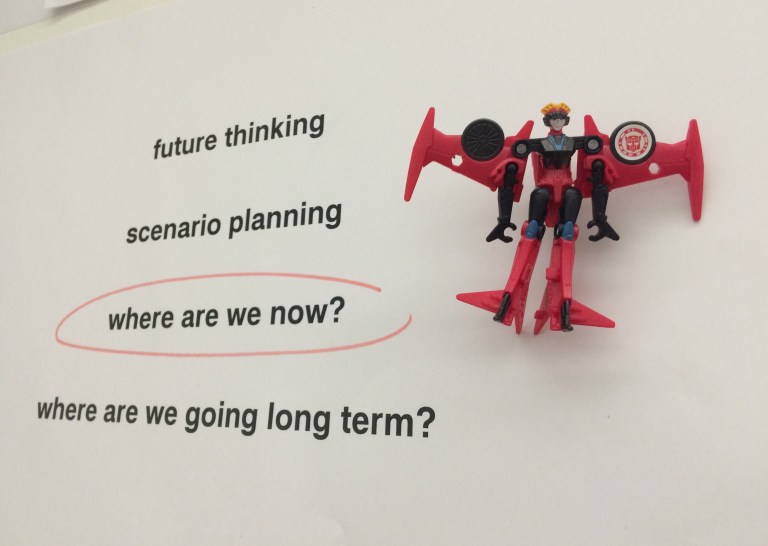
It’s a straightforward foresight and strategy starter pack, no nonsense, no jargon, helping to answer the questions “Where are we going?” and “What should we do?”

The session is aimed at US local government leaders, but should work for a wide range of institutions, communities, and settings.

You can read more about the session and download a PDF “handout” with slides and further reading at the ELGL webpage, and I previously spoke with the ELGL team about leadership and foresight on their podcast last year.