Wise Enough for an Uncertain World: Scenarios, Metrics, and Social Impact 

My latest piece of writing, “Wise Enough for an Uncertain World: Scenario Planning and Social Impact“, can be found at the Danish social impact nonprofit Impact Insider.

It’s an exploration of how we make a measurable difference to social issues in an unpredictable world, drawing on research with the University of Oslo, the Global Outbreak Alert and Response Network (GOARN), the IMAJINE project, and Peat Hub Ireland.

If social impact means creating long-term change, then we face a difficult problem: we live in turbulent times, and the future in which our impact will unfold is deeply uncertain.

Scenario planning can help by developing multiple plausible and contrasting futures, relevant to current concerns but challenging to our assumptions. Building and using scenarios offers the opportunity to critically explore expectations, hopes, and fears about the world within which we hope to make an impact.
Photo by Raul Kozenevski on Pexels.com

Scenarios can inform the design of impact metrics which embody deeper values by considering the question: What might future generations wish we had measured in hindsight?

As we consider what inhabitants of different future scenarios might value, we can then identify and design appropriate impact measures to implement today. 

Read “Wise Enough for an Uncertain World” at Impact Insider.

UNESCO Prospects Journal: Scenarios and the future of education

The question for teachers, learners, and the various organizations and communities in which they participate becomes “How will we adapt, evolve, and thrive even if uncertainties play out in ways for which we had not initially prepared?”

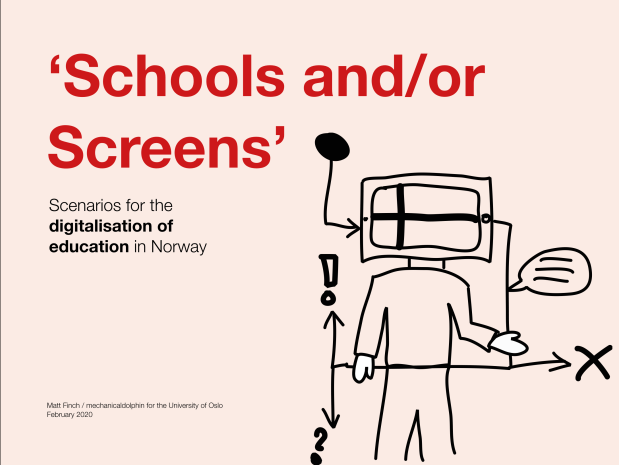
In the UNESCO International Bureau of Education’s journal Prospects, the University of Oslo’s Steffen Krüger, the University of Agder’s Niamh Ní Bhroin, and I discuss the “Schools and/or screens” scenario project for the digitalisation of education in Norway.

UNESCO Headquarters sign. (C) Matt Finch, 2023

We show how challenging issues raised in the context of distant imagined futures proved to be immediately pertinent in the developing Covid-19 pandemic, and, as a wide range of actors explore the possibility of a new social contract for education, we reflect on how future scenarios can provide fresh perspectives on issues that are difficult or even impossible to resolve within current frames of reference, including questions of equity and justice that may be construed differently in times to come.

Read “Unlearning, relearning, staying with the trouble: Scenarios and the future of education” at Prospects online.

Taboo Futures, Fate, and Destiny – Conversation with Steffen Krueger

In 2019-2020, I worked with researchers from the University of Oslo on a set of scenarios for the future of Norwegian schools. You can see the full scenario set, “Schools and/or Screens”, here.

Niamh ni Broin and Steffen Kruger of the University of Oslo convened the project and recruited me to help a group of key stakeholders develop the scenarios. Today Steffen, a psychoanalytic researcher and senior lecturer in the university’s Department of Media and Communication, joins me to talk about the project, taboo futures, pop culture, and questions of fate and destiny in foresight work.

Read more

“2050 was last year”: Times of COVID-19

Together with the University of Oslo’s Dr. Steffen Krüger, I’ve written a short piece on the Norwegian education scenarios, set thirty years hence, which we published at the start of this year – plus how the COVID-19 pandemic both confirmed some of our insights and challenged our perceptions.

Seeking an imagined future that would threaten a data-driven, corporatised health and care system, we created a world with distinct similarities to Norway’s coronavirus experience in 2020. In the essay, we talk about our scenarios, the cabin fever of homeschooled lockdown days, and how to bring the stuff of dystopian sci-fi into the realm of plausible policy discussion.

You can read “2050 was last year”, at the Times of COVID-19 blog.

“Just Waiting for the Locusts, Really”: OECD Government After Shock Interviews with Innovation Norway & National Library of Australia

“Smoke, fire, hail, and pestilence…we’re just waiting for the locusts, really” – the wry and insightful Marie-Louise Ayres, who heads the National Library of Australia in Canberra, talked to me about guiding her unique federal institution through the many challenges faced by the Australian capital in 2020.

You can hear what Marie-Louise had to say on the OECD’s Government After Shock podcast.

I also spoke with Håkon Haugli, CEO of Innovation Norway, a state body which promotes sustainable growth and exports for Norwegian businesses through capital and expertise. Håkon talks about moving to a digital workplace, the struggle to preserve multilateralism, and embracing the messy nature of innovation. His episode of the podcast can be found here.

Future health: Oslo and the ‘a-ha’ moment

Our University of Oslo scenarios for the future of schools, out this week, surfaced health, and perceptions of health, as a battleground between parents and institutions in the education sector of 2050.

This was an “a-ha” moment for university researchers seeking new issues to explore around the digitalisation of education.

In scenario planning, we don’t aim to predict the future, but rather to generate plausible visions which can usefully inform present-day decision-making.

The future stories we create together are intended to highlight issues and drivers which exist in the present; the future scenario can then be set aside in order to focus on the issue at hand.

For the Oslo education researchers, a world in which parents and institutions warred over children’s health in a heavily-surveilled society – bickering with ‘the algorithm’ even over when to wipe your child’s nose – highlighted the extent to which their research should explore questions of health and wellbeing.

Today, in the Norwegian news, we see a parent-led Facebook group urging the city to close schools while the municipal authorities maintain that there is no reason yet to do so.

The campaigners argue that if businesses are sending staff home, then young children – who are less able to follow guidelines on infection control, like coughing into your elbow – should certainly go back to their families too.

Questions of distance learning, and education via screens and digital devices, may be sharpened by the current pandemic – even for the youngest children.

How will coronavirus affect the way we teach and learn, in the short and long term? Could it impact even the youngest children, irrespective of whether they contract the disease?

Good foresight work can help communities, institutions, and individuals navigate such turbulent and uncertain situations. You can read more about the Oslo education scenarios project here.