Thinking with your non-dominant hand: ambidexterity and foresight

I wouldn’t say I have the best handwriting. It’s a bit of an unpretty scrawl, though people can mostly decipher it. I use my left hand to hold a pencil or pen, though I do everything else with my right; I can’t use left-handed scissors or can openers, and whenever it was I last played cricket or tennis, my right hand was dominant. I’m probably a natural righty who picked up the left-hand habit from copying a left-handed parent, back in those days when they first get you to clutch a crayon and make your mark.

M.C. Escher, Drawing Hands

This week, I was helping a group of people learn to use scenario planning. There are a lot of ways to define what a scenario is, but in the Oxford Scenario Planning Approach, scenarios are assessments of the future context, developed for a particular user and purpose, to contrast with the way that the future context is currently being framed. People engaged in scenario planning devise plausible futures in order to test assumptions, challenge existing framings, and enrich decision-making in the present.

Stretching your sense of the futures you may have to inhabit can feel like “thinking with your non-dominant hand”. We’re so used to trying to solve the problem in front of us, “get on with the job”, fix things, make them better, chart a course, steer the ship. The act of strategic reframing – creating plausible futures to stretch our understanding of a given context – can feel seriously counterintuitive.

Even clasping your hands or crossing your legs the opposite way round to usual can feel odd; using your non-dominant hand when playing sports, using scissors, or writing could feel even more so. So it’s not a surprise that scenario planning might feel strange when you first try it.

Yet releasing yourself from a dominant or habitual approach can bring all kinds of benefits. You may be forced to rethink processes from first principles, returning you to “beginner’s mind” and unpicking tightly woven assumptions. You may find that your engrained habits of thinking are patterns of comfort and convention, rather than the best way to address an issue. You may see things from a different angle when approaching from the left instead of the right, or vice versa.

In successful scenario planning engagements, people often feel a sudden moment of realisation – what the pioneering scenario planner Pierre Wack called an “a-ha” moment. “It does not simply leap at you,” Wack wrote in a 1985 issue of the Harvard Business Review. “It happens when your message reaches the microcosms of decision makers, obliges them to question their assumptions…and leads them to change and reorganise their inner models of reality.”

Once people have experienced this benefit of thinking from the “outside in” – starting with future contexts, then working back to an assessment of options and strategic possibilities, often in an iterative process which is enriched by multiple repetitions – they see the merits in going against the grain of habit.

The more they employ this approach, the better their “muscle memory” for scenario work. (A right-hander who tries playing the guitar left-handed just once might not get very far, but continued practice could yield competence and even virtuosity). Gradually it becomes possible to integrate “left-handed” and “right-handed” thinking into processes of assessment and decision-making, so that our perceptions, our judgment, and our capacity to act are enriched.

And in times of turbulence and uncertainty, when tomorrow will not be like yesterday or today, that could make all the difference.

Songs That Set The Archive Free: Interview with Jonatha Brooke

For the latest edition of Information Professional magazine, I interviewed singer-songwriter Jonatha Brooke about her experiences creating an album of new songs from Woody Guthrie’s archives.

You can read the Information Professional article here, and I’ve also included the full conversation with Jonatha below.

Matt: Guthrie’s archive is a blend of images and words, sketches and paintings – it’s not just a collection of texts, let alone ready-made lyrics waiting to be put to music. What surprised you when you started to explore what he’d left behind?

Read more

Simon Groth: After the Future of the Book

To consume media today means using the same tools and skills as it takes to produce; the device in your pocket is capable of both and its platforms are built with this in mind. This is a profound shift, even from the assumptions that underlie the web, and it’s a landscape in which, superficially, the book does not seem to have an obvious place.

In the latest edition of his newsletter, marginalia, Australia’s Simon Groth describes the closure of if:book Australia, the Brisbane-based “institute for the future of the book” which explored new forms of literature and the changing relationship between writers and readers in the digital age.

if:book projects included a book written and published in just 24 hours, the live-writing event series Memory Makes Us, the N00bz project which saw writers take up tools and formats which were strange to them, the “remixed memoir” collection Lost in Track Changes, and Hunted Down, another “remix” of short stories by nineteenth-century author Marcus Clarke.

Simon’s elegaic piece recounts his journey with if:book as “one of being swept up by larger shifts in current that made it possible—if only for a brief moment in time—to create interesting experiences and opportunities for a small number of writers and readers to engage with each other”.

The anxieties and excitement around digital literature in the 2010s, back when some thought that “the ebook spelled the end of civilisation as we know it”, created an opportunity for the if:book community to surf for a while on some of the more challenging and remote parts of Australia’s literary coastline. No matter how many people were standing on the shore to bear witness, those surfers know what they achieved. The tricks and techniques they discovered will continue to teach all of us who are interested in the future of the written word, both digital and physical.

Today, Simon notes, if:book Australia has no web presence:

Its various project sites have all vanished, their domains no longer point to active sites. Its social media accounts are deleted. If not for the Internet Archive, there would be almost no online evidence that any of it had happened. Maybe this was how it was meant to be. Memory Makes Us had already anticipated disappearance as the logical end for digital literary projects. Such is the nature of the web and digital media more broadly: the threat of data rot is much more aggressive and immediate than the slow degradation of the page.

[…] Ten years on from its initial flurry of activity, its bold charge to explore and investigate how technology was set to expand our conception of the book, all that’s left of if:book Australia is a collection of printed, bound pages.

See more about Simon Groth’s work, and the projects he ran for if:book Australia, at his website.

Exploring Photography with Wendy Catling, Dr. Natasha Barrett, and Jonathan Bart

Last month, I invited three photographers to discuss how their medium is used for art, research, and storytelling in families, communities, and institutions.

Joining me for the conversation were Australian artist Wendy Catling, Research Librarian Dr. Natasha Barrett of the Alexander Turnbull Library (National Library of New Zealand Te Puna Mātauranga o Aotearoa), and British filmmaker Jonathan Bart.

Do photographs offer a collection of scattered moments or an unbroken connection to the past? From first pictures taken through “memories of memories”, stories of migration and famiy secrets, questions of colonialism, agency, and power, my three guests talk candidly about their personal, professional, and artistic relationships to this unique and powerful medium.

You can listen to the discussion on Soundcloud or YouTube.

Would you like to find out more about my guests?

Wendy Catling’s work appears at her own website and the site for her most recent project Nightshade, discussed in the podcast. (She is currently fundraising for the Nightshade photobook).

Read more about Dr. Natasha Barrett’s research at the University of Leicester website, and you can also find Natasha on Twitter.

Jonathan Bart’s work appears at his own website. You can also find Jonathan on Instagram, Behance, Vimeo, and Flickr.

Islands in the Sky: Scenario Planning for Information Architects

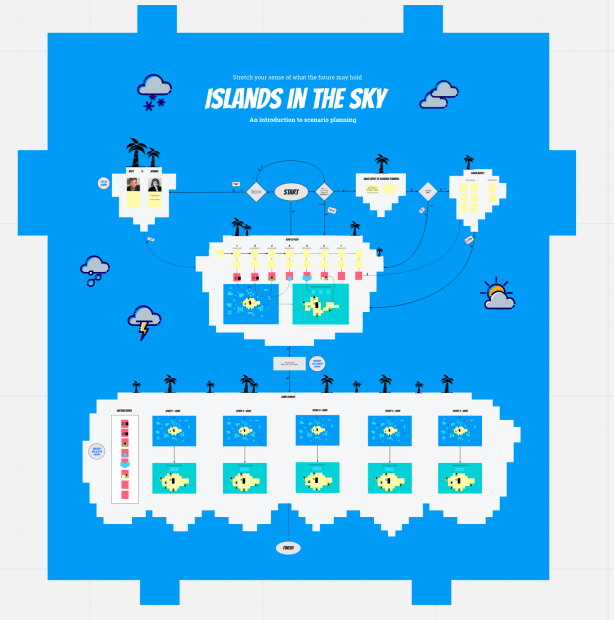
My colleague Monika Flakowska and I are presenting Islands in the Sky – An Introduction to Scenario Planning at the Information Architecture Conference this week.

Information architects design, organize, and label digital artefacts and services like websites, intranets, and software to help people find and use the information they want and need. Recently, Peter Morville, one of the “founding fathers” of IA, proposed a new definition: “the design of language and classification systems to change the world”. (You can read my interview with Peter here). In uncertain times, information architects need tools to think about the futures which their work may have to inhabit. That’s where scenario planning comes in.

Our interactive conference session invites attendees to try their hand at the basics of scenario planning, in a playful and thought-provoking online setting. It’s a successor of sorts to the in-person Library Island game which was so well-received in pre-COVID times.

We’ll report back from our experiments at the IA Conference and keep you updated as the Islands evolve.

“Laboratorios Ciudadanos Distribuidos” 2021 – Online Course for Community Innovators

The Spanish Ministry of Culture and Sport’s “Laboratorios Ciudadanos” (Citizen Labs) course returns this year, offering a series of online modules for Spanish speakers who would like to develop community-led innovation projects in their local area.

I’ll be joining the team to lead the module on strategic foresight, having previously contributed to last year’s session on questions of public value and impact measurement.

Si hablas castellano y te interesan las cuestiones de innovación liderada por la ciudadania, inscríbete antes del 29 de abril de 2021 para un viaje de aprendizaje y aventura. Sign up before 29th April 2021 to join us on a journey of learning & new adventures in citizen-led innovation.

New Strategic Plan for Open Education Global

The new strategic plan for Open Education Global (OEG), “Open for Public Good“, has just been released.

OEG is a member-based, global non-profit supporting the development and use of open education around the world. Over a six month period, I supported their leadership team in devising and delivering a planning process designed to engage stakeholders, elicit insights, and develop key areas of focus as part of a long-term strategy for the organisation.

Matt Finch played a tremendously helpful role in the development of Open Education Global’s 2021-2030 strategic plan – Open for Public Good.

Matt provided input and recommendations on what the overall process for developing a strategic plan should entail. He provided guidance on how to design hands-on interactive activities participants could do virtually during a pandemic to provide their input and recommendations. He introduced me to new concepts of value co-creation that ended up being one of our three areas of strategic focus. And he served as a member of a working group charged with synthesizing all the inputs into a draft strategic plan.

Throughout this entire process Matt was caring, helpful, and provocative, making sure we considered unexpected and novel perspectives. The resulting plan has been shared widely and is being received with excitement and support. I’m a Matt Finch fan and plan to do more work with him going forward.

Paul Stacey, Executive Director, Open Education Global

Find out more about Open Education Global at their website.

Islands of Memory: Layers, Growth, and Future Paths

Last month, I spoke with Travis Egedy, who makes electronic dance music as Pictureplane. His most famous track is “Goth Star”, a 2009 cut built from a Fleetwood Mac song, “Seven Wonders”, which he broke down and stripped for parts.

“Goth Star” is all but unique in the Pictureplane repertoire: Egedy doesn’t play any instrument or sing, but chops and layers the 1980s track until it’s all but unrecognisable. (The video depicts a séance whose participants are visited by the ghost of Stevie Nicks, her vocals transformed into yelps and word-fragments that taunt us with the possibility of deciphering them). Every single element of the song comes from Fleetwood Mac’s original.

“Goth Star” has its own origins in Egedy’s Santa Fe high school years, when, as an aspiring hip-hop musician, he’d raid the CD collections of his friends’ parents for anything that might yield a good beat.

Read more

Dancing through the pain

I turned my ankle walking in the park the other day, which is good going for someone who used to hike at every opportunity and now, in lockdown, barely gets more than a block from his house.

It hurt a little, but the more notable thing is that it revived some memories.

Ten years ago, I broke my leg quite badly. It required surgery, and they screwed the bone back together with bits of metal.

It never really gives me problems these days, but any injury to the same leg gets me wondering and even worrying: Have I done something to the screws? Am I going to have to go through all of that again?

I dealt with my park injury as I usually would, but the real problem was the sensation of “having done something to my leg”. Every bit of sensory information coming from that part of my body now goes through the lens of history, memory, and emotion. Does it feel weird? Does it feel different? Is there a problem there? I have to try and separate out my historic feelings from the present experience – not rejecting them, but recognising them for what they are.

Pain is a great source of information, if only you know how to process it.

The great choreographer Twyla Tharp wrote that:

“The dancer learns early to take pain for granted and that there is great freedom in choosing how to respond to its appearance. The thing NOT to do is deny pain. It must be acknowledged. Sometimes the right way of moving forward will be to push through pain. Your choices determine who you will be, who the world will see[.]”

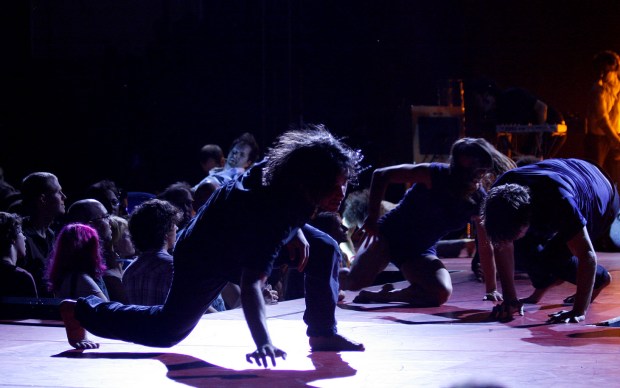
Ultima Vez / Wim Vandekeybus + Mauro Pawlowski: “What’s the Prediction?” (ImPulsTanz Vienna 2010)
Read more